Yes, every Tesla still carries a 12-volt-class battery besides the traction pack. Tesla ads talk about range and the big battery. The small one is what actually wakes the car. That split confuses a lot of Orange County owners, and it shouldn’t. Tesla held 138,121 of Orange County’s 210,842 battery-electric cars as of December 31, 2025. That’s 65.51% of the county’s BEV fleet, per the California Energy Commission. California’s Tesla share of BEVs was 61.34% on the same date. Orange County is 6.4 points more Tesla-heavy than the state. Every current model in that mix still hides a 12V-class system.
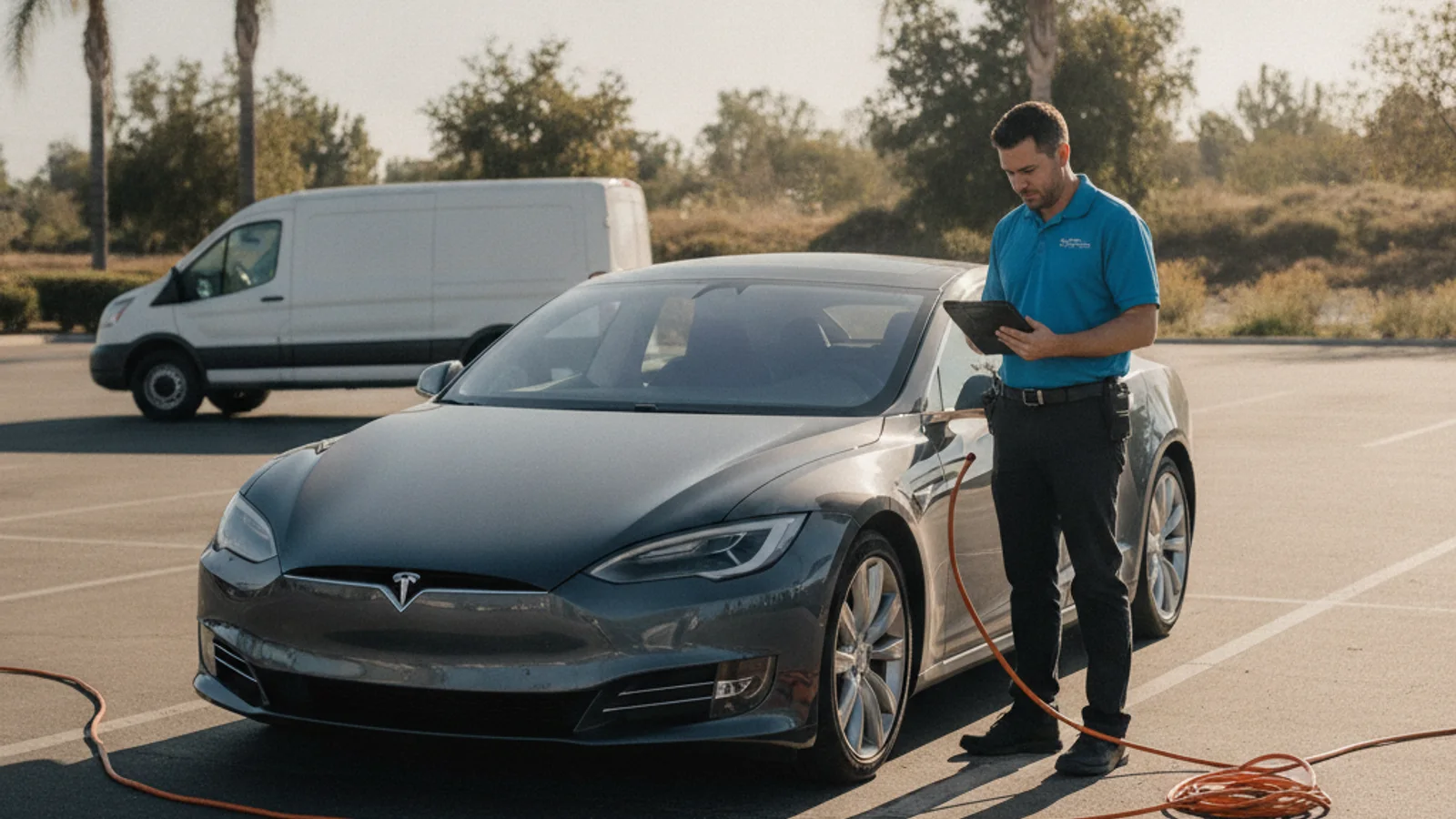
What that second battery actually does
A Tesla runs two power systems, not one. The traction pack feeds the motors. It also sets the range number on the window sticker. A much smaller low-voltage battery runs everything else that has to wake first. That list includes the screen, handles, cameras, and the computer that wakes the car.
If the small battery falls too low, the car can go fully dark. The screen stays black. Handles may not present. The phone app may not reach the vehicle. The pack behind it can still hold a healthy charge. A car that won’t start with miles left is usually this problem. That’s why “do Teslas have a 12V battery” gets searched so often.
The second battery isn’t a Tesla quirk. Nearly every production EV keeps a low-voltage battery beside the pack. The U.S. Department of Energy covers this two-system layout in how electric vehicles work.
Why Orange County Tesla owners keep hitting this
This isn’t a niche car here. Those 138,121 Teslas are 5.59% of Orange County’s light-duty fleet. New sales still skew Tesla as well. Tesla took 22,702 of 50,822 new Orange County ZEV sales in 2025, or 44.7%. Tesla took 10,323 of 18,293 new OC ZEVs in 2026’s first half, or 56.4%. Those figures come from the CEC’s New ZEV Sales file, not a dealer brochure.
A dark Model Y in an Irvine lot is a common local scene. So is one in an Anaheim lot after a long day. Santa Ana garages, Costa Mesa structures, and Huntington Beach stalls see the same 12V failure. Tustin lots and Yorba Linda driveways do too. The electrical fault doesn’t change by city. The gates, lots, and freeway shoulders around the car do.
Charge Pro OC is a referral line. We connect stranded EV drivers with independent local operators. We don’t own trucks, and we don’t employ technicians. We hold no license and we set no prices. The operator quotes you before starting, then bills you directly. The pros we connect you with are licensed.
Dark and silent, or awake and empty
A weak 12V usually looks like a car that won’t wake. Nothing in the cabin responds. The key fob does nothing useful. Owners often describe it as the car going to sleep and staying there.
A depleted traction pack looks different. The car often still wakes up. The screen still turns on. You get a range warning instead of total silence. Dark and silent versus awake but empty is the fastest split.
Tesla’s Model Y owner’s manual adds a third twist. Once driving range is exhausted, the low-voltage battery can lose support. It then needs external power before the pack can accept a charge. That’s Tesla’s published note, not a forum guess. An empty pack can look like a 12V death when range failed first.
Sitting at a Supercharger doesn’t settle the question by itself. Irvine’s 1920 Main Street site has 40 DC fast stalls. Garden Grove’s Harbor Boulevard site has 32. San Clemente’s Avenida Vista Hermosa site has 49. Tustin’s Franklin Avenue site has 36. A Tesla can sit in any of those stalls and stay dark. That happens when the 12V never closed the contactors. The stall isn’t the test. Whether the car wakes is the test.
If you’re sorting that split at the curb, read dead Tesla: how to tell 12V failure from a dead pack. For the jump sequence by body style, use Tesla won’t crank: jump-start steps for Model 3, Y, S, and X.
Why the pack can’t wake the car on its own
The traction pack operates at several hundred volts. That voltage is for motors, not door locks. Cabin lights, airbag modules, and most sensors use ordinary low-voltage automotive parts. Routing pack voltage through those circuits would be the wrong design.
Tesla isolates the pack behind contactors, which are large relays. Closing those contactors takes low-voltage power. Without it, the pack stays disconnected from the rest of the car. The 12V-class battery wakes the computers and closes the contactors. Only after that can the pack do any work.
It’s a chicken-and-egg problem every EV has to solve. The high-voltage system can’t power itself on. A gasoline car uses the same idea with a starter and an alternator. Tesla applies it to a car with no engine.
While you drive or stay plugged in, a DC-DC converter steps pack voltage down. That converter keeps the small battery topped off. After the car sleeps, the 12V-class battery carries the background load by itself. App pings and Sentry Mode draw from it. That’s why it can go flat while the car looks parked and idle.
What changes from Model 3 to Y, S, X, and Cybertruck
Every current Tesla still has that second battery. Model 3, Model Y, Model S, Model X, and Cybertruck all carry one. Chemistry, location, and access don’t stay fixed across the lineup.
Some Teslas use a conventional lead-acid 12V. Others use a lithium-based low-voltage battery. The two chemistries age differently and fail differently. They also aren’t serviced the same way. Access changes too. On some cars you can picture the battery from the owner’s manual diagram. On others, trim comes off, or the work happens from underneath. That isn’t a driveway video job.
This guide won’t print a model-year chemistry table. Tesla has made running changes in the middle of a production year. A stale chart sends someone toward the wrong part. Your owner’s manual for that exact car is the primary reference. Tesla’s current service documentation beats any article, including this one.
Look up your VIN’s low-voltage type in that manual before anyone orders a part. Confirm whether the battery is lead-acid or lithium. Confirm the access path. Then say those two facts out loud when you request help. A Model 3 procedure isn’t automatically right for a Model X. A Model Y lithium unit isn’t the same service as an older lead-acid 12V.
For the lithium units on newer 3 and Y cars, use lithium 12V dead on a newer Model 3 or Y. For physical layout on a 3, see Model 3 battery locations: 12V, pack, and why it matters.
What to confirm before anyone opens a panel
Name the exact model, year, and trim before work starts. That trio decides chemistry, location, and the access procedure. Don’t let a clip filmed on a different year talk you into a shortcut. A routine step on one Tesla can be the wrong move on another.
If you aren’t sure which low-voltage battery you have, say so. Guessing helps nobody at the car. The matched operator should confirm the setup before doing anything to it.
Where you’re parked changes access, not the diagnosis. An Irvine garage is a different reach than the I-405 shoulder. A Costa Mesa structure is a different reach than a Garden Grove curb. A Tustin stall isn’t a Yorba Linda driveway. The 91, I-5, and SR-22 shoulders add traffic and limited space. The 12V fault is the same. The truck still has to get next to the car.
The pros we connect you with can jump or replace a dead 12V on site. They can also bring a 240V Level 2 source when the pack itself is empty. That typically adds 10 to 20 miles of range in 15 to 30 minutes of charging. That window is charging time, never an arrival time. The truck uses a native NACS plug. CCS or J1772 adapters cover non-Tesla EVs.
Start with Tesla 12V battery jump if the car is dark. For broader Tesla help, see Tesla roadside rescue. County charging context, when the pack is the issue, lives on the Orange County EV charging hub.
When the car stays dark
Call when your Tesla has gone dark and unresponsive. Call even if the last range figure looked fine. That mismatch usually points at the low-voltage system, not the pack. We’ll connect you with a local EV rescue operator. Charge Pro OC doesn’t perform the work, set the price, or promise when someone arrives. Call (949) 444-0151 and we’ll match you with an operator. That operator quotes the job at the car.