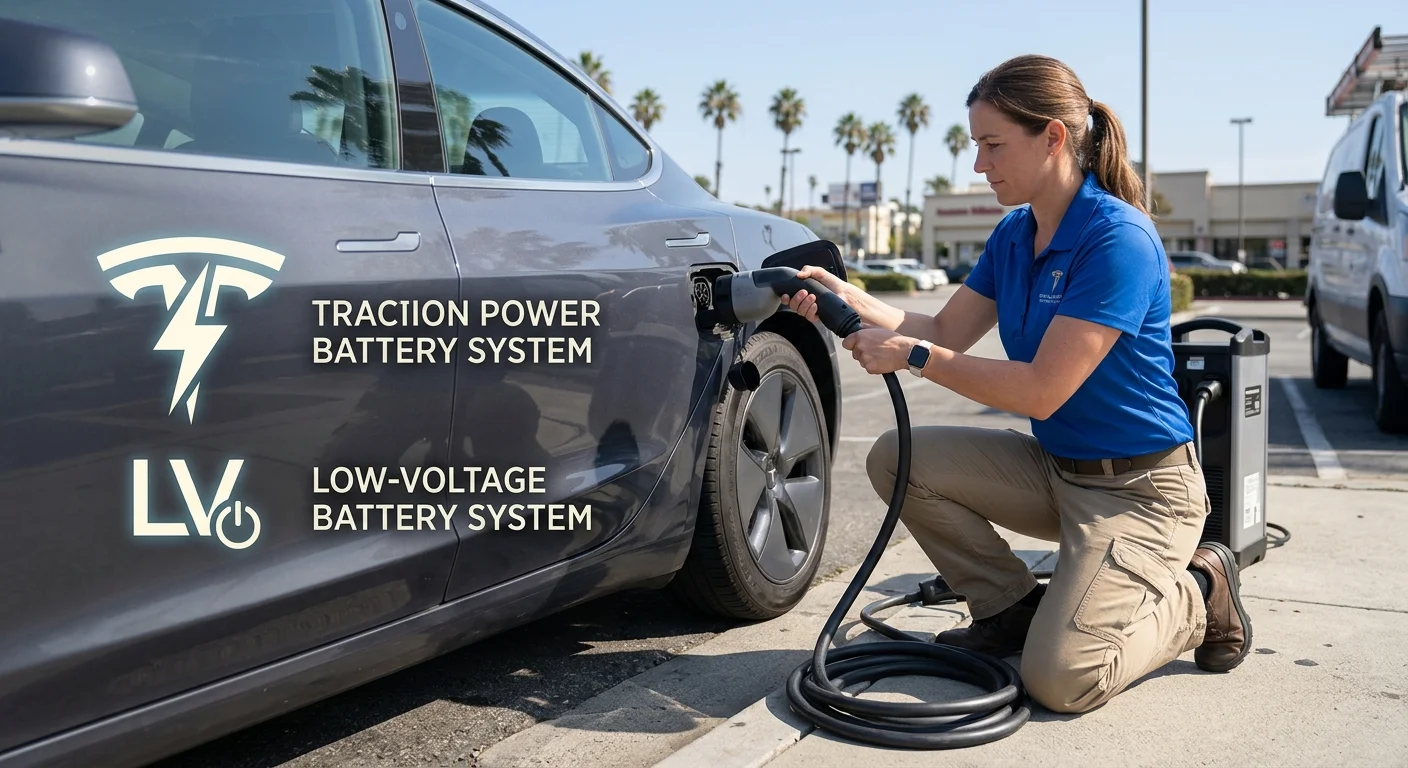
A Tesla Model 3 battery location search usually means the 12-volt pack. That’s the small battery an operator jumps in a stall. The traction pack lives in the floor and isn’t the jump target. In a tight Orange County parking structure, that split is the whole job. Concrete columns, low ceilings, and neighboring cars limit how an operator works. This page won’t name a panel, clip, or terminal. Tesla’s current Model 3 manual is the authority for your year. We’ll cover why the two batteries get mixed up. Then we’ll cover what to tell the person who shows up.
The 12-volt is the stall problem, not the pack
A dead Model 3 in a garage can look the same either way. The screen is dark, the handles don’t present, and the dash stays asleep. That still isn’t one diagnosis. The floor pack stores the miles. The low-voltage battery wakes the computers that use those miles. If you searched after a dark cabin, you likely mean the small battery. If you searched after a range scare, you mean the pack.
Orange County makes this mix-up easy to hit. The California Energy Commission counted 210,842 battery-electric cars here as of December 31, 2025. Teslas were 138,121 of those BEVs, or 65.51% of the county’s electric fleet. Plenty of those cars spend the day in stacked decks. Irvine office parks and Costa Mesa airport lots pack them in. So do Anaheim lots off Katella. A Model 3 that won’t wake there is a 12-volt talk first.
Our model-by-model Tesla 12V guide explains why “12V” still isn’t one part. Don’t treat the search phrase as proof of chemistry. Don’t treat a photo of another Model 3 as your access map.
Why a parking structure makes location the job
A Tesla service bay is built for covers and lifts. A public garage gives you a painted stall instead. The operator has to work in that box. They may have a wall on the left and a pickup on the right. A concrete soffit can kill van height. A charging pedestal can block the corner they need. That’s why the 12-volt location matters before anyone clips a cable.
It isn’t so you can start the job yourself. It’s so the operator can plan the approach. They’ll want to know which side of the car is reachable. They’ll want to know if a neighboring stall must stay empty. They’ll want to know if the car has to roll to a drive aisle first.
Costa Mesa decks near Bristol and South Coast Drive both produce this squeeze. So do Irvine structures around Michelson, Main Street, and Spectrum Center. So do Tustin office-park lots and Santa Ana downtown garages. A Model 3 can sit in the Brea Mall garage. It can still need a 12-volt jump. The 20 Supercharger stalls there don’t help until the car wakes. Stalled in a Costa Mesa parking structure walks the empty-pack version of this squeeze.
We still won’t point at a frunk bin, a rear well, or a kick panel. The sources behind this page don’t confirm one Model 3 placement for every year. A 2018 photo can be wrong for a later refresh. Hardware changed across the run, and access can change with it. If a thumbnail looks convincing, treat it as a guess. Open the matching Tesla manual instead.
Floor pack questions belong on a different map
Range, Supercharging, and pack replacement all point under the floor. You don’t jump that pack with booster cables. You charge it, or you take it to Tesla. Orange County Tesla service sites sit in Costa Mesa, Buena Park, and Santa Ana. You’ll also find them in Irvine, Anaheim, and Aliso Viejo. Street addresses on Tesla’s locator weren’t independently confirmed in this research. Check Tesla’s own find-us list before you drive.
Superchargers help a depleted pack, and they don’t wake a dead 12-volt. AFDC station data used here counts 48 Tesla Supercharger sites in the county. Those sites list 861 DC fast ports. Irvine’s 1920 Main Street site lists 40 stalls. San Clemente’s 101 W Avenida Vista Hermosa site lists 49. Garden Grove’s Harbor Boulevard site lists 32. A Model 3 that already won’t boot can’t use any of them. The low-voltage system has to come up first.
Tesla’s owner note on running out of range is the technical piece worth saving. Once the traction pack is exhausted, the low-voltage battery can lose support. The high-voltage pack then needs an outside supply before it will accept a charge. A garage stall can hide that sequence, and the car looks fully dead. The real fork is still 12-volt versus empty pack. Our dead pack or 12V guide is the companion check.
Tesla’s own roadside policy answers a depleted pack with transport. That’s from Tesla’s support language, as indexed in this research. It doesn’t answer it with charging at the car. Running out of charge isn’t treated as a warrantable breakdown. Covered transport of up to 500 miles is for a warrantable failure. That failure has to leave the car undrivable. tesla.com blocked our direct fetches during this research. Confirm the current wording on Tesla’s roadside page before you lean on it. Tesla’s published roadside number, listed on the Santa Ana service page, is 877-798-3752.
Model year is a manual key, not a map
Pull the year from the car’s records, not from a lookalike photo. Early Model 3 cars and later ones don’t share one low-voltage story. Owner talk still says “12V” for both. Later cars moved toward a lithium low-voltage unit. Lithium 12V failures on newer Model 3 and Y cars covers that change. It still isn’t a substitute for the manual that names your configuration.
Keep three details together: the model year, the warning text, and VIN hardware notes. You don’t have to interpret them, because that’s the operator’s job. If a blog or a search snippet disagrees with the current manual, say so. An older guide can be right for the car it covered. It can still be wrong for yours.
If you can’t make the match, stop at identification. Tell the operator you opened the Model 3 manual. Tell them you couldn’t confirm the low-voltage location. That’s more useful than a guessed corner of the frunk.
Leave the trim on until the procedure matches
Finding a diagram isn’t permission to start. A location image can skip warnings, prep steps, and order. Don’t pull covers, clips, or connectors from a forum still. Don’t hunt jump posts because a video paused on a similar dash. This page’s sources don’t confirm those posts for your Model 3. We won’t tell you where to clip.
Orange cable, airbag marks, and unfamiliar fasteners are stop signs. If the panel in front of you doesn’t match the illustration, stop. If the warning text doesn’t match the section you opened, stop. Forcing a step because the title said Model 3 makes a stall problem worse.
The operators we connect you with can jump a dead 12-volt on site. They can replace it when that’s the right job. They also bring a 240-volt Level 2 source when the pack is the issue. They use native NACS for Teslas, plus CCS or J1772 adapters for other EVs. They typically add 10 to 20 miles of range. That takes 15 to 30 minutes of charging. That’s charging time, not a promise of when someone arrives. Charge Pro OC is a referral line. We don’t own trucks, employ techs, or touch the car. The operator quotes you before starting and bills you directly. The pros we connect you with are licensed.
If the stall is the constraint, say that first. Mention a pillar, a wall, a bike cage, or a pedestal. Mention a steep ramp or a nose-in space against a bumper stop. Mention whether a door can open fully. Those details beat a copied battery diagram.
What to hand the operator from the stall
Start with where you are, then what the car is doing. Give the city, the garage name if you know it, and the level. A landmark on that floor helps: a stairwell, a color zone, or a store entrance. Then give the Model 3 year. Copy the warning word for word. Don’t flatten it to “battery dead” unless that’s the real text.
Tell them if it sat all day, sat unplugged, or died after you parked. Note the door, the app, headlights, and the screen. Don’t assign the cause. Let the operator read those facts. If you looked in the Tesla manual, name the section. If you couldn’t confirm the 12-volt location, say that too.
Have this list ready:
- Confirmed Model 3 year
- City and the structure or lot name
- Level, stall side, and any clearance problem
- Warning text copied exactly
- What still responds when you try the car
- Whether you were charging, parked, or driving
- Whether the current Tesla manual was open
- The section title you actually read
Don’t report a location copied from another year as verified. If a search result and your manual disagree, report the conflict. For jump sequence context by model, see jump-start steps for Model 3, Y, S, and X. If the 12-volt is the likely failure, Tesla 12V battery jump is the referral path. If you’re not sure which system failed, Tesla roadside rescue is the broader match.
Charge Pro OC doesn’t diagnose the car, set the price, or warrant the work. You contract with the operator who arrives.
When the structure has you stuck
Call when the Model 3 is disabled and the access steps aren’t confirmed. A local operator can look at the year, the warning, and the stall. Then they decide what belongs on site. We’ll connect you with an independent Orange County operator. Call (949) 444-0151 and we’ll make that match.