A dead 12-volt battery can lock you out of a Tesla. That can happen even with range still in the pack. Handles stay flush and the app goes quiet. Orange County’s working sequence is a 12V jump or a swap at the car.
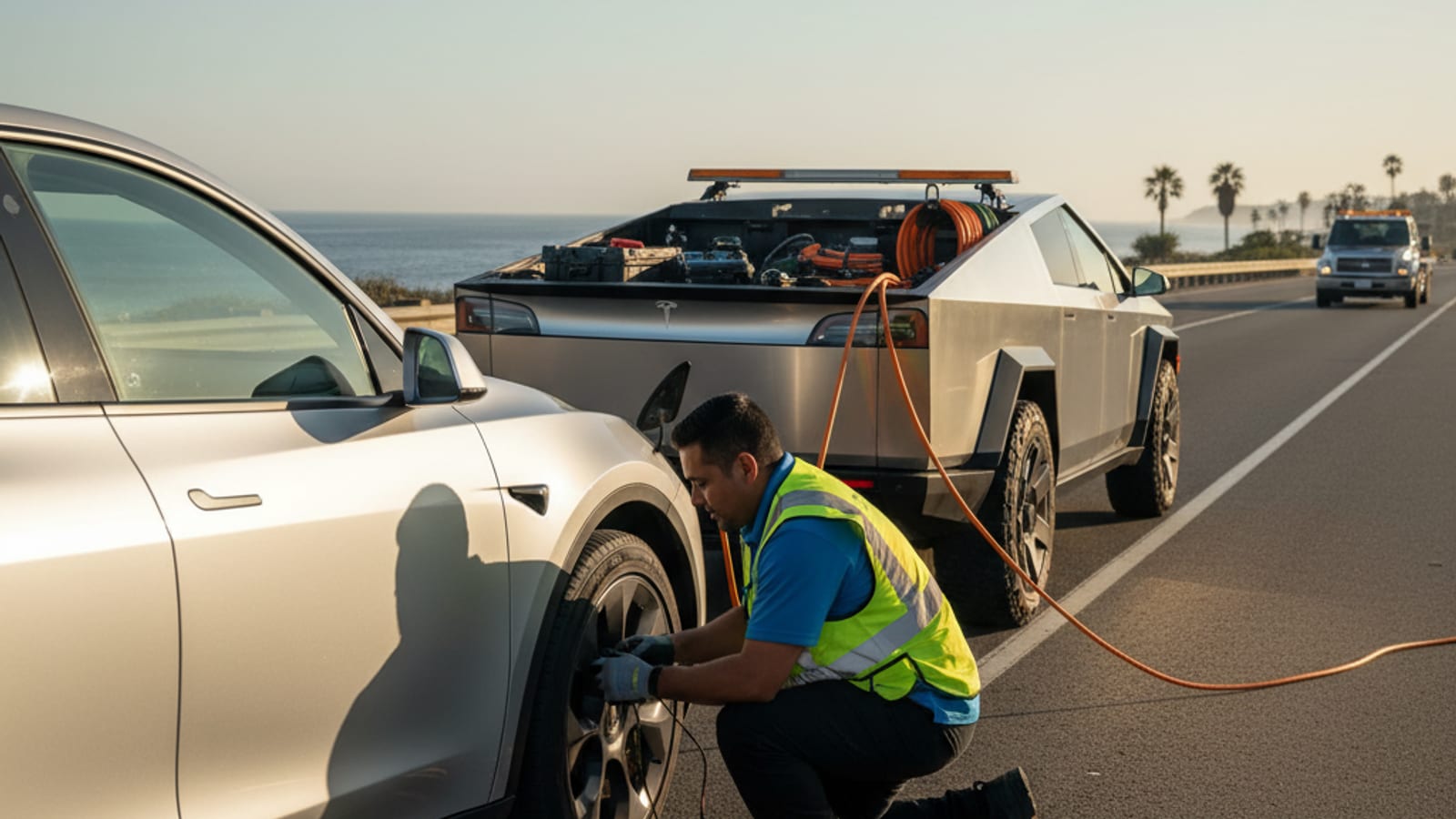
The lockout is a 12V failure, not an empty pack
Every Tesla still uses a small low-voltage battery. That battery runs the computers, lights, and door latches. The large high-voltage pack is what moves the car. When the 12V dies, the whole vehicle looks dead. Door handles won’t present and the frunk stays shut. Your phone often can’t wake the car at all.
This can happen after an ordinary Orange County day. You parked with range still showing on the last drive. You came back to a silent shell in the lot. The high-voltage pack is supposed to keep the 12V charged. A failed 12V just won’t hold that top-up. Tesla’s Model Y owner’s manual also flags a second trap. Once the high-voltage pack is fully empty, the low-voltage battery loses support. You then need outside 12V power before the pack can charge.
Orange County sees this often because Teslas dominate the electric fleet. The California Energy Commission counted 210,842 battery-electric cars here through December 31, 2025. Teslas were 138,121 of those BEVs, or 65.51 percent. A locked Tesla in an Anaheim structure is a local pattern.
Quick checks before anyone opens a bumper
Start with what you can see from the curb. Flush handles and a dark cabin already point at 12V. If the app still answers, read the last charge it shows. Range on file with a car that won’t unlock is the classic split. That split is spelled out in our 12V versus pack guide.
Press the key card to the B-pillar and wait. Try the card a second time if nothing happens. A fully dead 12V usually ignores the card. Model S and Model X fobs still hide a small mechanical key. That key can open the driver’s door on those two models. Model 3 and Model Y don’t include that backup.
Leave the front bumper alone on a live shoulder. Model 3 and Y hide jump posts behind a small nose cover. A portable 12V pack can wake the frunk latch from those posts. You’d need the pack, the right polarity, and room to stand. I-405, I-5, and SR-22 at the Crush don’t give you that room. Stay clear of traffic and wait for an operator.
How a local operator gets the doors open
Charge Pro OC is a referral line, not a shop. We match stranded drivers with independent local operators. We don’t own trucks, tools, or a yard. We don’t employ technicians or set the price. The operator quotes you before any work starts. You pay that operator directly for the job.
On a 12V lockout, the work happens at the car. The pro applies 12V and pops the frunk. Then they jump or replace the battery on site. That’s the sequence that actually unlocks the doors. For the model-by-model path, read jump-start steps for Model 3, Y, S, and X. To request that work, use Tesla 12V battery jump.
Model 3 and Model Y
These two use the front jump posts more often than a hidden cable. An operator removes the small bumper cover and hooks a 12V source. Then they wait for the frunk latch to click. The 12V battery sits in the frunk under a cover. A jump on the posts gets you in. A failed cell still needs a new battery before you trust the car overnight.
Model S and Model X
These lines vary by year, so the first panel isn’t always the same. The mechanical key can at least get you in the cabin. Check your owner’s manual for the exact panel on your year. An operator who works Teslas will know which path to try first.
If the high-voltage pack is empty too, a 12V jump only unlocks the car. You still can’t drive away on a jump alone. Operators then roll up a 240V Level 2 source. Teslas take a native NACS plug on the truck. Other EVs use a CCS or J1772 adapter. A typical session adds about 10 to 20 miles of range. That takes 15 to 30 minutes of charging at the car. That window is charge time on the port, not an arrival estimate.
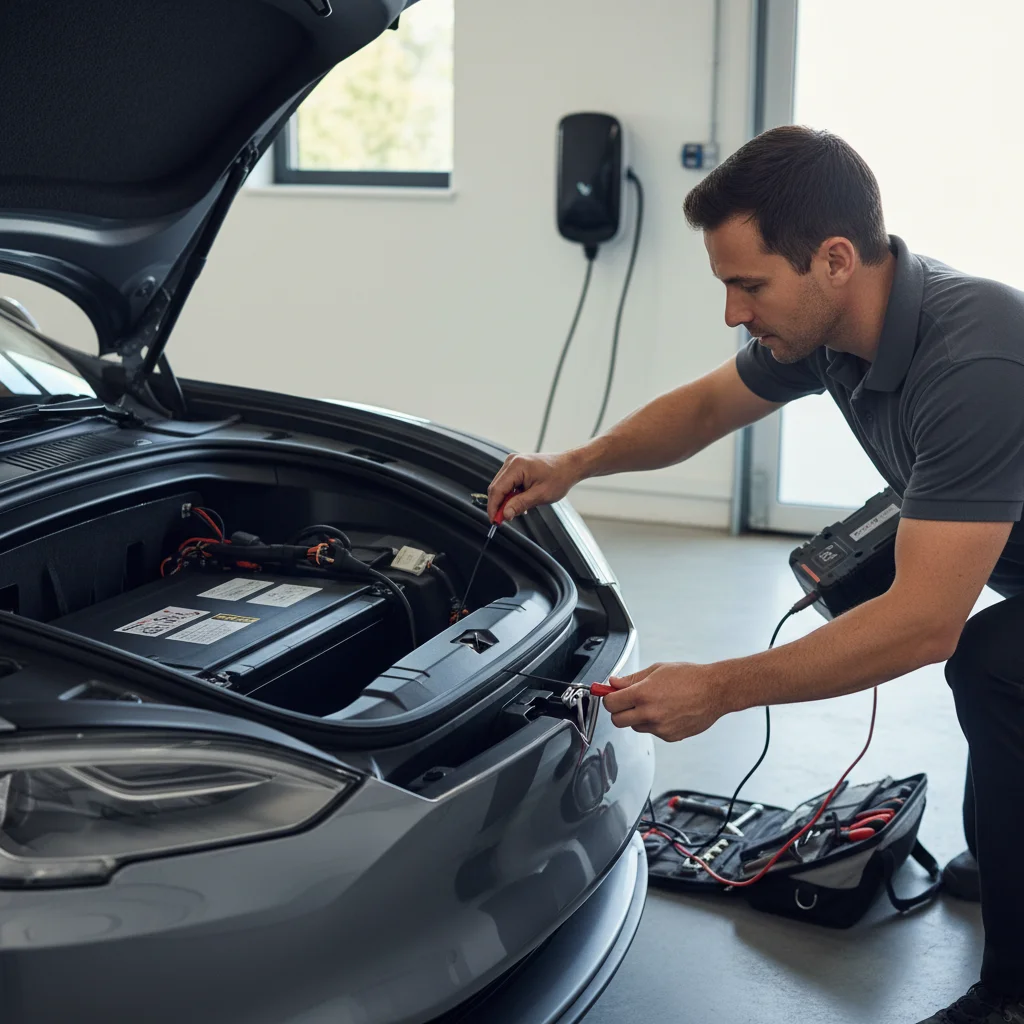
Once you’re inside, read the pack
Sit down and wait for the center display. If the traction pack still has charge, the car should come up. Drive it only when the road around you is safe. Then get the 12V tested as soon as you can. A jump that dies again in the driveway means the battery is finished. Replacement at the curb beats a second lockout at the store. Early signs are in how to tell your Tesla 12V is dead.
If the display shows little or no high-voltage charge, stay where you are. Tesla’s roadside policy answers a depleted pack with transportation. It answers that call with a tow, not with charging at the car. Tesla Roadside Assistance publishes 877-798-3752 as the number. That line can arrange a paid tow to a shop. Running out of charge isn’t treated as a warrantable breakdown. A warrantable breakdown can include transport to a service center. Tesla’s published cap on that trip is 500 miles. An empty pack doesn’t get that covered transport. A local operator can put 240V on the port where you sit. Then you can drive to a stall yourself.
Orange County had 48 Tesla Supercharger sites in the federal AFDC data. Those Supercharger sites listed 861 DC fast ports. Garden Grove’s Harbor Boulevard site lists 32 stalls. San Clemente’s site at 101 W Avenida Vista Hermosa lists 49. Those stalls help once the car can move. They can’t open a locked frunk in a parking structure.
Orange County lots where this shows up
Anaheim structure lots are a classic lockout setting. You leave a Model Y in a garage for hours. Anaheim has Superchargers on Lincoln Avenue and Katella Avenue. None of that helps until the latches have power. Buena Park plays out the same way after a long visit. The Beach Boulevard and Knott Avenue Superchargers only matter after the car wakes.
Irvine office garages go quiet in the same way. The Supercharger at 1920 Main St lists 40 stalls. Spectrum Center lists 16 more at 950 Spectrum Center Dr. Neither site helps a car that won’t unlock in the garage.
Coast parking is quieter and just as final. You walk back from the sand in Huntington Beach or Newport Beach. The handles stay flush on the walk back. Huntington Beach has a Supercharger at 6913 Warner Ave. Newport Beach has one at 4241 MacArthur Blvd. You still need the doors to work first. The beach-lot version is in Huntington Beach after a long day.
Costa Mesa lots around South Coast sit all afternoon too. The Supercharger at 1475 S Coast Dr lists 20 stalls. You still have to get in the car before that site matters.
Inland streets add grades, gates, and long sits. Yorba Linda and North Tustin leave cars sitting on grades. Many HOA garages leave the car sitting too. Operators can work at the curb on those streets. They can also come inside a gate when the community lets them in. Don’t try to drag a silent Tesla down a driveway.
Freeway shoulders are the dangerous version of the same failure. I-5 south of Irvine puts you next to fast traffic. I-405 through the central county is the same problem. SR-22 at the Crush leaves little room to work. Don’t kneel at the bumper on those shoulders. If the mechanical key got you in, stay in the cabin. If you’re still outside, get away from the travel lane and wait.
When a jump won’t finish the job
A 12V that won’t hold a charge needs a replacement, not a second jump. Operators who handle Tesla lockouts can swap that battery on site. If the pack is empty, you need energy at the charge port. Towing a Tesla with no power is a last move. Charging first is the cleaner path when an operator can reach the car.
A night lockout in Garden Grove doesn’t wait on a shop slot. Tesla roadside rescue is the local referral path for that moment.
Charge Pro OC serves every city in the county. If you’re locked out of the car, call (949) 444-0151. Say whether the app is dead, whether the handles moved, and your last known charge. The operator quotes you before any work starts. You pay that operator directly for the visit.