Tesla charging service in Orange County isn’t one job. Tesla answers an empty pack with transport, not charging at the car. Start by naming the real problem, not the search phrase. You might have a dead pack or a dark 12V. You might have a stall that won’t feed. You might need a hook, not energy.
What tesla charging service actually refers to
Drivers use that phrase for four different calls.
A home wall connector or a public stall can fail while the car still has range. That’s equipment trouble.
A pack at zero is a different job. The car can’t roll to a Supercharger on its own. Tesla’s published empty-pack path points to transportation. That ride is billed as transport. It isn’t a covered empty-pack perk.
A 12V dropout looks like a total failure. The high-voltage pack may still hold energy.
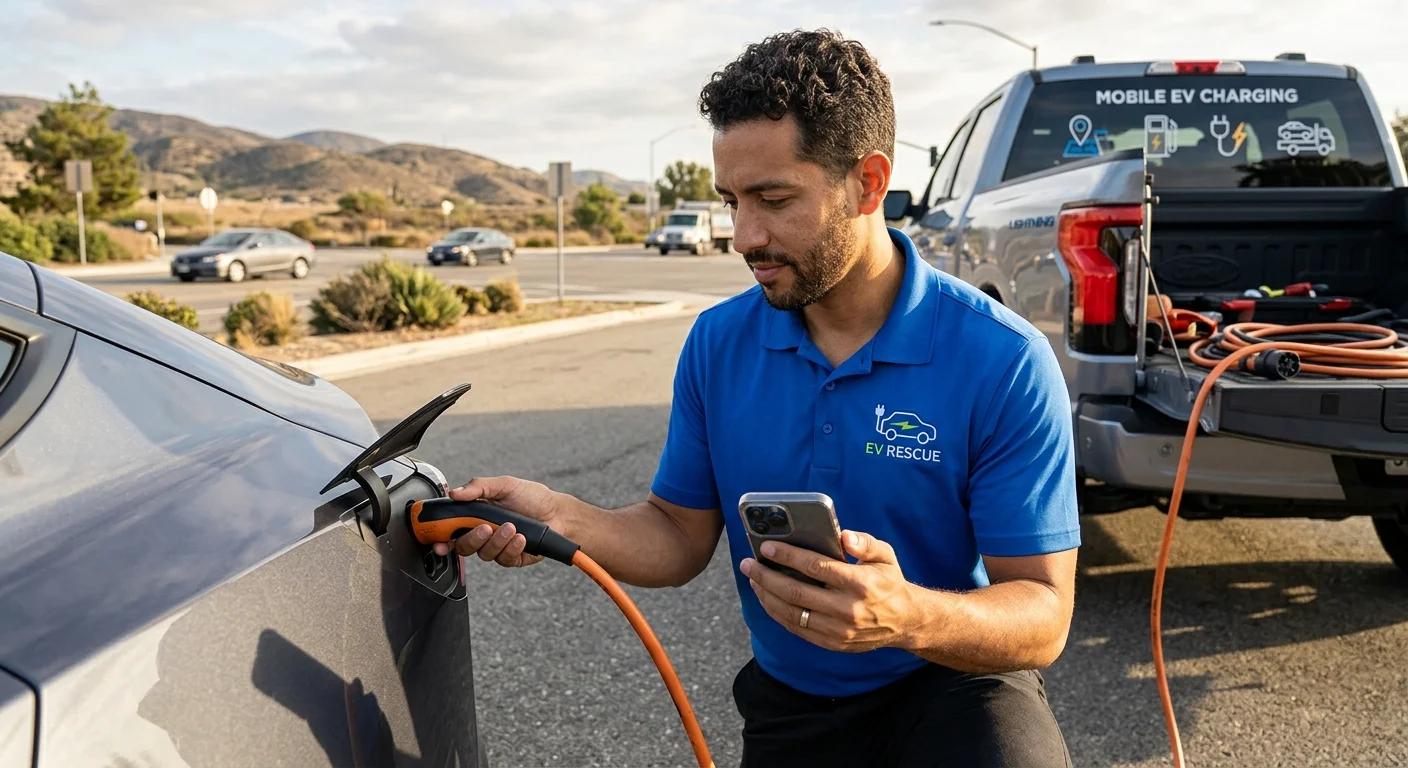
A mobile 240V charge at the bumper is a fourth job. Independent operators bring that source to the car. Tesla’s published empty-pack path doesn’t start there.
Orange County makes the split matter. The California Energy Commission counted 210,842 battery-electric vehicles here as of December 31, 2025. Teslas were 138,121 of those BEVs. That’s 65.51 percent of the county’s battery-electric fleet. The Tesla share sits 6.4 points above the state’s.
Tesla’s published empty-pack answer is a tow
Read Tesla’s own roadside materials before you assume a charger truck is coming. tesla.com/support/roadside-assistance returned a block to direct fetches for this research on September 5, 2026. Search-index text from Tesla’s page described depleted-battery help as assistance that isn’t financially covered. The next step it named was transportation. Confirm that wording on Tesla’s live roadside page before you rely on it.
Indexed text also tied covered transport of up to 500 miles to a warrantable breakdown that leaves the car undrivable. Running out of charge sat outside that list. Treat both lines as unverified until you open the live policy. Tesla roadside’s number, listed on the Santa Ana service page, is 877-798-3752.
Tesla lists service centers in Costa Mesa, Buena Park, Santa Ana, Irvine, Anaheim, and Aliso Viejo. Confirm the live findus address before a tow heads to a center.
No Tesla page opened for this research said the company never offers mobile charging. Tesla’s own roadside policy answers a depleted battery with transportation, not with on-site charging.
Tesla’s Model Y owner’s manual adds a technical catch. Once range is exhausted, the low-voltage battery can lose support. The high-voltage pack then needs an external supply before it can charge. A 12V jump and a pack charge remain different jobs.
For 2026 context in this county, read Tesla’s 2026 roadside policy for Orange County drivers.
Sort the problem before anyone rolls
The pack is empty and the car won’t roll
You used the last miles. Now the Tesla sits on a shoulder, in a lot, or in a driveway.
Tesla’s answer, as published, is a transport quote. Independent operators can instead bring a 240V Level 2 source to the car. Tesla owners get a native NACS plug. Other EVs use a CCS or J1772 adapter. Typical charging time adds 10 to 20 miles of range in 15 to 30 minutes at the bumper. That figure is charging time. It isn’t an arrival time.
If that’s the job, ask for mobile EV charging at your pin. The operator quotes you before starting.
A zero pack on local roads has a separate walkthrough in Tesla at zero on an Orange County road.
The 12V has dropped and nothing wakes
Dark screens and dead locks often point at the 12-volt battery. The traction pack can still hold energy. Tesla’s Running Out of Range note also ties a depleted pack to a low-voltage collapse. You can’t always tell which failed from the curb.
Describe what you see. Don’t diagnose it for the operator. Ask whether they can jump or replace a 12V on site. Tesla 12V battery jump help matches that symptom. Dead pack versus 12V walks through the telltales.
A stall or wall box won’t feed the car
The Tesla still has range. The session won’t start, or it cuts out. Write down the site name, stall number, and the exact message. Home wiring faults belong to a licensed electrician, not a rescue truck.
Orange County had 7,095 public charging ports as of December 31, 2025, per the CEC charger file. That’s 36.8 ZEVs per public port. The statewide figure is 24.4.
Named Superchargers you can check in the app include Irvine at 1920 Main Street with 40 stalls, and San Clemente at 101 West Avenida Vista Hermosa with 49 stalls. AFDC listed 48 Tesla Supercharger sites in the county, with 861 Tesla DC fast ports. Tesla holds 59 percent of Orange County’s public DC fast ports.
If the car can still drive, try another listed site before you request a bumper charge.
The car needs a hook, not energy
Collision damage points at transport. So does a blocked charge port. So does a car that refuses energy after a clean attempt. So does a spot where curb work isn’t safe. Confirm the operator can move a Tesla the right way before you approve a hook. When the only issue is an empty pack, charging first is the better path. Tesla roadside rescue is the match when you need that operator.
Local roads change access, even with large Supercharger sites
North county lots sit along Katella and Knott. Anaheim’s 16-stall Supercharger at 2404 East Katella Avenue has been in the AFDC file since 2019. Buena Park has 28 stalls at 8888 Knott Avenue, listed at up to 325 kW.
Coastal trips look different. Huntington Beach has 24 stalls at 6913 Warner Avenue. Newport Beach has 12 stalls at 4241 MacArthur Boulevard. Fashion Island also has an Electrify America site at 401 Newport Center Drive with eight DC fast ports.
Inland south county adds different sites. Mission Viejo’s Shops location has 10 Superchargers. Tesla lists those at up to 72 kW. Use Tesla’s 72 kW figure when AFDC disagrees. Lake Forest has a 16-stall Magic Dock on Rockfield Boulevard with CCS1 and NACS. Rancho Santa Margarita has an EVgo site at Plaza Antonio, 22351 Antonio Parkway, with 14 DC fast ports.
Tell the operator the city, the nearest arterial, and the setting. A Tesla on I-5 south of Irvine is a different access problem than a Tesla at 950 Spectrum Center Drive. A car on SR-22 near the Crush needs lane and direction. A car on SR-241 is on a toll road. Shoulder rules there aren’t the same as I-405.
Garage level, gate code, and HOA rules matter. The operator can’t guess those from a city name.
What the operator brings, and what we don’t
The pros we connect you with are licensed independent operators. They can charge at the bumper or jump a 12V on site.
They don’t replace Tesla Service. They don’t repair a wall connector. They don’t set Tesla’s transport terms. They quote the job in front of you, then bill you directly.
Charge Pro OC is a referral line for Orange County. We match stranded EV drivers with those operators. We perform no work. We own no trucks. We employ no technicians. We hold no license. We set no prices. We publish no arrival time.
When you call, say the model, the city, and what the car is doing. Say whether the display still wakes. Say whether you’re on a freeway shoulder or in a private lot. That’s enough for a match. The operator confirms connector, access, and the service before any work starts.
We serve every city in the county.
When tesla charging service is the wrong phrase
If the wall connector at home is the failure, you need an electrician, not a bumper charge. If the Supercharger session failed and you still have range, you need another stall. If the 12V is the failure, a NACS charge won’t wake the car. Low-voltage power has to come back first.
If the pack is at zero, Tesla’s published path is a tow. A local operator can instead put 10 to 20 miles back on the car in 15 to 30 minutes of charging. Then you drive to a listed Supercharger. Confirm that plan, and the quote, before anyone starts.
For county charging context, start at EV charging in Orange County.
Call (949) 444-0151 when you need a match with a local operator. The operator, not Charge Pro OC, sets the work and the bill.