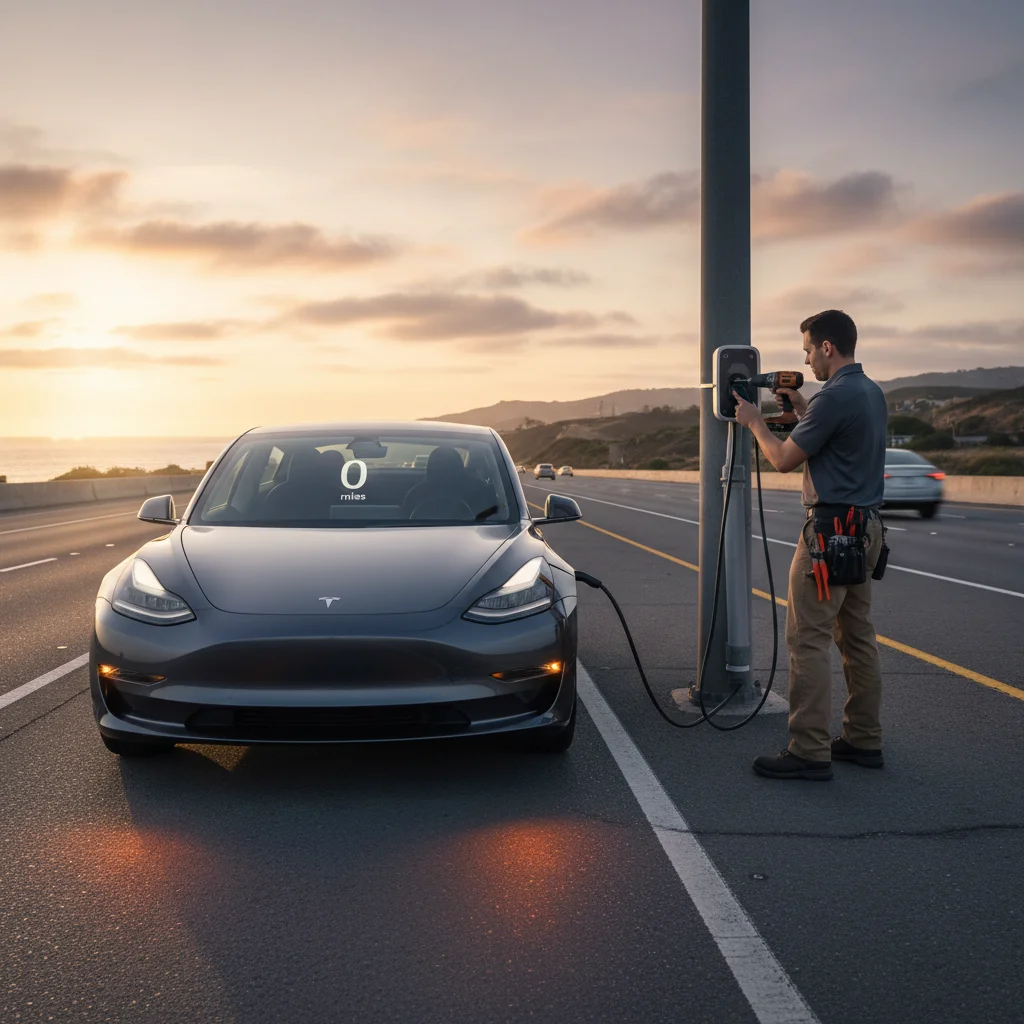
Your Tesla just hit zero on an Orange County road. What to do if a Tesla runs out of battery is a three-way call. Charge the pack where the car sits. Jump a dead 12V if that’s the real failure. Or take a tow. Tesla’s published roadside page answers a depleted pack with transportation. It doesn’t send a charger to the bumper. That ride isn’t a financially covered service. Orange County’s published freeway service patrol list skips the toll roads. If you’re on SR-241, that free patrol isn’t on the sheet.
Empty pack and dead 12V are different jobs
A Tesla that won’t roll isn’t always out of pack energy. The high-voltage battery can be at zero. The 12-volt battery can also be dead. Both leave you with a quiet car. The work that follows isn’t the same.
If range counted down while you were still driving, the pack is the story. Tesla will have warned you first. A yellow charge alert shows up. It turns red as the state of charge keeps falling. Power gets soft. The car starts shedding extras. Climate drops out. The screen may dim. A snowflake can sit beside the battery on a warm Orange County afternoon. That’s a limited-power flag, not a weather report.
Use those last minutes to park. Don’t stretch for a farther exit if this shoulder is already safe. The coast climb off Newport spends energy faster than a flat Santa Ana street. So do Santiago Canyon Road, Ortega Highway, and Laguna Canyon. Inland north county on the 91 is stop-and-go. South county I-5 into San Clemente is a long grade. Orange County isn’t one commute.
If the car was fine when you parked, then wouldn’t wake, start with the 12V. The dash can look just as dead. How to tell a dead pack from a dead 12V splits those two failures. Open the Tesla app if it still connects. Rated range still showing, and the car is mute, points at the small battery. Range at zero, and you felt the limp, points at the pack.
Tesla’s Model Y owner’s manual adds a messy overlap. Once range is exhausted, the low-voltage battery loses support. It needs an external power supply before the high-voltage pack can charge. A zero-mile Tesla can also lose handles, the charge port, and Tow Mode. You may need a 12V jump before any charge will take.
Tesla’s policy sends a transport, not a plug
Tesla’s roadside-assistance page treats a depleted battery as a transportation job. Tesla says it can assist when the charge is gone. That’s when you can’t make a station. It also says this isn’t a financially covered service. You’re arranging a paid ride. You’re not filing a warranty tow.
Covered transport is a different line. Tesla publishes transportation of up to 500 miles to the nearest Service Center. That applies to a warrantable breakdown that leaves the car undrivable. Running out of charge sits outside that bucket. Empty pack vs a warrantable breakdown is that split in plain words.
Tesla Roadside Assistance is at 877-798-3752 on the Santa Ana service page. That path is transportation. Tesla’s page doesn’t describe a charger at your door. Tesla answers an empty pack with a tow.
You’ll find Tesla service in Anaheim, Irvine, and Santa Ana. Costa Mesa, Buena Park, and Aliso Viejo have shops too. A bed ride to one of those shops still leaves the pack empty. The car still needs energy before it drives itself.
FSP’s published list skips the toll roads
Freeway service patrol is a public shoulder program on listed Orange County freeways. It isn’t a Tesla charging service. It won’t refill a pack.
The published list skips the toll roads. Empty on SR-241 is this problem with no patrol on the sheet. Waiting on the 241 for a truck that isn’t assigned there doesn’t help. Call from the car. Stay belted. Keep the hazards on. If you can still creep to a wider refuge, do that while propulsion lasts. Don’t walk the toll road with a phone pin.
Listed freeways still leave you with the same three-way call. I-5 and I-405 can hold a dead Tesla. So can the 91, and SR-22 at the Crush. You still need a charge, a 12V jump, or a Tesla-aware flatbed. The patrol doesn’t change the battery math.
If you can still roll, use a named Supercharger
Don’t hunt a favorite stall when rated range is already near empty. Use the in-car map. Let it pick a site inside the energy you still have.
Federal station data counted 48 Tesla Supercharger sites in Orange County. That’s 861 DC fast ports. Tesla held 59 percent of the county’s public DC fast ports. The California Energy Commission file for December 31, 2025 counted 138,121 Teslas here. That’s 65.51 percent of the county’s 210,842 battery-electric cars.
Named Superchargers, if you can still finish the drive.
San Clemente at 101 W Avenida Vista Hermosa has 49 stalls at up to 250 kW. Irvine at 1920 Main St has 40 stalls at up to 250 kW. Tustin at 14661 Franklin Ave has 36 stalls at up to 250 kW. Garden Grove at 12891 Harbor Blvd has 32 stalls at up to 250 kW. Buena Park at 8888 Knott Ave has 28 stalls at up to 325 kW. Santa Ana at 1008 17th St has 28 stalls at up to 325 kW. Mission Viejo at 27741 Crown Valley Pkwy has 24 stalls at up to 250 kW. Huntington Beach at 6913 Warner Ave has 24 stalls at up to 325 kW. Anaheim at 2270 E Lincoln Ave has 20 stalls at up to 325 kW.
The Shops at Mission Viejo, 555 The Shops, lists 10 stalls. Tesla’s own listing puts those at up to 72 kW. That’s a slower Supercharger. Don’t treat it like a 250 kW site if that’s your only makeable pin.
The same CEC charger file counted 7,095 public ports in Orange County. It also counted 260,833 zero-emission vehicles. That’s 36.8 ZEVs per public port. California sat at 24.4. A Tesla already at zero can’t sit in a queue.
Don’t push a Tesla, and don’t drag it on its wheels
You can shove a dead gas car onto a wider shoulder. You can’t do that with a Tesla. The motors stay coupled to the wheels. If those wheels turn, the motors turn. Regenerative braking uses that while the car is alive. Dragging a dead Tesla on its tires spins the motors without the cooling they need. That’s how drive units get hurt.
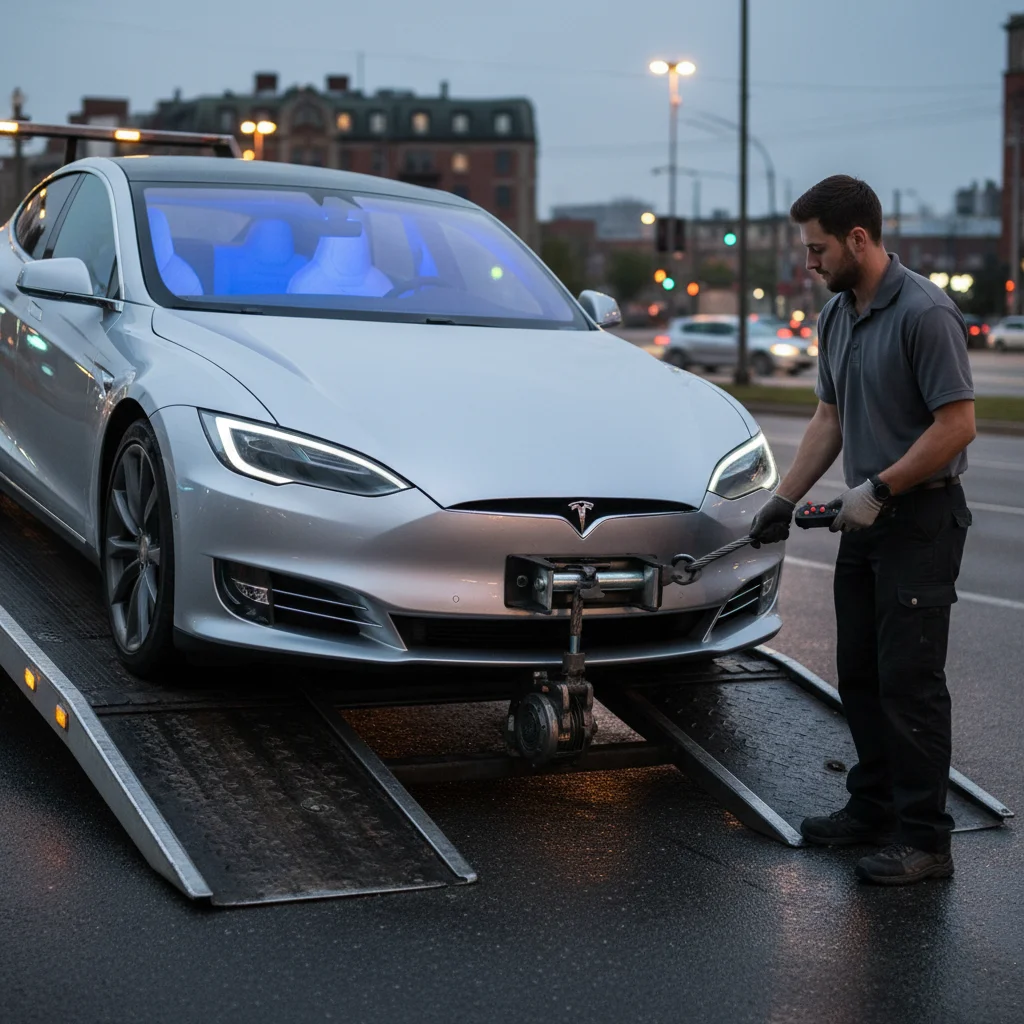
Tesla’s path is Transport Mode. On a car with a living 12V, open Controls, then Service, then Towing. That releases the parking brake and puts the car in Neutral. Load it on a flatbed. If Neutral won’t take, the operator uses dollies or skates. That keeps the wheels from turning. See towing a Tesla with a dead pack before anyone hooks a strap.
Transport Mode needs 12-volt power. After the pack hits empty, that 12V can sag. Then you lose the screen, the handles, and Neutral. The car is a brick. The operator has to winch it as a dead load. It’s why the first truck should know Teslas, not just hooks.
Charge at the car, jump the 12V, or take the tow
Match the tool to the failure.
A mobile 240-volt charge is the pack answer. Charge Pro OC is a referral line. It matches stranded EV drivers with independent local mobile rescue operators. Those operators bring a Level 2 source to the bumper. Teslas take a native NACS plug. Typical charging adds 10 to 20 miles of range. That’s in 15 to 30 minutes of charging. It isn’t a clock on arrival. The operator quotes you before work starts. The operator bills you directly.
Those 10 to 20 miles usually reach a Supercharger from the list above. It can also cover a run to your own driveway. It doesn’t fill the pack. It gets you off the shoulder. Out-of-charge recovery is the job name for an empty pack. Tesla roadside rescue is the Tesla-shaped version of the same match.
A 12V jump is the other on-site job. If rated miles remain and the car is asleep, start there. A Tesla 12V jump is that path. A jump can restore handles, Neutral, and the charge port. It won’t refill an empty high-voltage pack. If both batteries are down, the jump may have to come first. The pack needs that 12V support before it’ll accept the 240-volt charge.
A flatbed is still right when you need a shop, not a stall. It’s also what Tesla’s own depleted-pack policy sends. Loading a Tesla is slow, careful work. Then you ride to a charger or a service center. Then you unload before a single kWh goes in. For an empty pack with no other fault, charging at the bumper skips that chain. Tesla’s published path is still the tow. You can choose the local charge instead.
What to say when you call
Stay out of the lanes. Hazards on. As far right as the shoulder allows. In a Costa Mesa structure or an Anaheim theme-park garage, stay with the car. Pin the level and the aisle.
Don’t say your Tesla died and stop talking. That phrase covers a pack, a 12V, a tire, and a glitch.
Give four facts.
- The model: 3, Y, S, X, or Cybertruck.
- The failure: high-voltage pack at zero. Or a 12V that won’t wake the car.
- The pin: freeway, direction, nearest exit, or street and cross street. On SR-241 or another toll road, say you’re on the toll road. Published FSP coverage isn’t listed there.
- The job: a 240-volt charge at the car, a 12V jump, or a flatbed.
If Tesla Roadside is already arranging transport, you can still ask for a bumper charge. A local operator can do that job. That’s your call. Nobody quotes a price until they know the car and the pin. The operator on scene does that quote. Charge Pro OC doesn’t set it.
Charge Pro OC doesn’t own trucks. It doesn’t employ technicians. It doesn’t promise an arrival. It connects you with independent operators across Orange County. We serve every city in the county. The person at your bumper does the work and bills you.
For that match, call (949) 444-0151.