Tesla roadside assistance is free for a warrantable breakdown. An empty pack isn’t. Tesla’s own roadside page draws that line. A covered defect that leaves the car undrivable can get transport. That covered move is up to 500 miles to the nearest Service Center. A depleted high-voltage pack is different. Tesla can still help. It’s not a financially covered service.
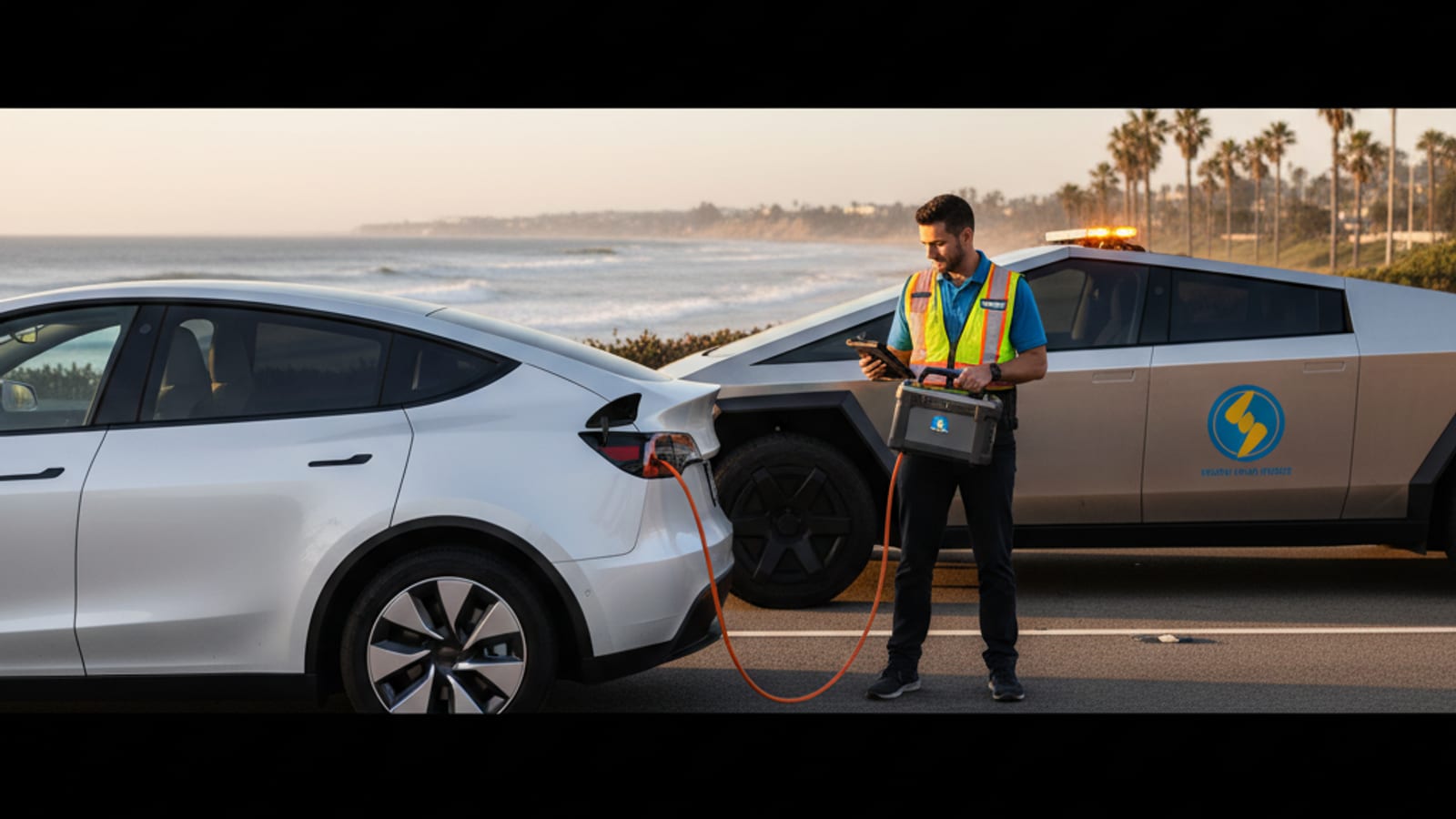
That mixup is common here. Teslas dominate Orange County’s battery-electric fleet. CEC data as of December 31, 2025 counted 210,842 BEVs in the county. Teslas were 138,121 of those BEVs. That’s 65.51% of the battery-electric fleet. Statewide, Tesla’s share of BEVs was 61.34%. Orange County sits 6.4 points more Tesla-heavy than California. Many owners treat Tesla roadside like a blanket warranty. The published policy is narrower.
Warrantable breakdowns get transport, not a curb charge
Tesla’s roadside page describes the free path in one sentence. Transportation of up to 500 miles to the nearest Service Center is the covered benefit. It applies to a warrantable breakdown that leaves the car undrivable. It’s a move to service. It’s not a charge at the bumper. It’s not a 12V jump.
Tesla lists Service Centers in Costa Mesa, Buena Park, and Santa Ana. Irvine, Anaheim, and Aliso Viejo have listed shops too. Confirm the live street address on Tesla’s Find Us list before a tow rolls. Tesla’s site blocked automated checks on 2026-09-05. Open the Find Us page in a browser.
Five hundred miles covers any Orange County hop to those shops. Distance isn’t the usual catch. The failure has to be warrantable. An empty pack doesn’t qualify because you stalled near an Irvine Service Center.
Dark screens aren’t proof of a pack or drive-unit defect. Tesla’s Model Y owner’s manual notes a technical catch. The low-voltage battery can lose support once range is exhausted. The car then needs an external power supply before the high-voltage pack can charge. That looks like a total failure. It often isn’t a warrantable drive-unit event. Start with how to tell a dead pack from a 12V failure.
Empty pack: Tesla can assist, and it bills
Tesla’s roadside page is direct about a depleted battery. When the charge is gone and you can’t make a station, Tesla can still help. That help isn’t a financially covered service. The same rule applies if the car sat unplugged for a long stretch.
Tesla can still arrange transportation. The public policy answers a depleted battery with a tow. It doesn’t describe on-site charging as the covered fix. This research didn’t find a Tesla page that says the company never offers mobile charging. The roadside page still answers a depleted pack with transportation. Running out of charge sits outside the financially covered list.
Open Tesla’s North America roadside policy PDF before you assume a free tow. Tesla’s roadside number, as published on the Santa Ana service page, is 877-798-3752.
A paid Tesla transport usually aims at a Supercharger, a destination charger, or another point you name. Orange County has 48 Tesla Supercharger sites and 861 DC fast ports. That’s federal AFDC station data, filtered to the county boundary. Tesla holds 59% of Orange County’s public DC fast ports. Those stalls are real. They still don’t put miles into a car sitting on the shoulder.
Large Tesla sites a tow might target include 1920 Main St in Irvine, with 40 stalls. Tustin’s 14661 Franklin Ave has 36 stalls. Garden Grove’s 12891 Harbor Blvd has 32 stalls. San Clemente’s 101 W Avenida Vista Hermosa has 49 stalls. Anaheim has several Lincoln Avenue and Katella Avenue Superchargers. Mission Viejo’s Shops site lists 10 stalls. Tesla’s own page rates them at up to 72 kW. None of that changes the billing line. An empty pack isn’t the warrantable-breakdown benefit.
For the empty-pack sequence on county roads, see Tesla at zero on an Orange County road. For the broader coverage question, see what Tesla roadside actually treats as free.
Why this split shows up so often in Orange County
Orange County holds 12.02% of California’s battery-electric vehicles. It makes up 8.33% of the state’s light-duty fleet. ZEVs are 10.56% of the county’s light-duty fleet. BEVs alone are 8.54%.
Public charging is thinner per EV than the state average. Orange County had 7,095 public ports at the end of 2025, per the CEC charger file. That’s 36.8 ZEVs per public port. Statewide the ratio is 24.4. The county holds 7.75% of California’s public ports. It holds a larger share of the state’s BEVs.
That ratio isn’t a claim about any one lot. It’s why empty-pack calls keep happening even with 861 Tesla Supercharger stalls in the county. Drivers still miss a stall. They still sit on I-405 with zero miles. The same call happens on I-5 south of Irvine, on SR-22 at the Crush, and on the 91 through north county.
What a local operator does that Tesla’s tow doesn’t
Charge Pro OC is a referral line. It matches stranded EV drivers with independent local mobile rescue operators. It doesn’t hold a trade license. It doesn’t own trucks. It doesn’t employ technicians. It doesn’t set prices. It doesn’t publish hours.
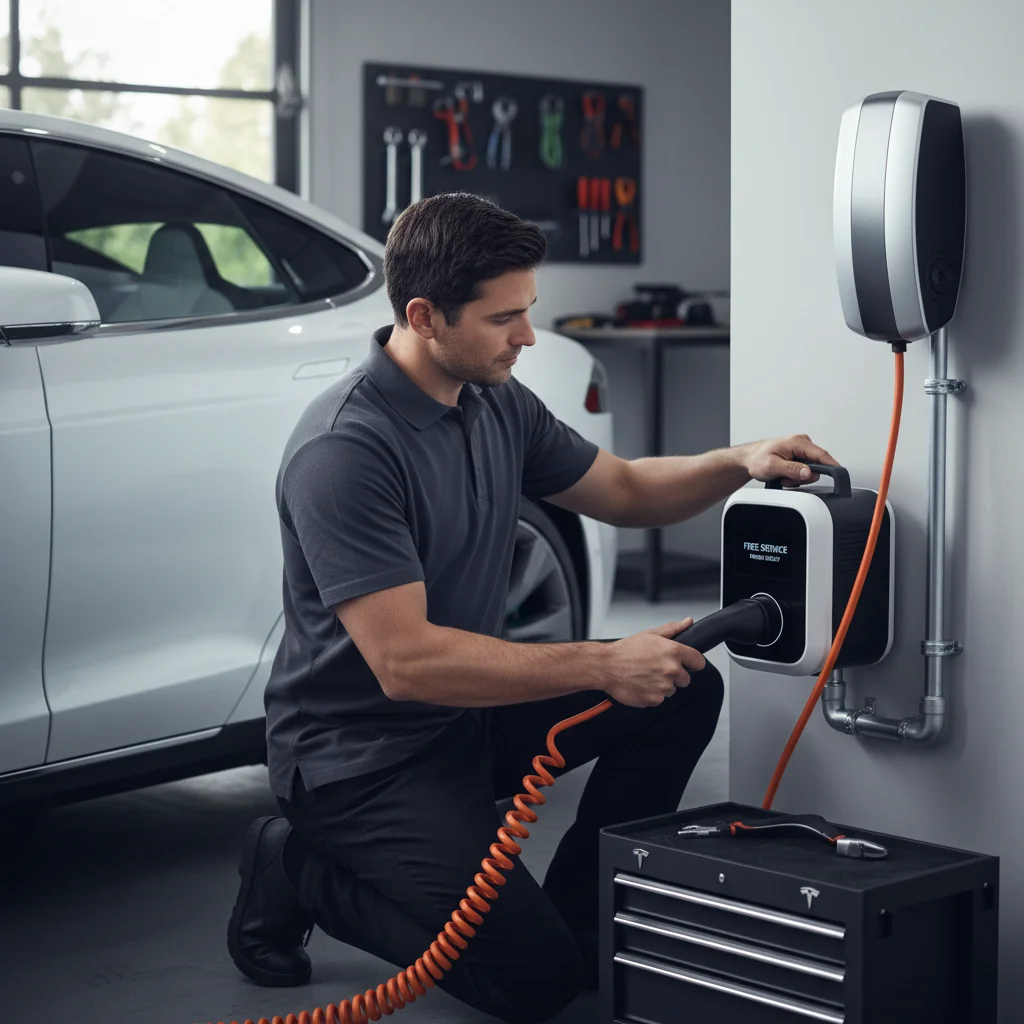
The operators we connect you with are licensed. They bring a 240V Level 2 source to the car. Teslas take a native NACS plug. Other EVs use a CCS or J1772 adapter. A typical session adds 10 to 20 miles of range in 15 to 30 minutes of charging. That window is charging time, never an arrival time. The same operators can jump or replace a dead 12V on site.
The operator quotes you before starting. They bill you directly.
That’s the on-site path when Tesla’s covered transport doesn’t apply. Picture an empty pack in a Tustin office park. Or a car that won’t wake in a Costa Mesa structure. Or a Model 3 on the shoulder of the 91. Tesla can still send a contractor for a paid tow. A local operator can put enough range in the pack to reach a stall under your own power.
If you want that on-site charge, start with out-of-charge recovery or Tesla roadside rescue. For how Tesla’s billable items are described, see what Tesla roadside covers, and what it bills. For the 2026 wording, see Tesla’s 2026 roadside policy for OC drivers.
Sort the failure before you request a truck
Stay in the car if you’re on a freeway shoulder. Keep hazards on. Point the wheels with traffic.
Then decide what actually failed.
If the displays still boot and range reads zero, you have an empty pack. Tesla roadside can arrange transport. It isn’t the warrantable 500-mile benefit. A local Level 2 truck can charge where you sit.
If nothing lights and the door handles are dead, treat it as 12V until proven otherwise. A jump or a 12V swap on site is often the first fix. Towing a car that only needed a 12V wake-up wastes a Service Center bay.
If the pack still shows range and the car won’t drive, that’s the warrantable-breakdown conversation. Call Tesla. Ask whether the failure is a covered defect. Ask whether transport to the nearest Service Center is included. Confirm it against the current roadside policy PDF.
No public Tesla menu of unpaid tow rates turned up in this research. Whatever the contractor bills is set by that contractor, not by Charge Pro OC. Confirm the figure before the hook goes on. The same rule applies to a local mobile charge. The operator quotes first. You accept or you don’t.
If you want the on-site charge instead of Tesla’s paid tow, call (949) 444-0151. Charge Pro OC will connect you with an independent pro who quotes before starting. That number is a referral line, not a promise of when someone arrives.
Frequently asked questions
Is Tesla roadside assistance free when the pack is empty?
No. Tesla’s roadside page says a depleted battery isn’t a financially covered service. Tesla can still arrange transport. That move is billed unless a separate warrantable defect is what’s actually wrong.
What does a warrantable breakdown get you?
Tesla’s published benefit is transport of up to 500 miles to the nearest Service Center. That applies when a warrantable breakdown leaves the car undrivable. It’s a tow to service, not a charge on the shoulder.
Can Tesla still tow an empty Tesla if it isn’t covered?
Yes. Tesla can assist with transportation when the pack is depleted. It isn’t the free warrantable-breakdown benefit. A local operator can bring 240V to the car instead.