Tesla’s overnight roadside hours in Orange County couldn’t be confirmed from our approved sources. Don’t treat an old search as proof a truck is standing by after midnight. Open the Tesla app for the options tied to your car. After hours, freeway patrol is a different program with its own published schedule. Confirm those hours before you wait on the shoulder for a patrol truck.
After hours is a different call here
The California Energy Commission counted 138,121 Teslas here as of December 31, 2025. That’s 65.51% of local battery-electric cars, and 5.59% of all light-duty vehicles. CEC also counted 210,842 battery-electrics countywide. Tesla still dominates that fleet.
That density is why a late-night stop isn’t a freak event. Theme-park lots in Anaheim fill after dark. So do Irvine office parks and Huntington Beach streets near the water. AFDC records list 48 Tesla Supercharger sites and 861 DC fast ports here. An empty pack at 11 p.m. is still a coverage question.
We couldn’t confirm overnight or holiday hours for Orange County freeway patrol. Check the program’s current published schedule before you count on it. Daytime freeway help and a midnight Tesla request aren’t the same call. Empty on the 241 is a special case. Read Empty on SR-241: published FSP coverage skips the toll roads.
Tesla’s app can look open while your problem sits outside the terms. A request button isn’t overnight coverage. Read what’s on the screen for this vehicle, this location, and this hour.
What Tesla roadside actually answers
Tesla’s roadside page couldn’t be opened directly in our September 2026 check. Search-index copies of Tesla’s own page are what we used. Confirm the current wording in the app or on Tesla’s site. Do that before you rely on it.
As indexed, Tesla treats a depleted pack as transport. It’s not charging at the car. When the pack is empty, Tesla says it can assist. It also says this isn’t a financially covered service. Tesla’s page points you to Tesla Roadside Assistance. Use that channel to learn more or arrange a move.
The free transport Tesla describes is for a warrantable breakdown. That breakdown has to leave the car undrivable. The published cap is 500 miles to the nearest Service Center. Tesla lists service centers in Costa Mesa, Buena Park, and Santa Ana. It also lists Irvine, Anaheim, and Aliso Viejo. Confirm those listings on Tesla’s own location pages. Running out of charge sits outside the free transport rule. Tesla will move an empty car as paid transport. Those materials don’t answer an empty pack with charging at the car.
We couldn’t confirm a full list of every problem Tesla roadside will handle overnight. Check the terms in the app or Tesla’s current official materials. Those sources decide whether your situation qualifies. Read What Tesla roadside covers, and what it sends a truck for. It helps separate confirmed terms from guesses.
Start with a plain description of what happened. Report the exact message on the screen. Don’t tell a provider it just needs a jump unless that’s confirmed. The wrong description sends the wrong equipment.
Coverage and cost are separate. We couldn’t confirm Tesla covers every request, location, or service without charge. Review the terms shown for your vehicle. Ask who sets the charge and who collects payment when the request isn’t covered.
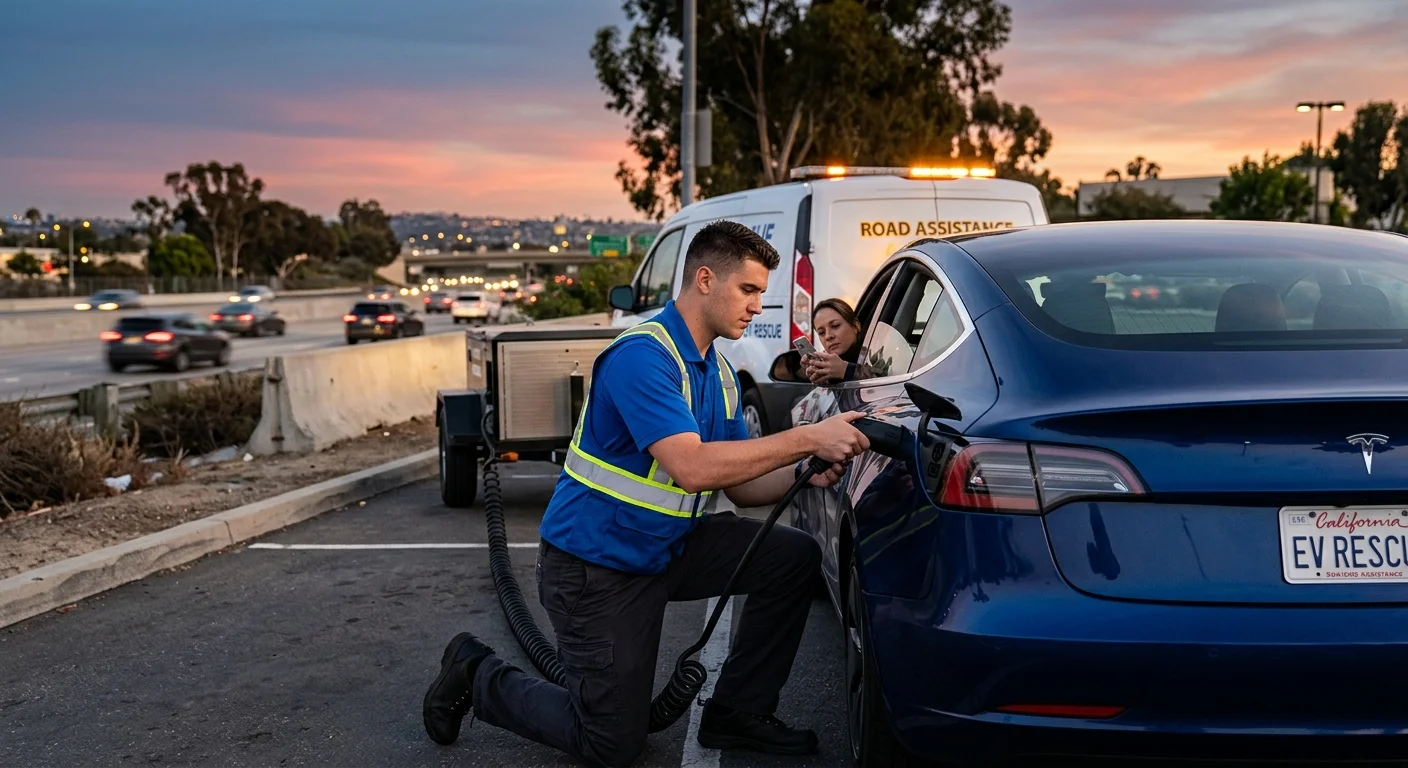
If the pack is empty, an independent operator is another path. That operator can bring a 240V Level 2 source to the car. That’s a different service from Tesla’s transport path. See Tesla roadside rescue for how that referral works.
Check the app, then the published number
Phone numbers in old search results go stale. Tesla’s roadside number, as published on the Santa Ana service page, is 877-798-3752. Still open the Tesla app connected to the stranded car first. Look for the current Roadside or support option. Read every condition before you submit a request.
If the option doesn’t appear, use Tesla’s current support materials. Skip an older third-party page. Read Tesla’s roadside number, and a local Orange County backup. It explains why the app stays part of that check.
Have the location ready in words, not only a pin. Saying you’re on I-5 isn’t enough. Note the direction and the nearest exit. Say whether you’re on the shoulder, in a garage, or in a lot. In Anaheim, a structure name and level beats a street number. In Irvine or Tustin, name the office park and the closest driveway. San Clemente has Superchargers at 101 W Avenida Vista Hermosa and 990 Avenida Vista Hermosa. Don’t roll toward them if the pack is already at zero.
Describe the car in plain words. Say if the screens are on, and whether it shifts into gear. Don’t open electrical components beside moving traffic.
Take screenshots of the request and any confirmation. If the request stalls, return to Tesla’s current support channel. Don’t keep retrying an unsourced directory number. Read Tesla roadside by app or by phone: which path reaches a person. It covers what to prepare for either route. It doesn’t promise which one answers first.
If the Tesla is in a bad spot after dark
Treat a live lane as an emergency, not a coverage question. If the car is blocking traffic, or someone is in immediate danger, call 911. If you can move the car without adding risk, leave the travel lane. Don’t push, charge, tow, or inspect a Tesla from a live freeway lane. Conditions change fast on I-5, I-405, SR-22, and SR-91.
Use the hazard lights if they work. Share the exact position. Nearest exit, direction, shoulder side, and a mile marker cut confusion. A written description still beats a map pin alone.
Once the immediate hazard is handled, decide what the Tesla actually needs. A tow, a mobile charge, or a 12V check aren’t interchangeable. Read Out of charge on an Orange County freeway: what to do next.
When an independent operator is the overnight option
An independent operator can make sense when the Tesla app doesn’t offer a fit. It also fits when you want charging at the car instead of a tow. Confirm the service, price, and payment terms before you agree. The operator quotes you before starting, and bills you directly.
Charge Pro OC is a referral line for Orange County. We connect stranded EV drivers with independent local mobile rescue operators. We don’t perform the work or own trucks. We don’t employ technicians or set prices. We don’t promise an arrival time, and we don’t hold a license. The pros we connect you with are licensed.
Tell the operator the Tesla model and the exact spot. Say whether the car is in a lot, a garage, or near traffic. The operator decides whether the request matches its equipment.
Those operators typically bring a 240V Level 2 source to the car. Native NACS for Teslas. CCS or J1772 adapters for other EVs. That charge usually adds 10 to 20 miles of range. Charging time is 15 to 30 minutes. That’s charging time, never an arrival time. They can also jump or replace a dead 12V on site.
For help beyond Tesla’s program, see EV roadside assistance. Before you accept, ask who performs the work and what the quote covers. Keep the agreement and payment record from that operator.
If you’re still waiting
Don’t sit in a live lane hoping Tesla’s overnight coverage exists. We couldn’t confirm that it does. Don’t assume freeway patrol is still out after dark. Check holiday hours on the published schedule too. If Tesla’s path is transport, that’s one option. Wanting range at the car is a separate request.
Call when your Tesla is stranded in Orange County. We can connect you with a mobile EV rescue operator. We don’t promise availability or an arrival time. The independent operator confirms the service and terms directly.
Call (949) 444-0151 and we’ll connect you with a local EV rescue operator.