Most factory Teslas don’t use run flat tires. That includes the Model 3, Y, S, and X parked around Orange County. A puncture still leaves you on a conventional tire. The car won’t limp to a shop on a reinforced sidewall. You need a plug, Tesla’s sealant kit if you have one, or a tow. Assume an Orange County shoulder still needs tire help.
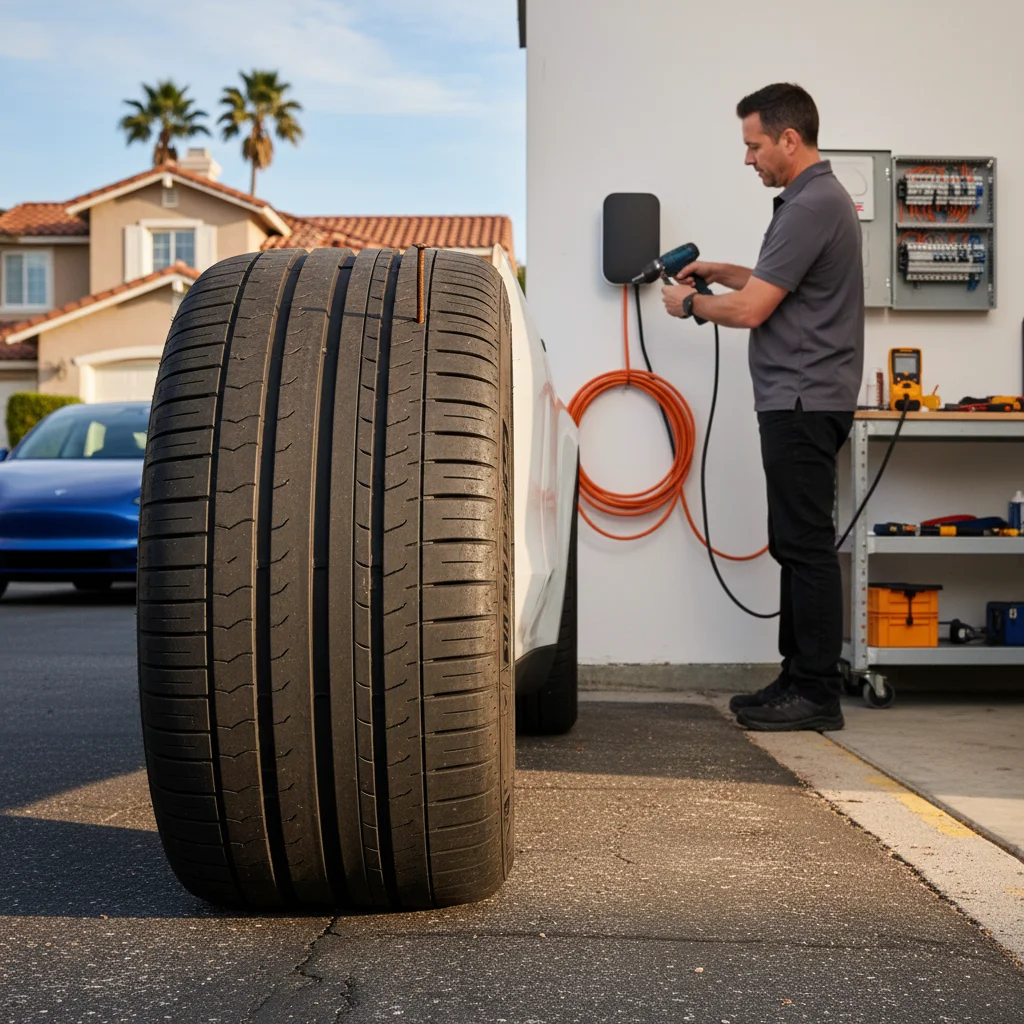
Why this question comes up so often here
New owners open the frunk, then the trunk, then the app. There’s no spare. No jack. No lug wrench hiding under the floor. The next guess is usually run-flats. That guess is understandable. It’s also wrong for a stock Tesla.
Orange County makes the mix-up common. The California Energy Commission counted 210,842 battery-electric cars in the county. That figure is as of December 31, 2025. Teslas were 138,121 of those, or 65.51% of the BEV fleet. Statewide, Tesla’s share of BEVs was 61.34%. This county is more Tesla-heavy than California as a whole. The no-spare layout is the default on a huge slice of local traffic.
Run-flats carry the car. Tesla tires quiet the cabin.
A run-flat tire uses a thick, stiff sidewall. After a total loss of pressure, that sidewall can still hold the wheel. It does that for a short, slow drive. How far and how fast is the tire maker’s spec, not a Tesla spec. Check the brand on your sidewall if you fitted aftermarket run-flats. Don’t invent a distance and keep driving.
Stock Teslas take a different path. Many original-equipment Tesla tires from Michelin and Pirelli use inner foam. A ring of polyurethane foam is bonded inside the tread. That foam soaks up cavity noise. It doesn’t support the car when the air is gone. In an EV, there’s no engine roar to hide road drone. Range and ride are the other reasons Tesla skipped run-flats. Extra sidewall rubber adds weight and rolling resistance.
If you bought aftermarket tires, read the sidewall. Some owners fit run-flats later. Look for marks such as RFT, ZP, SSR, or EMT. Most cars leaving Tesla service in Costa Mesa, Irvine, or Anaheim still wear acoustic rubber. The same is true in Santa Ana, Buena Park, and Aliso Viejo. Confirm the current tire, not the brochure from delivery day.
Where a Tesla flat actually shows up in the county
This isn’t a generic California problem with a city name swapped. Tesla traffic piles up in specific Orange County lots. Irvine’s Supercharger at 1920 Main Street has 40 stalls. San Clemente’s site at 101 W Avenida Vista Hermosa has 49. Garden Grove’s Harbor Boulevard site has 32. Tustin’s Franklin Avenue site has 36. Buena Park’s Knott Avenue site has 28. Those are AFDC counts from a 2026 pull, not a guess.
A screw at Brea Mall is still a regular puncture. So is a nail on Katella in Anaheim. Westminster Mall and The Shops at Mission Viejo don’t change the tire. The difference is where you can stand. A mall aisle gives you room to look at the tread. A live freeway shoulder doesn’t. Huntington Beach’s Warner Avenue Supercharger sits in busy coastal retail. Newport Beach’s MacArthur Boulevard site does too. Fashion Island has Electrify America stalls at 401 Newport Center Drive. Teslas sit next to other brands in that garage. None of those places turn a Tesla into a run-flat car.
Inland lots in Anaheim, Santa Ana, and Tustin bake in afternoon heat. Heat raises tire pressure. A cool morning then drops it. TPMS can ping after a temperature swing even when nothing is punctured. Check the tire with your eyes before you assume a nail. Coastal lots in San Clemente, Huntington Beach, and Costa Mesa run cooler. Foam doesn’t seal a hole.
North county has its own pattern. Fullerton’s Superchargers sit on Harbor and Orangethorpe. Brea’s sites sit at the mall and on Madrona. Yorba Linda’s stalls sit on Yorba Linda Boulevard. South county clusters in Mission Viejo, Laguna Hills, Lake Forest, and San Juan Capistrano. A quiet street there still isn’t a run-flat.
What the car tells you, and what you do first
Tesla watches pressure with TPMS. A low tire lights a warning on the screen. It usually names the corner and the current psi. That alert is your cue to stop, not to finish the errand.
Pull over as soon as you have a safe, legal place to sit. Driving on a nearly empty tire cooks the sidewall. Get off the live lane. Stay behind a barrier if you can. Don’t kneel in traffic to inspect a gash.
If you can see the tread, look once. A nail in the center of the tread is what the sealant kit is for. A sidewall slice needs a new tire. So does a bulge, or a tire off the bead. The kit won’t save those.
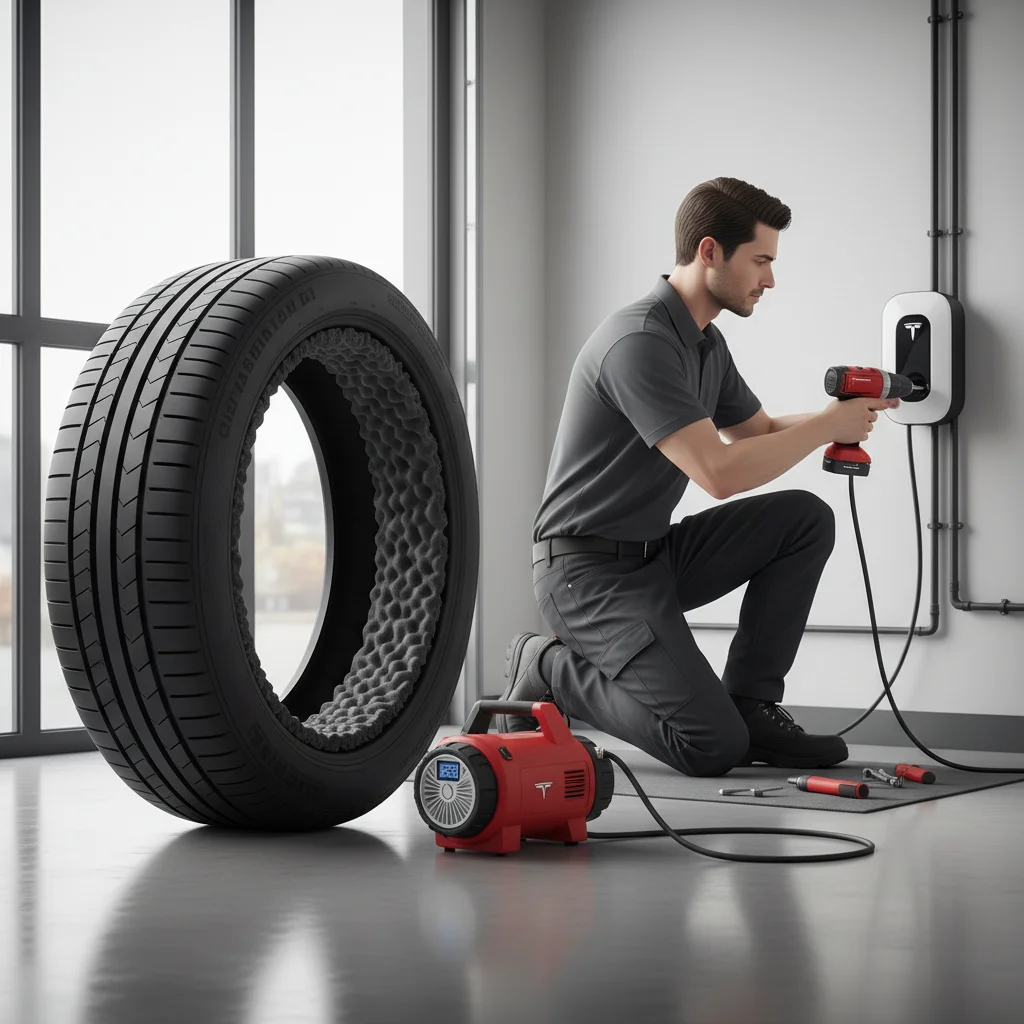
Tesla’s repair kit is a stopgap
Tesla sells a tire repair kit for small punctures. Some cars included one. Don’t assume it shipped in the trunk.
The kit is a bottle of sealant plus a small compressor. That compressor draws 12V from the car. You thread the bottle onto the valve and push sealant in. Then you inflate to the door-jamb pressure. The goo coats the inner liner as the tire turns. It’s meant to plug a small tread hole. It’s a way to creep to a tire shop. It isn’t a permanent patch.
It fails in predictable ways. Large holes, sidewall cuts, and blowouts won’t seal. If the tire won’t take air, stop. More sealant won’t close a tear. Many shops also dislike sealant. They have to clean the mess before they can inspect the liner. Some say it can foul the TPMS sensor inside the wheel. Some won’t patch a tire that’s been filled with goo. A clean plug in the tread is often the repair they prefer. That’s the version done without sealant.
If the 12V system is already weak, that little compressor may not be your friend. It loads the same low-voltage battery that keeps the car awake. A long wait with flashers on can drain it. That’s a separate failure from the flat.
Why there’s no spare in a 3, Y, S, or X
Tesla didn’t forget the spare. The skateboard pack sits under the floor. There’s no deep well for a doughnut spare. Adding one would steal cargo volume or fight the pack and motor layout.
Weight is the other reason. A spare, jack, and wrench are extra mass you haul every day. The U.S. Department of Energy notes that extra weight reduces efficiency. Tesla chases EPA range. Skipping the spare is part of that math. The DOE page uses 100 pounds as its example. A spare setup weighs less than that, but it isn’t free.
Other brands have made the same trade. Tesla isn’t unique for dropping the spare. It’s unique in how many Orange County drivers now live with that choice. CEC data put Teslas at 5.59% of Orange County’s light-duty fleet. That share is as of the end of 2025.
A mobile tire tech, or a flatbed
Once the kit is the wrong tool, you pick a next step. That’s a mobile tire repair or a tow. We don’t do that work. The brand is a referral line for mobile EV charging and 12V rescue. Tire work stays with Tesla Roadside, a shop, or a mobile tire tech you hire.
A mobile tire tech can meet you in Yorba Linda, Irvine, or Fullerton. Some will plug a simple tread nail on the wheel. More often they mount a replacement on site. Tesla sizes, especially acoustic OEM patterns, are specific. Confirm the size on the door sticker. A van may not carry it.
A tow is the path for a sidewall, a blowout, or a damaged wheel. Tesla Roadside can arrange transport. The number published on Tesla’s Santa Ana service page is 877-798-3752. You can also start from the app. Confirm tire coverage in Tesla’s roadside policy. Don’t assume a flat is free. A depleted pack isn’t a warrantable breakdown on Tesla’s published page. A puncture is a different event. Tesla tire repair on the roadside: what they will and won’t do covers those limits. Tesla flat tire coverage, and Orange County’s free freeway option covers the freeway-patrol question.
If the car must be towed, it needs a flatbed and the correct transport mode. Towing an EV with drive wheels on the pavement can damage the motor. Ask the driver before the hook goes on. Tesla service sits in Costa Mesa, Irvine, Anaheim, Santa Ana, Buena Park, and Aliso Viejo. Street addresses for those sites weren’t independently confirmed here. Verify them in the Tesla app. A local tire shop is often closer than a service center.
Read Towing a Tesla with a dead pack: the safe way to move it first if the pack is empty too.
When the flat is only half the problem
A flat doesn’t empty the traction pack. It can still strand you long enough for the 12V battery to sag. Lights, the screen, and door latches all lean on that small battery. Tesla’s owner’s manual for a depleted pack is specific. The low-voltage battery can lose support once range is gone. The car may need external power before the high-voltage pack will charge. That’s a range-zero fact, not a flat-tire fact. Keep them straight.
If you sat until the 12V died, the tire shop can’t wake the car. That’s when a mobile EV rescue matters. The operators Charge Pro OC connects you with bring a 240V Level 2 source to the car. They use a native NACS plug, or a CCS or J1772 adapter for non-Tesla EVs. A typical session adds about 10 to 20 miles of range in 15 to 30 minutes of charging. That’s charging time, not a promise of when someone arrives. They can also jump or replace a dead 12V on site. They don’t mount tires.
Don’t treat a Supercharger hunt as the fix for a shredded sidewall. Charge at the car only if the pack is the problem. Repair the tire if the tire is the problem. You may need both calls. Tesla 12V battery failure: when it strands you, and what follows covers the power side. For a Tesla that still needs range after the tire is sorted, Tesla roadside rescue is the referral path.
What to assume before you roll
Assume there’s no spare and no run-flat sidewall. Assume the kit is only for a small tread puncture. Assume Tesla Roadside and a tire shop own the rubber.
We match stranded EV drivers with independent local operators. We hold no license, own no trucks, and don’t bill the job. The operator quotes you before work starts and bills you directly. If the car needs a pack charge or a 12V jump, call (949) 444-0151. That line is for power rescue, not for a new set of tires.