Orange County’s battery-electric fleet is Tesla-heavy. That still doesn’t put every EV on Tesla’s service clock. The California Energy Commission counted local vehicles through December 31, 2025. Tesla made up 138,121 of 210,842 battery-electric cars. That’s 65.51% of the county’s BEVs. A Rivian, Mach-E, Ioniq 5, or Bolt still follows its own maker’s list.
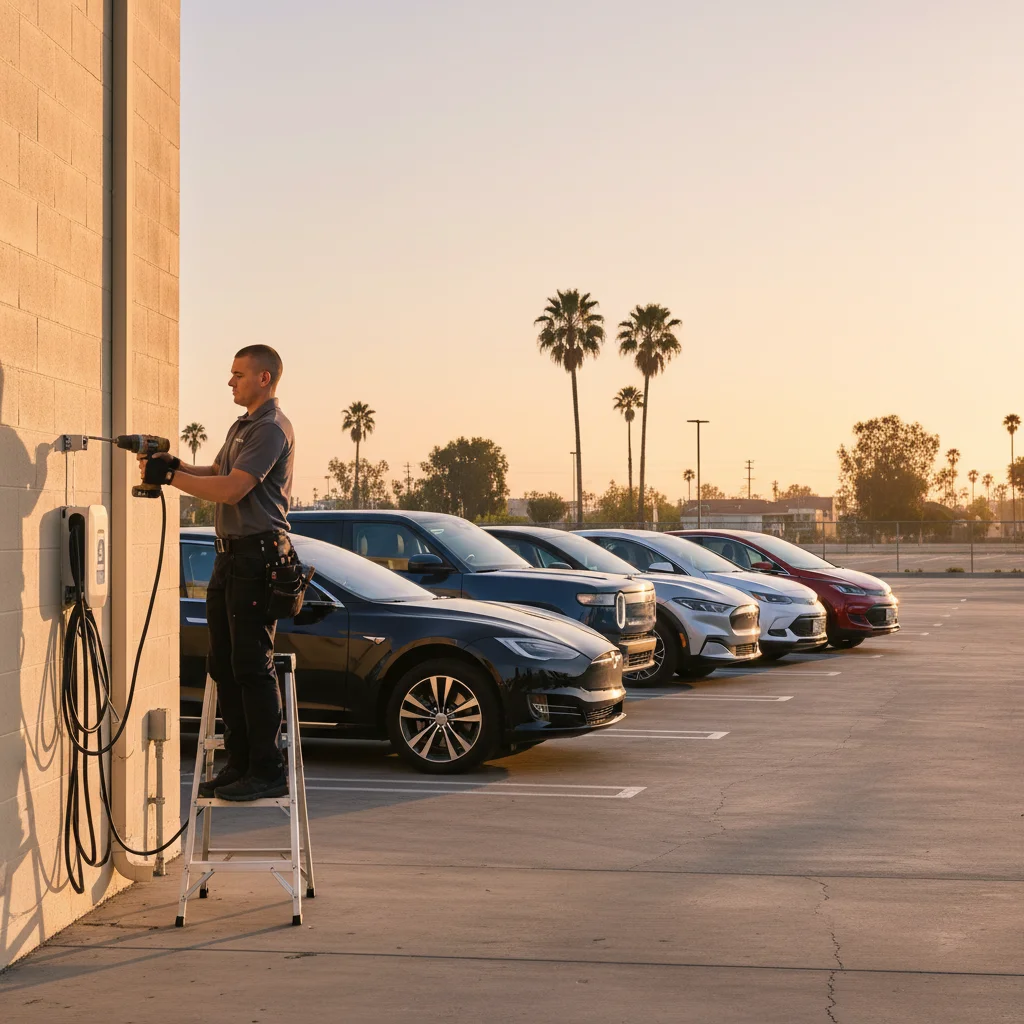
Your search is the interval sheet, not a neighbor’s Tesla app. Tesla’s reminders don’t mention a Ford eAxle. Hyundai’s tire rotation isn’t Chevy’s 7,500-mile stop. Copy a Model Y habit onto another brand. You’ll skip work that car still needs.
Tesla owns the mix. The other clocks still run.
Orange County held 12.02% of California’s battery-electric vehicles at the end of 2025. It was 8.33% of the state’s light-duty fleet. Both shares come from the CEC county file. ZEVs were 10.56% of local light-duty vehicles. BEVs alone were 8.54%. California’s BEV fleet was 61.34% Tesla on that same date. Orange County ran 6.4 points more Tesla-heavy than the state.
That Tesla share is how this county’s EV mix actually looks. It isn’t one maintenance plan. Tesla’s cut of new Orange County ZEV sales was 44.7% in 2025. It was 56.4% in the first half of 2026, per the CEC new-sales file. Non-Tesla cars already sit in Irvine, Anaheim, Santa Ana, and Costa Mesa driveways.
Tesla lists service in Anaheim, Irvine, Santa Ana, Costa Mesa, Buena Park, and Aliso Viejo. Tesla lists more than one Costa Mesa site. Street addresses weren’t confirmed in this research pass. Confirm the current location on Tesla’s service locator before you book. A Mach-E, Ioniq 5, or Bolt doesn’t use that network. Those cars go to Ford, Hyundai, or Chevy stores. An independent shop works if it stocks the right fluid. Buena Park’s auto row is one place those brand stores cluster. Don’t assume a Tesla service visit covers a Lightning.
For the chores every EV still shares, read what to service on your EV and when it actually matters. The rest of this page is the brand split.
Jobs every EV still has, even without oil
No EV needs an oil change. The car isn’t chore-free. Tires, the 12-volt battery, brake fluid, the cabin filter, and wipers show up on every maker’s list. Only the mile marks change.
Tires take the hardest wear. These cars are heavy, and torque hits at once. Skip rotations and one edge of the tread goes first. Use the interval in your brand section. Don’t reuse a gas-car sticker from the last sedan in the household.
The 12-volt pack is the quiet failure. It wakes computers, locks, and contactors. If it dies, a full high-voltage pack won’t save the drive. The car can sit like a brick in a garage or at the curb. Tesla layouts are in Do Teslas have a 12V battery? A model-by-model guide. Signs across brands are in your EV 12V replacement guide.
Brake pads often last longer, because regen does much of the slowing. Brake fluid still takes on moisture. Makers still want a check or a flush on a calendar. Cabin filters still clog. Wipers still streak. None of that vanishes because the engine is gone.
Inland heat in Anaheim and Yorba Linda isn’t the same air as Huntington Beach. The manuals don’t publish a coastal vs inland filter interval. They publish a time or mile mark. Follow that mark. Don’t invent a local shortcut.
Tesla: tires, brake fluid, cabin filters, and the desiccant bag
Most Orange County EV owners are on this clock. Tesla dropped the old yearly shop visit as a required ritual. The car surfaces many reminders. You still have to act on them.
Tesla’s published service marks
Tesla calls for a tire rotation every 6,250 miles. Rotate sooner if tread depth between any two tires differs by 2/32 inch or more. That’s tighter than several rivals below. Weight and power are the reason.
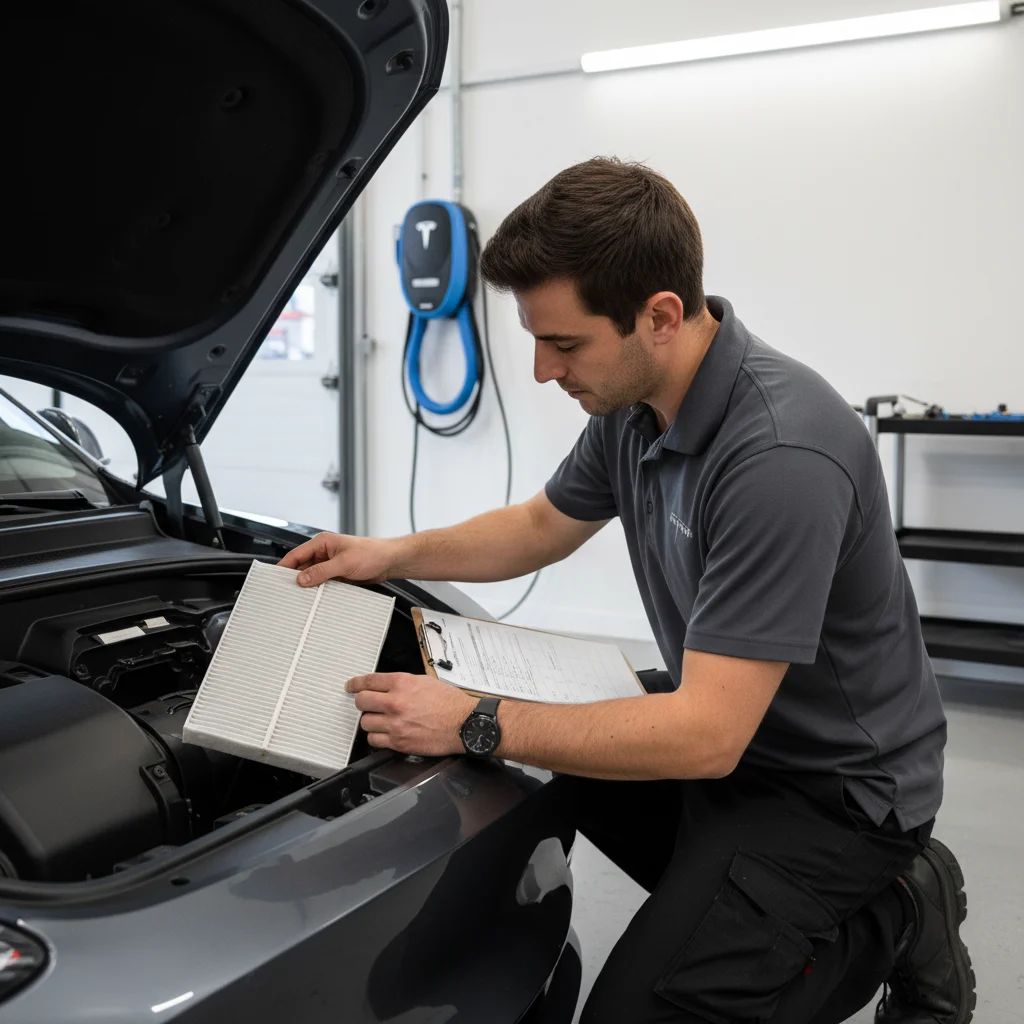
Tesla wants brake fluid checked for contamination every two years. Replace it if the test fails. Cabin filters are a two-year item on most cars. Newer Model S and Model X HEPA plus carbon filters are a three-year swap. The A/C desiccant bag pulls moisture out of the air-conditioning loop. Tesla lists it every four years on Model 3 and Model Y. 2012 through 2020 Model S listings put it at three years. Other models land between three and six. Confirm the year in your own manual.
Tesla visits often include a multi-point look. That doesn’t replace the tire interval. Commutes on the 91, the 405, I-5, or SR-22 add miles fast. A weekend car doesn’t. Theme-park days in Anaheim and office loops in Irvine do the same.
Keep the Tesla app’s service card honest. It won’t warn you that a spouse’s Ioniq 5 is due this month.
Rivian R1T and R1S: drive-unit fluid and air springs
Rivian is the slice of this fleet that still thinks like a trail truck. The R1T and R1S share tires and brakes with everyone else. They also have hardware Tesla doesn’t put on the same page.
Rivian’s longer list
Rivian wants tires rotated every 7,000 miles. Alignment gets a check every 14,000 miles, or when wear looks uneven. Drive-unit fluid lubricates the motor gear assemblies. Rivian lists a replacement at 140,000 miles. That’s a long wait. It’s still a real service line many other EVs never print.
Air suspension wants an inspection for leaks or damage every 28,000 miles. The compressor filter is a 56,000-mile swap. Cabin filters are annual, or every 14,000 miles. Brake fluid is a three-year replacement.
If the Rivian lives on canyon pavement, don’t copy a Model Y reminder. That isn’t the same book. The air springs and drive units are why Rivian printed a different list.
Ford Mach-E and F-150 Lightning: the 10,000-mile visit
Ford kept a checklist that feels like a gas-car book with most pages removed. The spine is a multi-point inspection every 10,000 miles, or at least once a year.
That visit covers tire rotation. It also covers a brake look at pads, rotors, hoses, and the parking brake. Techs inspect cooling hoses and connections. They check half-shaft boots. They look at steering, suspension, and ball joints.
Cabin filters on these Fords go to 20,000 miles. That’s much longer than Rivian’s annual swap. The F-150 Lightning’s all-wheel-drive rear eAxle fluid is a 150,000-mile item. High-voltage battery coolant is the long job. Ford lists the first replacement at 100,000 miles, then every 50,000 miles after that.
A Lightning used as a work truck still needs those inspections. Extra hardware doesn’t erase the 10,000-mile stop. Confirm the latest wording in the glovebox manual.
Hyundai Ioniq 5: eight-thousand-mile steps
Hyundai built the Ioniq 5 schedule on 8,000-mile blocks. Tires rotate at each of those marks. Brakes, steering, and suspension get an inspection every 16,000 miles. The cabin filter is a 24,000-mile replacement.
Battery coolant gets an inspection at 40,000 miles. Hyundai lists the first coolant replacement at 120,000 miles. After that, it’s every 40,000 miles. Brake fluid is a two-year flush and fill.
If you came from a Tesla household, don’t reuse the Tesla tire card. Put the Hyundai number on the calendar. Ioniq 5s are already on Orange County streets. They need Hyundai’s clock, not a borrowed Tesla habit.
Chevy Bolt EV and Bolt EUV: 7,500 miles and a five-year coolant job
Chevrolet’s plan is the simplest on this list. Every 7,500 miles you rotate tires and run a multi-point inspection. The passenger-compartment filter is 22,500 miles. Brake fluid is a five-year flush. At five years or 150,000 miles, Chevy wants the coolant circuits drained and filled. Those loops cover the battery, power electronics, and cabin heater as separate circuits.
A Bolt in Garden Grove or Fullerton doesn’t get a Tesla desiccant-bag appointment. It gets this Chevy clock. Mixing the two is how coolant work gets skipped.
Skipped service is how a healthy pack still leaves you stuck
Charge Pro OC doesn’t perform the shop work in this guide. The brand is a referral line. It matches stranded drivers with independent local operators. A skipped 12-volt test can leave a full pack sitting still. A tire that should have been rotated can do the same on the shoulder.
A dead 12-volt battery can make the whole car look finished. Doors, screen, and drive contactors all need that small pack. Tesla’s Model Y owner’s manual notes another related case. Once range is gone, the low-voltage battery can lose support. It may need external power before the high-voltage pack can charge. That’s an empty-pack case. A weak 12-volt on a car that still shows miles is the weekday surprise.
When the car won’t wake, start with EV roadside assistance. That’s a jump or a 12-volt swap at the car. Tesla-specific jumps sit under Tesla 12V battery jump. That isn’t a cabin-filter visit. It’s the failure the filter schedule never listed.
Tires are the other preventable stop. Low pressure cuts range. It also raises the odds of a roadside. Every brand above still prints a rotation interval. Use it.
Hot summers, coastal moisture, and inland heat all live in this county. How to care for an EV battery across Orange County conditions covers pack habits. It doesn’t replace the brand schedule above.
When the schedule didn’t catch it
The pros we connect you with don’t replace your cabin filter. They don’t flush coolant. They bring a 240V Level 2 source to the car. That’s a native NACS plug, plus CCS or J1772 adapters for non-Tesla EVs. Charging time is typically 15 to 30 minutes. That usually adds about 10 to 20 miles of range. That’s charging time, never an arrival time. They can also jump or replace a dead 12-volt battery on site. They handle Tesla and every major EV brand.
If you’re not in a Tesla, non-Tesla EV rescue in Orange County is the matching read. The operator quotes you before starting. The operator bills you directly. Charge Pro OC holds no license, owns no trucks, and sets no prices.
Call (949) 444-0151 when the car is already stuck. Keep the maker’s interval sheet for the days it isn’t.