You walk back to the Lightning after a long park in a North OC structure. Theme-park and stadium ramps are where this 12V dies. The fob does nothing, and the screens stay dark. A Ford F-150 Lightning that won’t start is usually the 12V battery, not an empty pack.
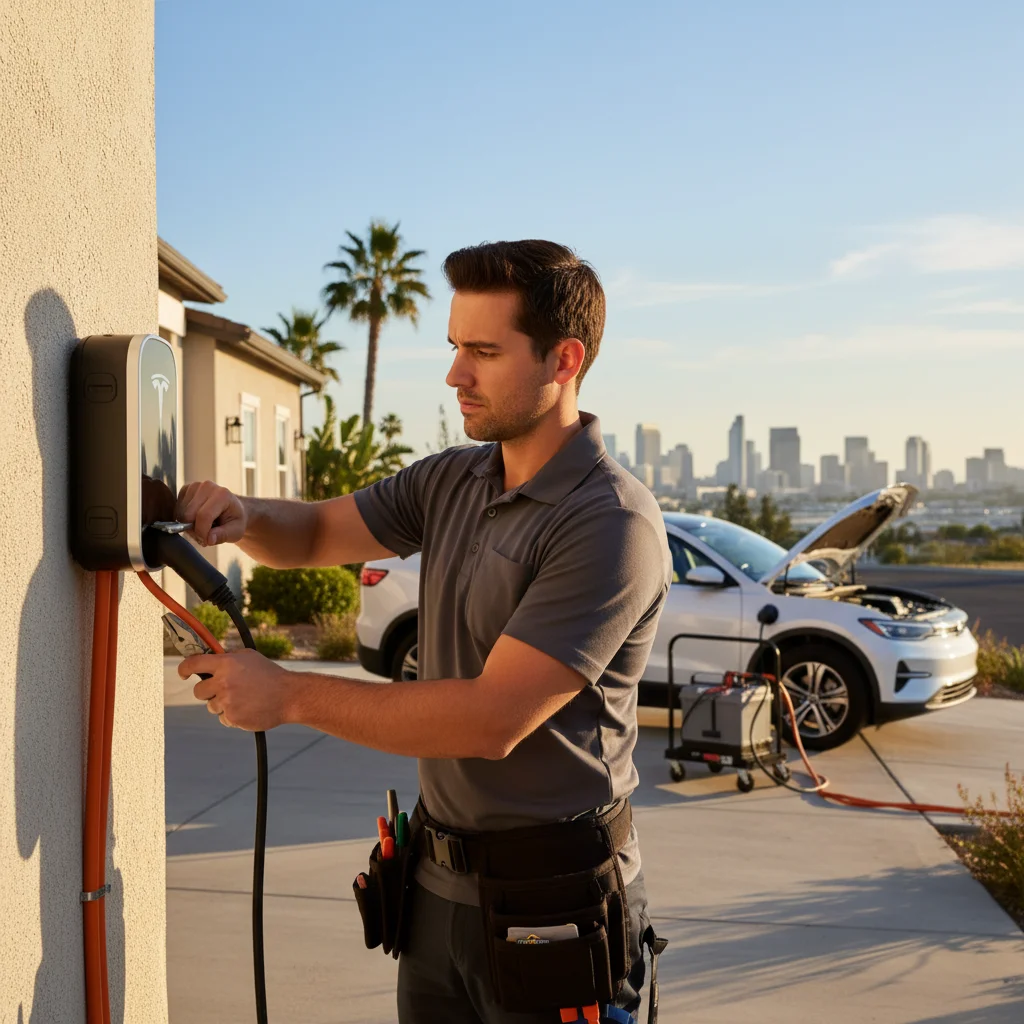
The truck can be full and still sit dead
The Lightning keeps two batteries on different jobs. The traction pack is the high-voltage battery that moves the truck. The 12V is a small lead-acid battery that wakes the rest of the truck. It runs the computers, screens, locks, lights, and contactors. Those contactors have to close before the pack can feed anything. If the 12V is too low, the Lightning can’t wake. It also can’t recharge that small battery from the pack. You can have miles sitting in the truck and no way to use them.
The 12V failure leaves a clear trail. You’ll usually get more than one of these at once. The key fob or phone app gets no reply. The center screen stays black, or it flashes once and dies. The power frunk latch won’t release, so you’re locked out. Interior lights are dim, relays click, or there’s no chime. A plugged-in charge session never starts, because the truck can’t initialize.
A traction-pack problem reads the other way. The cabin usually still powers on, and the screens come up. You get a low-range warning, reduced power, or a truck that won’t take Drive. Those are two failures, and they need two fixes. If the cabin lights up and the truck still won’t roll, that’s a different path. Read when the 12-volt dies, why the EV looks completely dead.
Why North OC structures drain the 12V
The 12V dies for ordinary reasons, not mystery ones. Short trips never let the truck top it off. A door left ajar overnight will pull it down. Accessories left on in the stall will pull it down. Pro Power Onboard and aftermarket gear keep drawing current while the truck looks off.
A full day in an Anaheim or Buena Park structure stretches that same drain. Theme-park and stadium ramps hold the truck still from morning until night. The truck still draws current while it sits. By the time you walk back, the 12V has nothing left. The pack never got a chance to refill it.
Stay with the truck if it won’t wake. Don’t try to roll a dark Lightning toward a stall. The computers aren’t up, so a plug often won’t start anyway. EV roadside assistance in Anaheim around theme-park and stadium lots is the local sequence for that setting. Parked all day in Buena Park covers the same long-park failure on that side of North OC.
Orange County had 210,842 battery-electric vehicles on the road as of December 31, 2025. That’s California Energy Commission data for year-end 2025. ZEVs were 10.56% of the county’s light-duty fleet that year. A dark Lightning in a North OC ramp is still often a 12V story. It isn’t always an empty pack.
Open the frunk first, then find the posts
Ford put the 12V battery and the jump terminals in the frunk. That’s a problem once the latch is dead. The mega power frunk uses an electric latch, and that latch needs 12V. A dead 12V leaves you locked out of the posts you need.
The Lightning has a manual frunk release for this failure. It’s a mechanical pull, a tab or a cable. The exact spot changes by model year. Read the owner’s manual for your truck before you tug on trim.
With the frunk open, look for dedicated jump terminals. Don’t clamp the battery posts themselves. The positive terminal sits under a red cap. The negative is a nearby ground, usually a bare metal stud or a body bracket. Hook a 12V jump pack or a donor battery to those points. Treat it like jumping a gas truck, with one extra rule.
You’re only reviving the 12V system. Never clip onto the orange high-voltage cables. If you can’t tell the terminals apart, stop. Don’t guess under the hood. How to jump start an electric car without making it worse walks through cable order.
When a jump won’t move the truck
A 12V jump won’t add miles. If the traction pack is at zero, the truck needs range. There’s no energy in the big battery to take you anywhere. What it needs is enough charge to reach a stall your Lightning can use, or to get home.
Charge Pro OC is a referral line. We match stranded EV drivers with independent local mobile rescue operators. We don’t perform the work, own trucks, or set prices. We don’t employ technicians or promise an arrival time. The operator quotes you before starting, then bills you directly.
The operators we connect you with bring a 240V Level 2 source to the car. For a Lightning they use a CCS or J1772 adapter. They typically add 10 to 20 miles of range in 15 to 30 minutes of charging. That’s charging time, not an arrival window.
Empty-pack help is out-of-charge recovery. After you have miles, drive to a stall the Lightning can actually use. Electrify America at Walmart, 440 N Euclid Street in Anaheim, shows 10 DC fast ports in federal station data. Tesla Superchargers sit on the same North OC map. Anaheim has sites at 1128 W Lincoln Ave, 2404 E Katella Ave, and 680 N Euclid St. Buena Park has 6940 Beach Blvd and 8888 Knott Ave. Fullerton has 1475 S Harbor Blvd. Those are Tesla network sites. Confirm your truck and that stall can talk before you roll over.
The California Energy Commission counted 7,095 public charging ports in Orange County as of December 31, 2025. That total includes 1,475 public DC fast ports. That’s the county map. It isn’t a promise that the structure you’re in has a working stall. If the truck won’t wake, the stall down the ramp doesn’t matter yet.
Along the 91 after a park day, use mobile EV charging along the 91. That’s the on-site version of the same choice.
What the operator does at the Lightning
The operator tests the 12V first. If it’s only discharged, they jump it through the dedicated terminals. Once the truck wakes, the DC-DC converter can recharge the 12V off the traction pack. If the 12V is dead and won’t hold, they can replace it on site.
If the pack is empty instead, they add those 10 to 20 miles at the curb, then you drive. We don’t install chargers, do electrical work, or touch Pro Power Onboard wiring. A home charger or a wiring fault is a licensed electrician’s job. The pros we connect you with handle the roadside 12V and the empty pack, and they’re licensed. Charge Pro OC isn’t the one holding the tools.
For a non-Tesla truck, non-Tesla EV rescue in Orange County is the service path. We serve every city in the county. The operator on your job is who quotes the work.
If your Lightning won’t start, call (949) 444-0151. Tell them where the truck is sitting. They’ll match you with an operator who quotes before any cables go on.
Frequently asked questions
Why does a full Lightning still refuse to start?
The full charge lives in the traction pack. The truck still needs a healthy 12V to wake the computers. If that small battery is drained, the contactors never close. The Lightning stays dark with range still in the pack. A jump on the frunk 12V terminals is the usual first fix.
What if the frunk won’t open on a dead Lightning?
The mega power frunk uses an electric latch that needs 12V. When the 12V is dead, that latch stays shut. Use the manual frunk release, a mechanical pull or cable. The location varies by model year, so check your owner’s manual. Once the frunk is up, you can reach the jump terminals.
Is jumping a Lightning the same as jumping a gas F-150?
The 12V side is similar, with one hard limit. You only revive the 12V system. Never touch the orange high-voltage cables. Ford gives you dedicated jump terminals in the frunk: a positive post under a red cap, and a nearby ground. Connect a 12V donor or jump pack to those points. If you’re not sure which post is which, stop and call for help.