You walk back to a hospital garage and the Ioniq 5 is dark. The dash stays black. The fob may not even open a door. That looks like a dead Hyundai. In Orange County apartment structures, it’s usually a flat 12-volt battery.
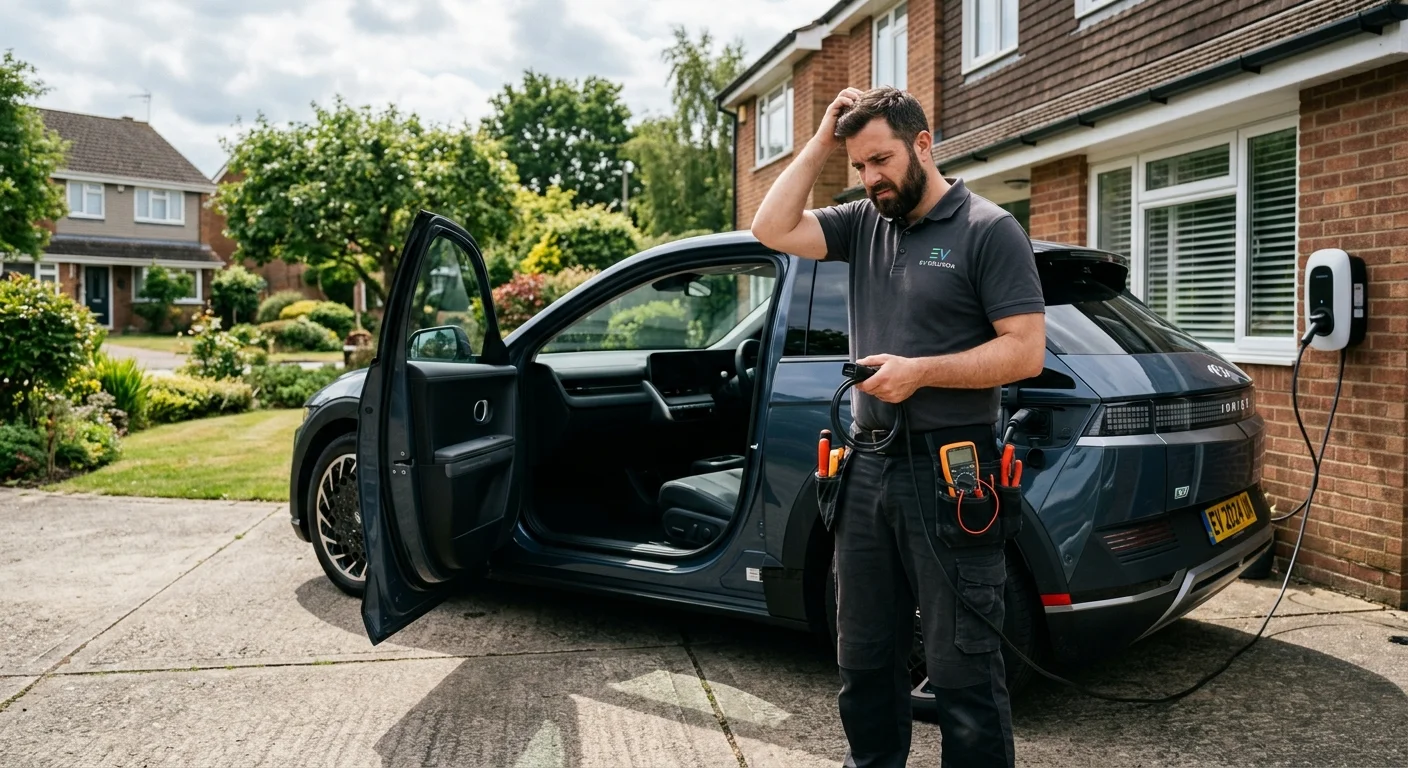
The traction pack can still hold a workday of range. The small 12V battery is what wakes the computers. Those computers close the high-voltage contactors. When the 12V is spent, the car goes silent. You get no chime and no Ready mode.
This stranding is easy to misread in Orange County. The county had 210,842 battery-electric cars on the road. The California Energy Commission published that count as of December 31, 2025. Teslas were 65.51 percent of those BEVs in the same file. Ioniq 5 owners still park in the same podiums and medical lots. A stall in the next aisle doesn’t help if the car won’t wake.
Why a dark Ioniq 5 is usually the 12V
An Ioniq 5 has two batteries with two jobs. The large pack turns the motors. The 12V runs locks, screens, lights, and control modules. If that small battery is dead, the high-voltage system never comes up. Miles left in the pack don’t matter. The cluster never turns on to show them.
An empty traction pack still shows some life. You may see a low-charge warning. You may get a reduced-power message. The fob may still unlock the doors. Total darkness is the 12V pattern. Start there, before you look for a DC fast stall.
CEC counted 7,095 public charging ports in Orange County as of December 31, 2025. That file also lists 1,475 public DC fast ports. None of them can talk to a car whose computers are off. The Tesla Supercharger at 1920 Main St in Irvine has 40 stalls. It still can’t boot a dead 12V. Electrify America lists a Fashion Island site at 401 Newport Center Dr. That record shows 8 DC fast ports. Same limit. Get the low-voltage system alive first.
The same 12V failure shows up across brands. Read when the 12-volt dies, why the EV looks completely dead.
Run these checks before you open the hood
Do this in the stall, in this order. It takes about a minute. It can save a jump you don’t need.
Brake, then the start button
Put your foot on the brake. Then press Start/Stop. Accessories can wake without the brake. Ready mode won’t. Screens can glow while the car still won’t roll. Hold the brake and press again.
Treat the fob as a suspect
A weak fob battery can mimic a dead car. Try the spare if you carry one. If the doors still ignore you, pop the mechanical key out of the fob. Unlock the door with that key. Then put the fob in the in-car backup slot. Your owner’s manual shows that slot. It’s often in the console. A closer signal can wake a picky receiver.
Read the lights you do get
Flicker in the cabin lights means the 12V is fading. Clicking from under the dash is the same story. Error tiles that pop and vanish are another tell. A fully black cabin is still 12V, just later. A lit dash with a traction warning is different. That’s a range problem, not a jump problem.
A stuck charge cable is a different failure too. In that case the car usually has power. You just can’t unplug. A silent Ioniq 5 is almost never that fault.
The Ioniq 5’s main battery size can’t close contactors on its own. The large pack needs the 12V awake first.
Hospital decks, apartment podiums, and long parking days
Hospital visitor structures are a regular trap. You park for a long appointment. The 12V sits in sleep with the doors locked. You come back, press start, and get silence. Irvine apartment podiums do the same thing after a workday. Office decks in Tustin hold cars for hours too. Overnight HOA garages in Lake Forest add heat and long rest.
Costa Mesa parking structures add a layout problem. You may be several floors below street level. Pulling a silent Ioniq 5 up a tight ramp is a last move. A 12V jump at the stall is the first one. Anaheim theme-park and stadium lots hold cars all day. Santa Ana office and downtown lots do too. Huntington Beach lots sit in the same pattern. Newport Beach lots do too after a long visit. After a long sit, the car that won’t wake is often the auxiliary battery.
Fullerton Harbor and Orangethorpe lots see the same dark-dash return. So do Garden Grove and Westminster mall decks. The county’s public DC network is real. CEC’s December 2025 file is the source for those port counts. A dark Ioniq 5 still can’t use any of it until the 12V is up.
Coastal heat and inland heat both wear a 12V. This research pass didn’t turn up a verified replacement interval we can print. Use the interval in your Hyundai manual. If that page is missing, ask a Hyundai dealer for the current figure. Don’t guess a year count.
Jump the underhood posts, not the hidden battery
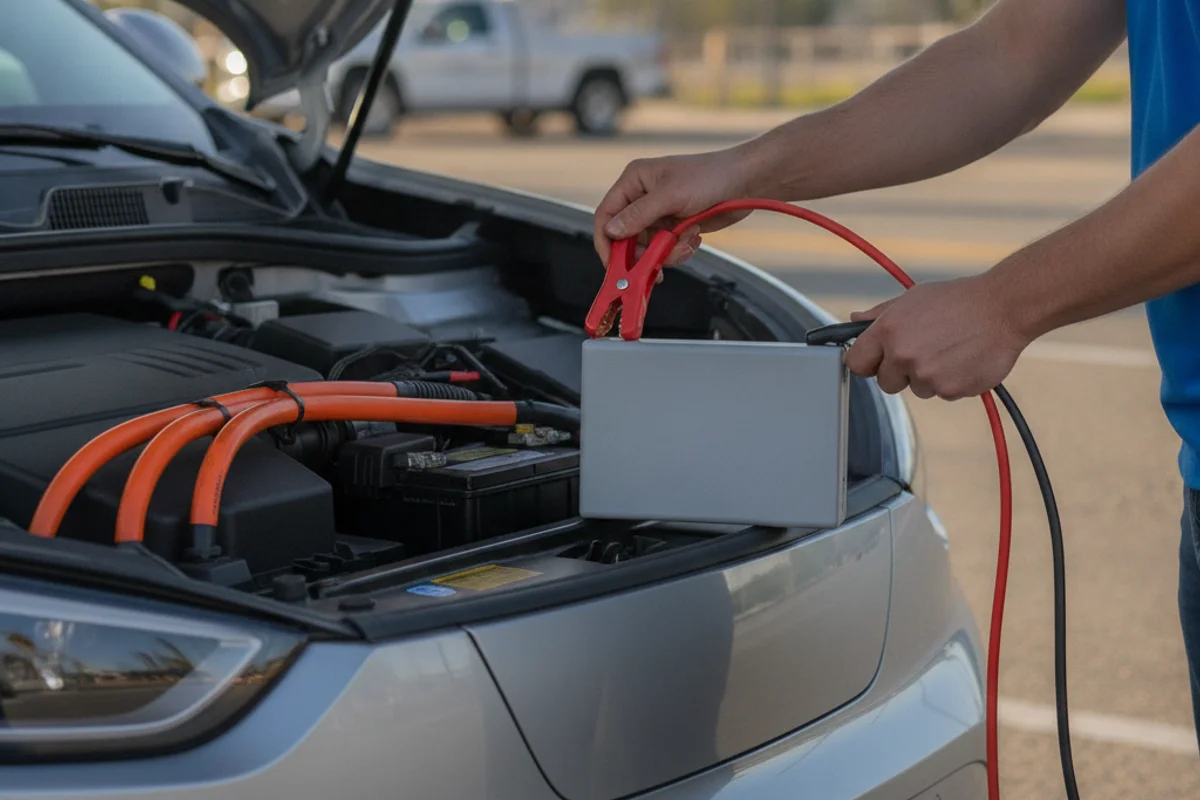
If the cabin is dark and the fob checks failed, jump next. You don’t clamp the 12V battery itself. The Ioniq 5 has dedicated jump posts under the hood.
Pop the hood. On the driver’s side, find the black fuse-box cover. Lift it. Look for the red positive (+) post under a small cap. That’s your jump positive. For the negative, use a clean, unpainted metal ground on the chassis. A marked ground stud is even better. Don’t clamp the 12V battery’s negative post if you can see it. You’re avoiding a spark at the battery.
Clip positive to the Ioniq 5 first. Then positive on the jump pack or donor car. Then negative on the pack or donor. Last, negative to the Ioniq 5 ground. Wait about two minutes. Then brake, then Start/Stop. You want Ready, not just a glowing screen.
Safety steps are in how to jump start an electric car without making it worse. If polarity isn’t obvious, stop. Ask a pro instead of guessing.
What Ready should look like after a jump
Ready means the drive system is actually online. Accessory mode isn’t enough. If you only have screens, redo the brake-and-button step. Once Ready holds, keep the car awake until you can get the 12V tested. Shutting down in the same stall can drop you right back into silence.
Don’t drive off a flickering Ready just to hunt a stall. Irvine has six Tesla Supercharger sites in the AFDC list, including 1920 Main St. Anaheim has seven, including 2404 E Katella Ave. Those sites help a car that can already roll. They don’t replace a 12V that won’t hold.
If Ready comes back, then fades
A jump that lasts a few minutes and then dies is a hold problem. The 12V may be worn out. The car’s converter may not be replenishing it. Another jump is a delay, not a repair. Drive to a Hyundai shop if Ready holds. If it doesn’t, stay where you are.
Don’t keep cycling packs in a structure. That’s the pattern in EV battery dies again after a jump. Repeated jumps heat cables. They also confuse modules. The operators we connect you with can jump on site. They can replace a failed 12V at the car when that’s the right call. They quote you before they start. They bill you directly.
Try one reset if the 12V isn’t the issue
Sometimes the 12V is healthy and the car still won’t enter Ready. That’s often a software hang. Hold Start/Stop for 10 to 15 seconds. Keep your foot off the brake. Lights may flicker. The screen may reboot. Wait a minute. Then brake and start as usual.
A blown dash fuse is possible. It’s not the usual cause of a fully dark Ioniq 5. Check fuses only if you have the diagram. For a no-power car, the 12V still comes first.
When the traction pack is the actual problem
Sometimes the 12V is fine and the drive pack is at zero. You usually saw range warnings first. A jump doesn’t add miles in that case. You need energy in the high-voltage pack.
Operators in this network bring a 240V Level 2 source to the car. They use a native NACS plug. For a non-Tesla like the Ioniq 5, they use a CCS or J1772 adapter. Typical sessions add 10 to 20 miles of range. That takes 15 to 30 minutes of charging. That’s charging time, not a promise about when someone arrives. After that, you can roll to a public stall if you still need more.
Irvine, Santa Ana, and Anaheim have Tesla Supercharger sites in the AFDC inventory. So do Tustin and Costa Mesa. Fullerton has two, at 1475 S Harbor Blvd and 220 E Orangethorpe Ave. Huntington Beach has one at 6913 Warner Ave. Non-Tesla DC fast is on that map too. Electrify America lists 10 DC fast ports at 440 N Euclid St in Anaheim. Those sites help after the car can drive. They also help after a mobile charge has restored enough range.
Hyundai and other non-Tesla brands have a local path. Start with non-Tesla EV rescue in Orange County. The service path is non-Tesla EV rescue.
Skip the tow until the 12V is ruled out
A silent Ioniq 5 in a podium garage is often a 12V job. A flatbed from a hospital ramp is the harder path. Don’t jump a gas car off your Ioniq 5. Don’t guess at shop prices or wait times. Those figures weren’t verified for this page. Ask the operator or the dealer for the current number.
Charge Pro OC is a referral line. It matches stranded EV drivers with independent local mobile rescue operators. It doesn’t own trucks. It doesn’t employ technicians. It doesn’t set prices. The pros we connect you with are licensed. They handle Tesla and every major EV brand, including Hyundai.
If the checks above haven’t woken the car, call (949) 444-0151. Say you’re in a structure or on a surface lot. Say whether the cabin is fully dark. Say whether a jump already failed. The operator quotes before starting work.