The Hyundai Ioniq 5 battery size is 58.0 kWh on Standard Range. It’s 77.4 kWh on Long Range. Usable energy is closer to 54 kWh and 74 kWh. Hyundai keeps a buffer at both ends of the pack. EPA range is about 220 miles on Standard Range. Long Range rear-drive is about 303 miles. Long Range all-wheel drive is about 260 miles. Those usable kilowatt-hours are the ones you spend in Orange County. At the end of 2025 the county had 260,833 zero-emission vehicles. Public ports totaled 7,095. That’s 36.8 ZEVs per public port, against 24.4 statewide.
Usable kWh is the number that actually moves the car
Gross capacity is the tank Hyundai built. Usable capacity is the energy the car will let you use. The Ioniq 5 holds back roughly 5 percent. That reserve protects cells from sitting at empty or at full. You feel it as a 100 percent reading that isn’t the whole pack. Zero percent still has a little energy locked away.
Orange County punishes a thin buffer. The California Energy Commission counted 210,842 battery-electric vehicles here. That count is as of December 31, 2025. Plug-in hybrids added 47,567. Fuel-cell cars added 2,424. ZEVs total 260,833. That’s 10.56 percent of the county’s light-duty fleet. BEVs alone are 8.54 percent. California’s ZEV share of the light-duty fleet is 7.54 percent. Orange County holds 12.02 percent of California’s battery-electric cars. It’s only 8.33 percent of the state’s light-duty fleet.
Ports didn’t match that weight. CEC’s charger file for the same date lists 20 public Level 1 ports. It lists 5,600 public Level 2 ports. It lists 1,475 public DC fast ports. Public ports total 7,095. Shared-private ports add 4,685. Combined that’s 11,780. California has 91,520 public ports. Orange County holds 7.75 percent of them. The ratio is 36.8 ZEVs per public port. Statewide it’s 24.4. More cars per plug than the state is the local math. A Long Range pack’s extra usable energy isn’t a vanity spec. It’s how you arrive at a stall with margin.
These CEC and AFDC figures come from the agencies’ own files. Access date is September 5, 2026.
New sales still run ahead of California. They aren’t racing upward. In 2025, ZEVs were 28.76 percent of new light-duty sales here. Statewide that share was 22.93 percent. In 2026 Q2 the county was 24.77 percent. The state was 19.09 percent. The lead is about 5 to 6 points. California’s ZEV share of new sales peaked at 25.31 percent in 2024. 2026 Q1 was the weakest quarter in the CEC series. Don’t read this file as adoption speeding up. Read it as a large fleet already here. Those cars share a finite set of public plugs. CEC also changed its new-sale method in 2023 and again in 2025. Year-over-year comparisons across those breaks aren’t clean.
Tesla still dominates the battery-electric fleet. 138,121 Teslas were 65.51 percent of Orange County BEVs at year-end 2025. Statewide Tesla’s BEV share was 61.34 percent. Your Ioniq 5 lives in the other third. Fast charging here still skews Tesla. AFDC data shows 861 Tesla DC fast ports out of 1,452 countywide. That’s about 59 percent. If you only plan on CCS stalls, you’re on the smaller slice. Most DC ports here speak NACS.
Tesla’s share of new Orange County ZEV sales was 56.9 percent in 2023. It was 47.2 percent in 2024 and 44.7 percent in 2025. In the first half of 2026 it was 56.4 percent. The rest of those sales are cars like the Ioniq 5. They still have to share Tesla-heavy fast charging. For the countywide picture, see range anxiety in Orange County: what the 2026 EV file shows.
What each Ioniq 5 pack buys on local roads
Standard Range is the 58.0 kWh pack. Usable energy is about 54.0 kWh. It’s typically a rear motor only. EPA range is about 220 miles. That’s plenty for a Garden Grove errand day. It’s plenty for a Stanton-to-Westminster loop. It gets tighter with heat, cooling, and a grade. Inland North County in summer is that stack. Fullerton, Brea, La Habra, Placentia, and Yorba Linda don’t drive like the coast.
Long Range is the 77.4 kWh pack on 2022 through 2024 cars. Usable energy is about 74.0 kWh. Rear-drive Long Range carries the 303-mile EPA rating. All-wheel drive keeps the same pack. It posts about 260 miles. The second motor is extra mass and extra draw. Most Ioniq 5s in Irvine office parks are this larger pack. So are many along Huntington Beach and Costa Mesa. Confirm your year on the energy screen or the window sticker. Hyundai has changed hardware across model years. This page doesn’t invent a later pack size that wasn’t checked.
Power figures travel with those packs on the same 2022-2024 set. Standard Range rear-drive is about 168 hp and 258 lb-ft. Long Range rear-drive is about 225 hp and 258 lb-ft. Long Range all-wheel drive is about 320 hp and 446 lb-ft. Zero to sixty is about 7.4 seconds, 7.3 seconds, and 4.7 seconds. Treat those as brochure context. They aren’t a forecast for the 91 in the afternoon.
2022 to 2024 Ioniq 5 battery specs
| Feature | Standard Range RWD | Long Range RWD | Long Range AWD |
|---|---|---|---|
| Gross battery | 58.0 kWh | 77.4 kWh | 77.4 kWh |
| Usable battery | about 54.0 kWh | about 74.0 kWh | about 74.0 kWh |
| Drivetrain | RWD | RWD | AWD |
| EPA range | 220 miles | 303 miles | 260 miles |
| Peak Level 2 | 10.9 kW | 10.9 kW | 10.9 kW |
| Peak DC fast | up to 239 kW | up to 239 kW | up to 239 kW |
| 0-60 mph | 7.4 seconds | 7.3 seconds | 4.7 seconds |
EPA range moves with wheels, tires, temperature, and how you drive. Usable kWh is approximate. Hyundai doesn’t always print the buffer in the brochure.
Orange County isn’t one commute for this pack
Coastal north county is the milder side of the same county. Huntington Beach, Seal Beach, Rossmoor, and Los Alamitos sit in marine air more often. So does the Cypress edge. Yorba Linda doesn’t. You still use the air conditioner. You still sit on I-405. You usually skip a long canyon grade.
Inland north county is hotter pavement and more cooling load. The battery system works while the car sits in an Anaheim lot. It works in a Buena Park lot too. Then you ask it for freeway speed. This research doesn’t publish a local percent of range lost to heat. This page won’t invent one. Plan as if summer inland miles cost more than the EPA sticker. Then check your trip computer after a real week.
Central cities are density and lights. Santa Ana, Garden Grove, Orange, and Tustin stack stop-and-go. The SR-22 Orange Crush does the same. Impatient throttle spends pack. Regen gives some back if you leave it on. I-5 through the center is a different spend. Steady 70 mph uses more energy than a 60 mph cruise. That’s true south of Irvine. It’s true on the 405.
East County and the canyons are elevation. Santiago Canyon Road pulls harder on the way up. So do Silverado, Modjeska, Trabuco Canyon, and Ortega Highway. You recover some on the way down if regen is on. South county mixes both patterns. San Clemente and Dana Point can feel coastal until you climb. The Newport Coast grade is a short, steep spend. Laguna Canyon is too. Aliso Viejo and Laguna Niguel sit on rolling planned streets. Laguna Hills and Mission Viejo do too. Those grades still add up.
Accessory load isn’t free. Cabin heat, air conditioning, and the screen all come from the same pack. Tire pressure and extra passengers do too. None of that is an Orange County rule. It’s how an EV uses kilowatt-hours. The local part is the stack. A beach lot, a grade, and a busy stall can sit in one day.
DMV counted 2,983,348 registered vehicles in Orange County as of January 1, 2026. That total includes trailers and motorcycles. Don’t mix it with the CEC light-duty ZEV share. The charging ratio uses CEC’s 2,469,737 light-duty universe. The roads still carry almost three million registrations. Your Ioniq 5 is one more body in that mix.
The map your usable miles have to reach
Public DC fast charging in Orange County comes from AFDC station data. That’s the U.S. DOE and NREL station file, filtered to public DC fast. Countywide it’s 223 stations and 1,452 DC fast ports. Take Tesla out and you have 175 stations and 591 ports. Tesla itself is 48 Supercharger sites and 861 ports.
ChargePoint shows the most sites, 71, with only 76 DC fast ports. That’s about 1.1 ports per site. Most are dealership and office singles, not a rescue-grade row. Electrify America has 30 stations and 138 ports. EVgo has 30 stations and 131 ports. EVCS has 14 stations and 87 ports. Smaller networks fill the rest, including ROVE, Rivian Adventure, Shell Recharge, Loop, and Blink.
Your Ioniq 5 speaks CCS. Many Tesla stalls need a NACS adapter. Some Tesla sites now include Magic Dock hardware that can present CCS. Lake Forest’s Supercharger at 24372 Rockfield Blvd is listed with CCS1 and NACS. It has 16 stalls and a 325 kW max. AFDC’s open date is August 28, 2026. That site is a practical Long Range top-up for this car. You aren’t guessing about adapters there.
Other named CCS-friendly fast sites, all from AFDC records, sit across the county. Electrify America at Fashion Island, 401 Newport Center Dr in Newport Beach, has 8 DC fast ports. For that stop, see EV charging near Fashion Island. Electrify America at 25825 Las Vegas in Capistrano Beach has 12 DC fast ports. That’s the largest non-Tesla site in south county. Electrify America at Walmart 2242, 440 N Euclid St in Anaheim, has 10 DC fast ports. EVgo at Plaza Antonio, 22351 Antonio Pkwy in Rancho Santa Margarita, has 14 DC fast ports. EVgo at Ocean View Plaza, 638 Camino de los Mares in San Clemente, has 10. EVgo at Westar Mercantile East, 27542 Antonio Pkwy in Ladera Ranch, has 8. EVgo at 801 Pacific Coast Hwy in Seal Beach has 4.
Superchargers still matter if you carry the adapter. North County has a dense Tesla row. Fullerton at 1475 S Harbor Blvd has 12 stalls at 325 kW. Fullerton at 220 E Orangethorpe Ave has 16 stalls at 250 kW. Brea Mall at 1065 Brea Mall has 20 stalls at 250 kW. Brea at 175 N Madrona Ave has 24 stalls at 250 kW. Buena Park at 6940 Beach Blvd has 24 stalls at 150 kW. Buena Park at 8888 Knott Ave has 28 stalls at 325 kW. Yorba Linda has two small sites on Yorba Linda Blvd, 8 stalls each at 250 kW. Cypress at 4959 Katella Ave has 16 stalls at 250 kW.
Anaheim is a cluster, not a single lot. 1128 W Lincoln Ave has 16 stalls at 250 kW. 1734 W Lincoln Ave has 20 stalls at 325 kW. 2270 E Lincoln Ave has 20 stalls at 325 kW. 156 N Imperial Hwy has 16 stalls at 325 kW. 2404 E Katella Ave has 16 stalls at 250 kW. 680 N Euclid St has 16 stalls at 325 kW. 8148 E Santa Ana Canyon Rd has 20 stalls at 75 kW. Theme-park days stack dwell time in those lots. Usable kWh is what gets you from the lot to a stall that isn’t a 75 kW trickle.
Central and coastal sites are larger still. Irvine at 1920 Main St has 40 stalls at 250 kW. Irvine also has Culver, Walnut, Spectrum, and Michelson sites. Santa Ana at 1008 17th St has 28 stalls at 325 kW. Garden Grove at 12891 Harbor Blvd has 32 stalls at 250 kW. Garden Grove at 12161 Valley View St lists 16 stalls at 500 kW. Your Ioniq 5 still peaks near 239 kW. A high-power cabinet still helps when the car can hold a high rate. Tustin at 14661 Franklin Ave has 36 stalls at 250 kW. Huntington Beach at 6913 Warner Ave has 24 stalls at 325 kW. Costa Mesa has Bristol, Coast Drive, and Hyland sites. Newport Beach at 4241 MacArthur Blvd has 12 stalls at 250 kW. Fountain Valley has Newhope and Warner.
South county is not one speed. San Clemente at 101 W Avenida Vista Hermosa has 49 stalls at 250 kW. That’s the largest Tesla site in the county by stall count. San Clemente at 990 Avenida Vista Hermosa has 16 more. Mission Viejo at 27741 Crown Valley Pkwy has 24 stalls at 250 kW. Laguna Hills has Moulton Parkway and Cabot Road, 16 stalls each at 250 kW. Lake Forest at 24301 Muirlands Blvd has 24 stalls at 250 kW, beside the Magic Dock site. San Juan Capistrano has Verdugo Street at 12 stalls and 250 kW, and Camino Capistrano at 7 stalls and 125 kW.
Not every Tesla site is a 239 kW opportunity. Tesla lists The Shops at Mission Viejo, 555, at 10 stalls and 72 kW. Use Tesla’s 72 kW figure there, not the AFDC rating. Westminster Mall is 24 stalls at 75 kW in the AFDC file. Santa Ana at 300 E 5th St is 20 stalls at 75 kW. Irvine at 3021 Michelson Dr is 12 stalls at 75 kW. An 800-volt Ioniq 5 on a 72 kW stall is just another car waiting. Match the site to the pack. The 36.8 ZEVs-per-port ratio is why a 74 kWh usable pack still wants a backup plan.
How the Ioniq 5 fills a 58 or 77 kWh pack
The Ioniq 5 uses an 800-volt architecture. That’s why peak DC rates can hit about 239 kW on a healthy, preconditioned pack. It’s also why a weak cabinet feels like a waste of the car you bought.
A 120-volt outlet is Level 1. It adds about 2 to 4 miles per hour. That’s a trickle, not a daily fill for this battery size. It won’t catch you up after a long south county day.
Level 2 at 240 volts is the home overnight path. The Ioniq 5 can take up to 10.9 kW on AC. That’s roughly 35 to 40 miles of range per hour. A Long Range pack from empty to full is about 7 to 8 hours at that rate. Standard Range is shorter. HOA garages in Irvine, Mission Viejo, and Ladera Ranch still depend on that overnight window. Your utility sets the rate. This page doesn’t publish a home-electricity figure, because none was confirmed in the research. Ask the utility that serves your meter before you treat overnight charging as cheap or expensive.
DC fast charging is the 10 to 80 percent story. Under ideal conditions the Ioniq 5 can cover that window in about 18 minutes at peak rate. Cabinets share power. Heat derates the curve. A pack that’s already hot from SR-241, or from sitting in inland sun, may taper sooner. Session time isn’t a promise. For a deeper timing walkthrough, see how long a Hyundai Ioniq 5 takes to charge in Orange County.
Precondition when you’re navigating to a fast stall. The car can warm or cool the pack while you drive. That’s how you actually see numbers closer to the 239 kW peak. Skipping it in summer inland North County is how an 18-minute stop becomes a slower curve.
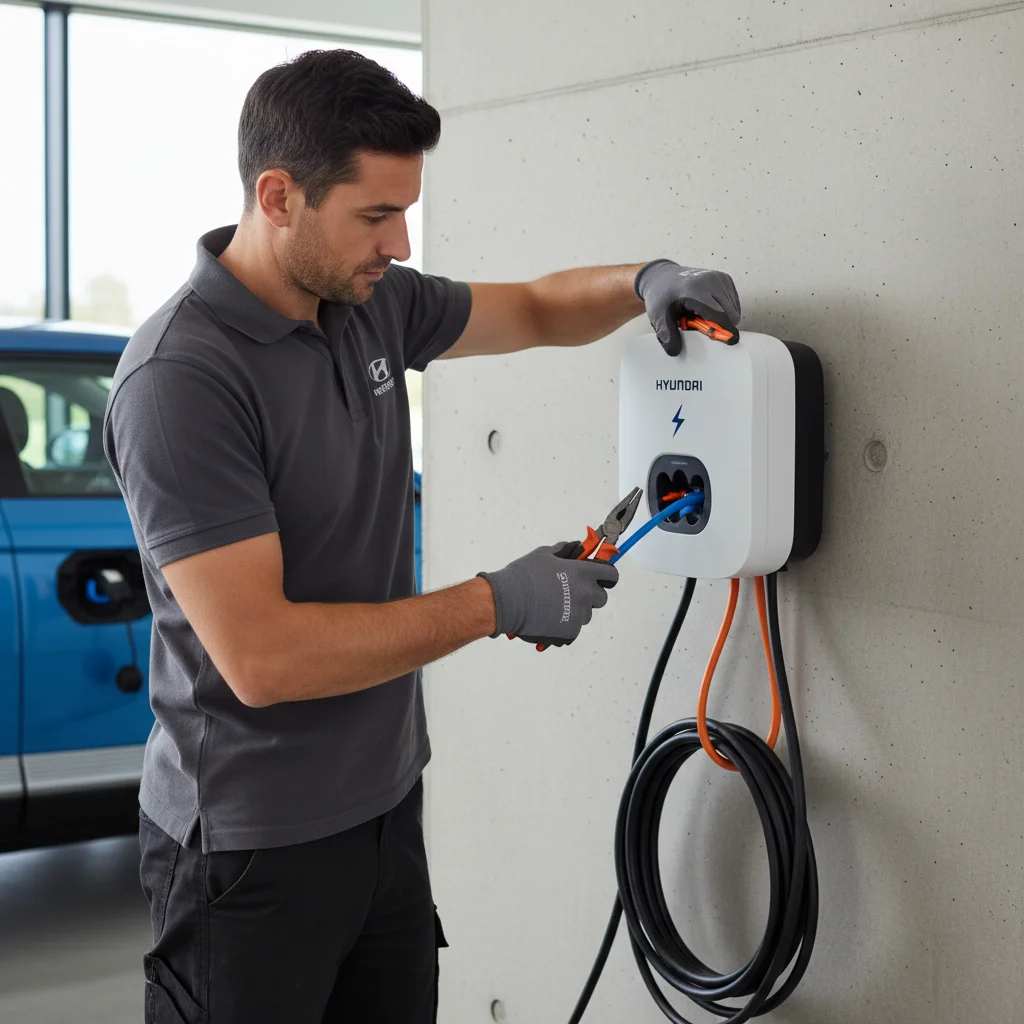
The Ioniq 5 can also feed a household outlet through vehicle-to-load. That’s about 3.6 kW. It runs a tool or a lamp. It isn’t a useful way to fill another EV on the shoulder. If a cable won’t release after a session, that’s a port latch, not an empty pack. Use the in-car release and the physical lever before you assume you need a tow.
The 12-volt pack can fake a dead Ioniq 5
The traction battery is the 58 or 77 kWh unit. A much smaller 12-volt battery still wakes the computers, the contactors, and the charge door. If that 12-volt is dead, the car can look fully dead with plenty of traction energy left. Lights, screens, and the ready state all fail together. That isn’t a 220-mile versus 303-mile problem. It’s a low-voltage problem.
Don’t keep hammering the start button. Check 12-volt symptoms first. Hyundai Ioniq 5 won’t start: the 12V checks to run first walks that sequence. The operators we connect you with can jump or replace a dead 12-volt on site. They also handle Tesla and every major EV brand. A jump is energy at the curb, not a trailer, when the big pack was never empty.
When the traction pack is the one that’s empty
It still happens. A stall is occupied. A session cuts off. A grade used more than the trip computer promised. A beach day ran longer than the morning charge. Stay with the car if you’re on a freeway shoulder. Hazards on. Then decide whether you can reach a named stall with a real reserve. If you can’t, the car needs energy where it sits. That includes the 91, I-5, I-405, SR-22 at the Crush, and SR-241.
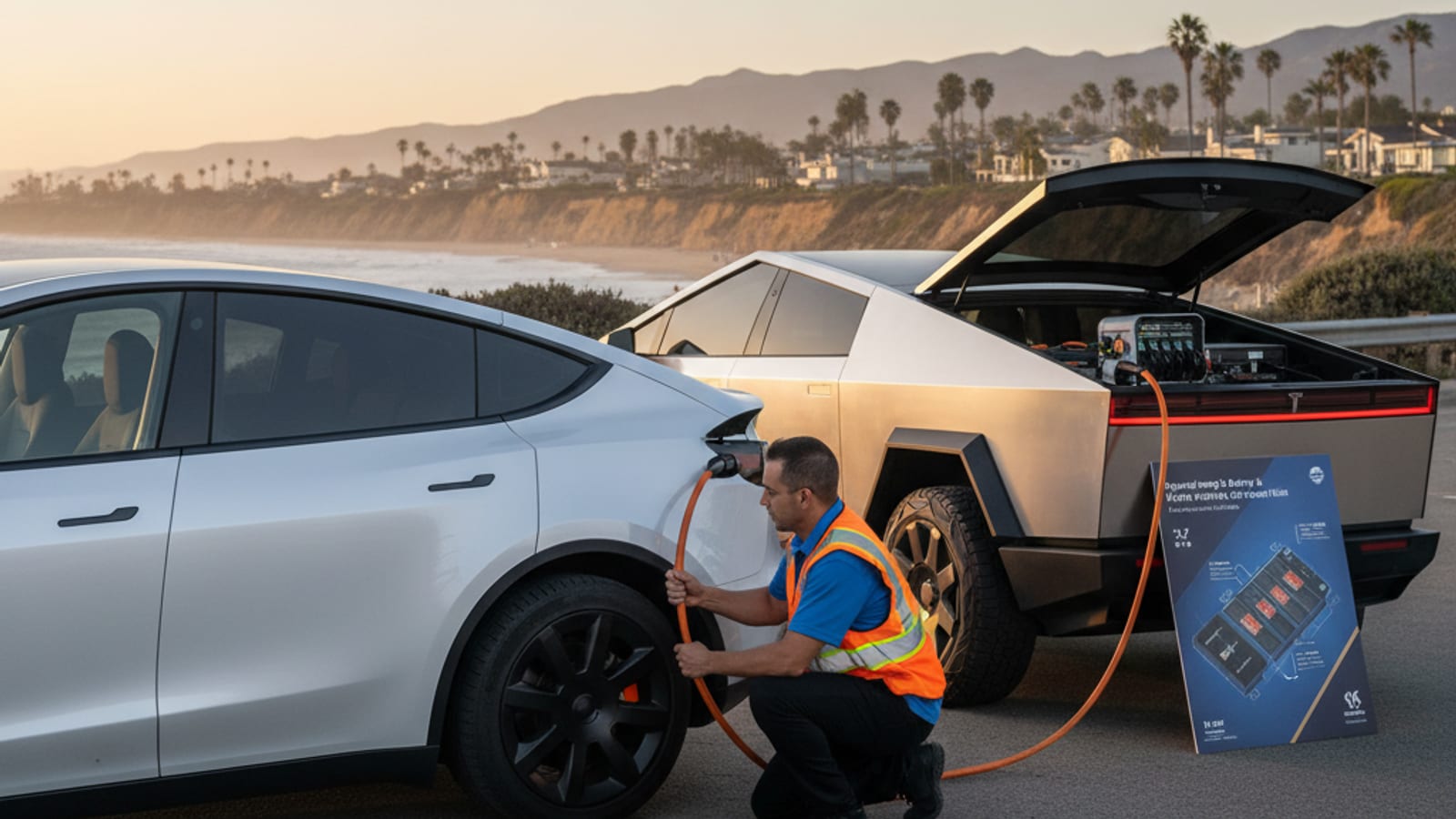
Charge Pro OC is a referral line. It doesn’t own trucks, employ technicians, or set prices. It matches stranded EV drivers with independent local mobile rescue operators. The operator quotes you before starting and bills you directly. What those operators bring is a 240-volt Level 2 source to the car. For an Ioniq 5 that means a CCS or J1772 adapter on a Level 2 lead. Typical charging time adds about 10 to 20 miles of range in 15 to 30 minutes. That’s charging time, not an arrival time. It’s enough to reach a public stall or a home outlet. It isn’t a full 74 kWh fill.
See mobile EV charging and non-Tesla EV rescue for how that matching works in this county. The same playbook covers out of charge recovery when the guess-o-meter is already at zero.
Habits that keep usable kWh closer to the sticker
Keep daily charging in a mid band when you can. Many owners use about 20 to 80 percent for commuting. Save 100 percent for a long day. Sitting at 100 percent in heat is extra stress. Sitting at a very low percent often is extra stress too. This is cell care, not a local rule.
On hot inland days, precondition while you’re still plugged in at home. The pack starts closer to a happy temperature. Tire pressure belongs on the same list. Soft throttle on I-5 and I-405 spends less than a hard launch at every light in Santa Ana. i-Pedal and the regen paddles recover energy you already paid for. That’s useful on a descent off Santiago Canyon or the Newport Coast.
Hyundai’s battery warranty terms weren’t pulled from a verified claims file for this page. Don’t treat a year-and-mile figure here as gospel. Read the warranty booklet in your glovebox. Or confirm current terms on Hyundai’s site for your model year.
Frequently asked questions
What is the Hyundai Ioniq 5 battery size?
Standard Range is 58.0 kWh gross, about 54 kWh usable. Long Range on 2022 to 2024 cars is 77.4 kWh gross, about 74 kWh usable. EPA range is about 220, 303, or 260 miles. That depends on the pack and whether you have all-wheel drive.
What does usable capacity mean on an Ioniq 5?
Usable capacity is the energy the car will actually release for driving. Gross capacity is the full pack. Hyundai keeps a buffer at the top and bottom so cells aren’t parked at empty or at full. On this model the usable figure is about 95 percent of gross. In Orange County, with 36.8 ZEVs per public port, that usable number is the one that has to reach a stall.
How long does a Hyundai Ioniq 5 take to charge?
On Level 2 at up to 10.9 kW, a Long Range pack is about 7 to 8 hours from empty to full. On DC fast charging, 10 to 80 percent can be about 18 minutes at peak rate in ideal conditions. Real cabinets, heat, and a shared stall change that. A mobile 240-volt charge is a smaller top-up: about 10 to 20 miles in 15 to 30 minutes of charging.
If the pack is empty and the car can’t move, call Charge Pro OC at (949) 444-0151. You’ll be matched with an independent operator who quotes before any charging starts.