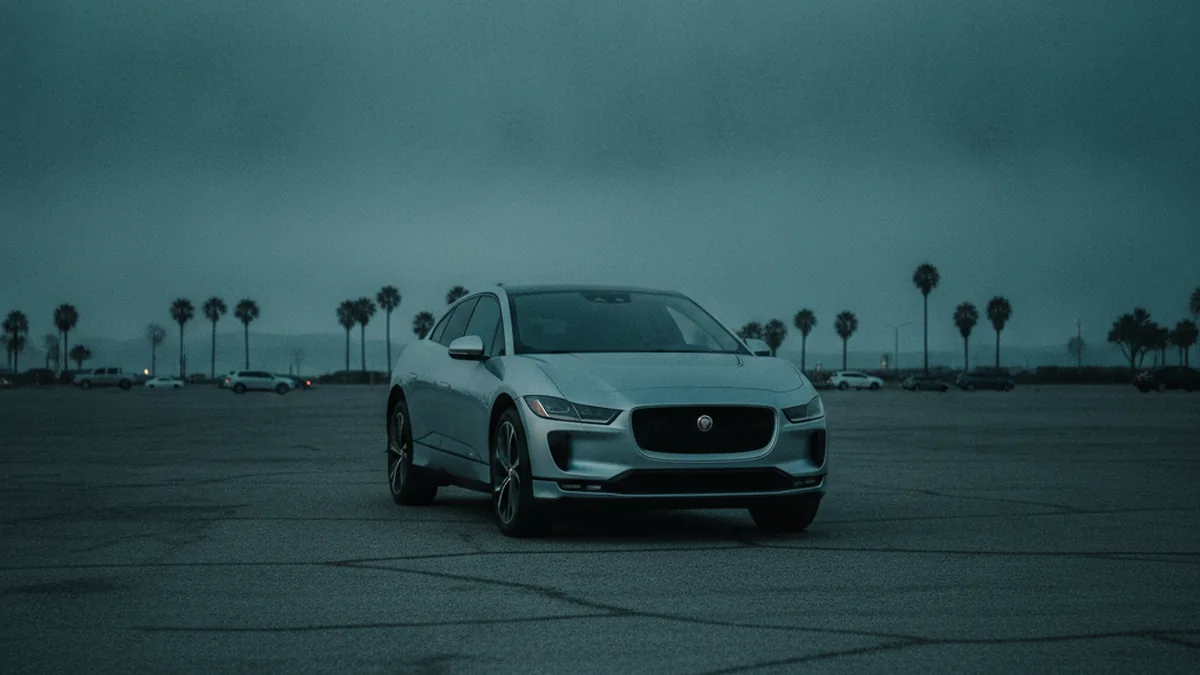
A Jaguar I-Pace that won’t start is usually a dead 12V. That’s true in Orange County lots, not just on paper. The traction pack is often still sitting at a usable charge. The small battery is what wakes the computers and connects the high-voltage system. When it fails, the flush handles stay in. The fob goes quiet and the dash stays black. The 12V itself lives in the frunk. A dead 12V is what keeps that lid latched. Use the metal key and pull the footwell release. Then jump the marked post before you call for a tow.
Orange County had 210,842 battery-electric cars registered as of December 31, 2025. The California Energy Commission counts 138,121 Teslas in that fleet. That’s 65.51% of Orange County’s battery-electric cars. An I-Pace lives in the remaining third. Orange County also holds 12.02% of California’s battery-electric vehicles. It’s 8.33% of the state’s light-duty fleet. Most public DC fast ports here still sit on the Tesla network. They won’t talk to a Jaguar. A dark I-Pace needs a 12V jump first, then a CCS or J1772 path. The operators in this network bring both.
Two systems, and only one of them moves the wheels
The I-Pace splits power the way most EVs do. A high-voltage pack turns the motors. A conventional 12V battery runs locks, screens, and control computers. Those computers have to boot before the pack is allowed to connect.
A car that went dark overnight almost never has a failed traction pack. The 12V just can’t start the wake sequence. Once that small battery has voltage again, the pack is usually still there.
Watch for a 12V pattern, not a pack pattern:
- Flush door handles stay retracted when you walk up
- The fob won’t unlock the car, so the metal key is the way in
- Dash, touchscreens, and cabin lights stay fully dark
- There’s no welcome chime and no lock clunk
If the dash lights, throws a warning, then dies, put the clamps away. That can be a high-voltage fault or a DC-DC converter fault. It needs a Jaguar scan, not another jump. For the same failure on every EV brand, read when the 12-volt dies, why the EV looks completely dead.
Adapters matter here, even after the 12V wakes
Tesla holds 59% of Orange County’s public DC fast ports. That’s 861 Tesla ports against 591 non-Tesla DC fast ports. The source is federal AFDC station data for the county. An I-Pace that won’t start can’t use any of them yet.
US I-Pace cars charge on CCS for DC and J1772 for AC. The operators Charge Pro OC refers carry a 240V Level 2 source. The truck’s native plug is NACS. They also bring a CCS or J1772 adapter for non-Tesla EVs. That adapter is the difference between a useful visit and a wasted one.
Named cabinets still don’t replace a jump. Electrify America at Fashion Island has 8 DC fast ports. That’s 401 Newport Center Dr in Newport Beach. The Tesla site at 24372 Rockfield Blvd in Lake Forest has Magic Dock, CCS1 plus NACS. None of those stalls will present your door handles. See EV charging near Fashion Island if you can already drive.
Once READY is up, check whether the pack is actually low. A Level 2 session at the curb typically adds 10 to 20 miles. That’s in 15 to 30 minutes of charging. That window is charging time, not when someone arrives.
Early I-Pace years use two 12V batteries
Pre-2021 cars hide two 12V batteries under the frunk’s center panel. A weak one can pull the whole low-voltage system down. The jump has to hit the marked positive post. Jaguar revised the layout for the 2021 model year. A 2018, 2019, or 2020 I-Pace is the one to watch.
Inland heat is harder on a lead battery than a coastal street. A frunk in Yorba Linda, North Tustin, or Rancho Santa Margarita soaks all afternoon. Huntington Beach, Newport Beach, and Seal Beach sit in a milder marine layer. A lead battery left low can sulfate, and that capacity doesn’t return. Your EV 12V replacement guide walks through the signs and the replacement path.
Match the post to your model-year manual. The dual setup and the later revision aren’t the same.
Open the door with the key blade, not a pry bar
Flush handles need power. With a dead 12V they sit flat in the door. You can’t grab one the way you grab a regular SUV handle.
The mechanical key is inside the fob. Slide the release and pull the metal blade out. On the driver’s door, push the front of the handle inward. Do that near the small button. The back edge should pivot out. Pull the handle out as far as it travels so the lock cylinder shows. Put the blade in and turn it clockwise.
Don’t lever the handle with a tool. If the cylinder won’t turn, stop. The Taycan version of this lockout is in Porsche Taycan won’t start: a dead 12V and what to do.
Pull the footwell cable, then jump the red cap
The 12V lives in the frunk under a removable center panel. A dead 12V holds the powered latch closed. After you’re in the cabin, check the right-side footwell. A black plug hides the manual frunk-release cable. Pull that cable and the frunk should pop, then lift the center panel. Pre-2021 cars show two batteries, and the positive posts have red caps.
Jump in this order, and only this order:
- Red clamp on the exposed positive post under the red cap
- Black clamp on bare, unpainted chassis metal, not the battery negative
- Let the donor source feed the system for two to three minutes
- Then power up and try to bring the car to READY
Don’t reverse the clamps. Don’t borrow 12V from another EV unless that car’s manual says you can. The brand-agnostic walkthrough is how to jump start an electric car without making it worse.
If READY comes up, leave the car awake. That lets the DC-DC converter support the 12V. Drive to a CCS cabinet only if you still need range. If a clean jump leaves it dark, you’re done with DIY. Call for a road check or a Jaguar-capable tow.
Read the car before you pick a next step
| What you see | Most likely cause | Next move |
|---|---|---|
| Handles stay in, dash dark, no chime | Dead 12V | Key entry, footwell release, jump the marked post |
| Screens wake, warn, then shut off | High-voltage or DC-DC fault | Stop jumping. Get a dealer scan. |
| It starts, then dies again in a few days | 12V near the end of its life | Load test and plan a replacement |
| A clean jump doesn’t wake it | Deeper electrical fault | Road diagnosis or a Jaguar-capable tow |
| Dead in a garage with no second car | No donor source on site | Call non-Tesla EV rescue with a jump pack |
A busy Tesla site in Anaheim or Garden Grove doesn’t rewrite that table. Those stalls still won’t boot a Jaguar.
Where this happens on Orange County streets
Coastal north county and inland north county already feel different. The central cities, east county, and south county do too.
Irvine office parks and Spectrum garages drain a 12V that sat on accessories all day. Costa Mesa parking structures near the mall do the same overnight. Newport lots around Fashion Island put you near that Electrify America cabinet. You still can’t plug in until the 12V boots.
Anaheim theme-park and stadium lots leave a dark car in full sun. Buena Park auto row is a long wait in that case. That’s if you’re hoping a stranger knows Jaguar jump points. Santa Ana street parking and older garages often mean there’s no second car for cables.
HOA streets in Mission Viejo, Lake Forest, Aliso Viejo, and Ladera Ranch add a gate code. An operator who can come inside the gate is the useful call. Hillside driveways in Yorba Linda and North Tustin add grade and a tight pad. Coto de Caza and similar gated streets want a quiet on-site jump.
I-5 south of Irvine and I-405 are poor jump sites. So are the 91 through north county and SR-22 at the Orange Crush. Don’t pull a frunk panel in that traffic. Santiago Canyon Road and Ortega Highway are worse for experimenting. Stay with the car, use the manual key, then get an operator to the shoulder.
A coastal climb on Laguna Canyon Road can empty a pack while you’re moving. A no-start in the driveway after you’re home is still the 12V. Don’t treat those as the same failure.
Charge Pro OC is a referral line. It matches stranded drivers with independent local operators. It doesn’t own trucks, employ technicians, or set prices. The operator quotes you before work starts and bills you directly. The pros we connect you with are licensed. Not in a Tesla? Who to call for EV rescue in Orange County is the wider CCS and J1772 map.
When to stop and call
Stop if the key won’t turn in the cylinder. Stop if the footwell cable doesn’t pop the frunk. Stop if a correct jump leaves the screens dark. Forcing a flush handle or the wrong terminal can break a latch you still need.
Stay in a safe spot on a freeway shoulder. Let an operator bring the jump pack and the adapters. If the 12V comes back and range is truly low, stay put. They can add that 10 to 20 miles of Level 2 at the curb. Then you drive to a CCS cabinet. A tow is the last move, not the first.
Frequently asked questions
Why won’t my Jaguar I-Pace start?
A dead 12V is the usual cause, not a drained traction pack. The I-Pace needs that small battery to boot the computers. Flush handles stay in and the fob does nothing, so jump the 12V first. If a clean jump still leaves it dark, it needs a dealer-level scan.
How do I get into an I-Pace when the handles won’t present?
Use the metal key inside the fob. Push the front of the driver’s handle inward so the back pivots out. Pull the handle out to uncover the lock cylinder. Turn the blade clockwise to unlock the door. That works with no power in the car. If the cylinder won’t turn, don’t force it.
Where is the I-Pace 12V, and who jumps it here?
It’s in the frunk under a removable center panel. The positive posts have red caps. Pre-2021 cars have two batteries there. Open the frunk with the manual cable in the right-side footwell. Do that after you unlock the cabin. Local operators can jump that post and load-test the battery. They can add a 240V charge if the pack is also low.
If your I-Pace is dark in an Irvine garage, run the 12V checks above. Same for a Newport lot or a hillside driveway in Yorba Linda. If you can’t get in, or a jump doesn’t wake it, call Charge Pro OC. The number is (949) 444-0151. We’ll connect you with a local operator who carries the adapters.