If the car will drive after a charge, you want mobile EV charging. If it won’t, you want a flatbed. A stall on SR-241 just removes a third option people expect. Published Freeway Service Patrol coverage skips the toll roads. That shoulder needs another call.
Charge Pro OC is a referral line. We match stranded EV drivers with independent local operators. We don’t own trucks, and we don’t send a hook. The operator quotes you before a cable goes in. Then they bill you directly.
Start with what failed, not with the map
A hook and a plug both get a stranded car off a shoulder. They don’t fix the same failure.
If the car can drive once it has range, mobile EV charging is the job. There’s no crash and no smoke. The dash isn’t showing a high-voltage warning. You’re empty. That’s out-of-charge recovery, not a shop visit.
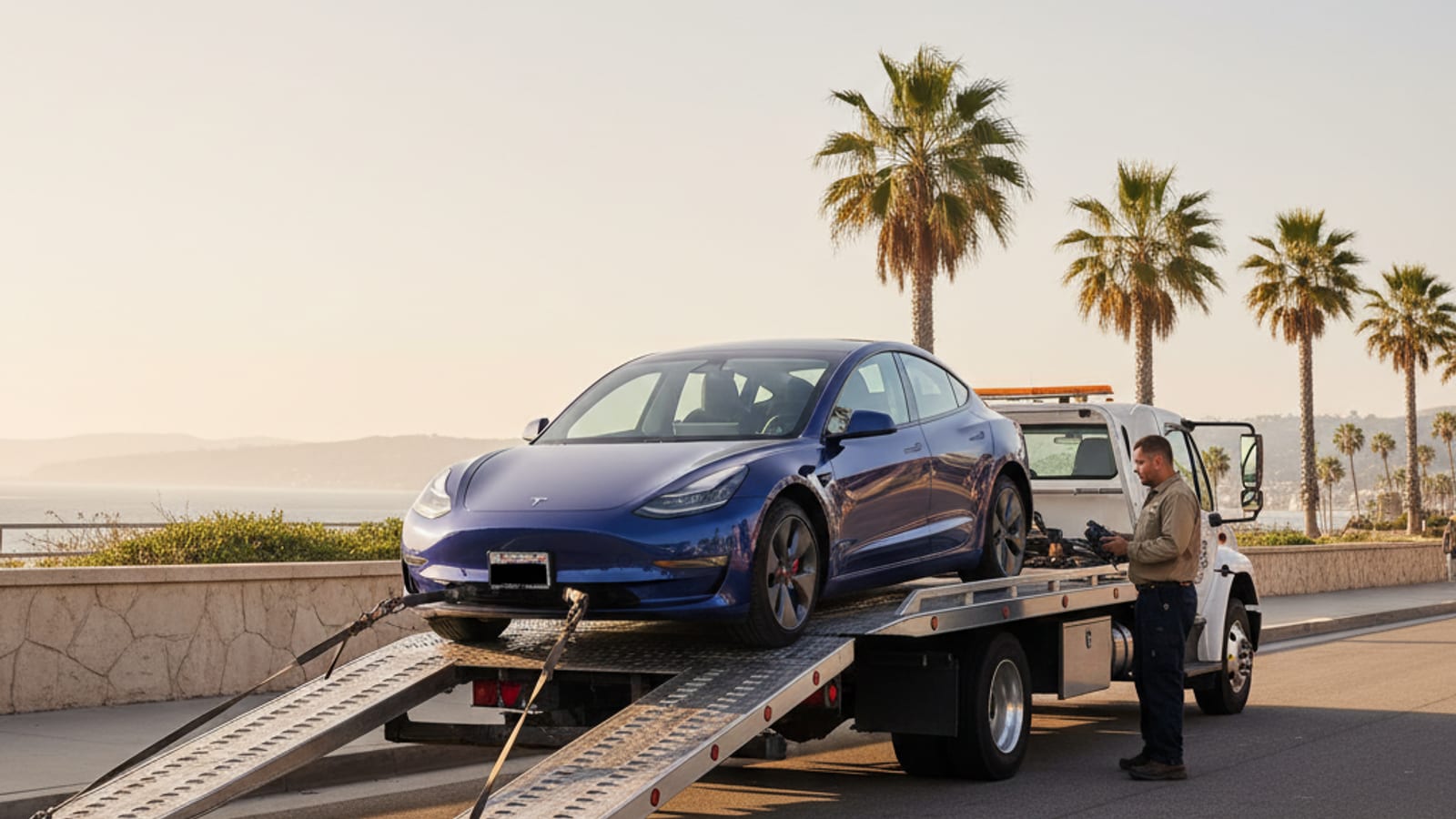
If the car still can’t move with range restored, a flatbed is the honest path. Crash damage, a bent wheel, or airbags that fired all belong on a hook. So does a high-voltage warning triangle. So does smoke, a burning smell, or a leak. A 12-volt that stays dead after a jump belongs there too when the main pack is also silent.
For the mixed case, describe the symptoms on the phone. The operator will say whether they can work at the car. If they can’t, they’ll tell you to call a tow.
Why a toll-road stall needs a different number
Orange County’s published FSP list doesn’t include the toll roads. A stop on SR-241 isn’t a Freeway Service Patrol event. Don’t wait for a truck that was never assigned to that pavement.
Drivers on I-5, the 405, the 91, or SR-22 sometimes start with FSP out of habit. Even there, an empty EV still needs range or a flatbed. The toll roads just make that first habit a miss. Stay in the car. Keep the hazards on. Don’t walk a live lane looking for a plug.
The rest of the choice matches any Orange County freeway stall. Either the car can drive after a top-off, or it needs a wrecker.
When the charge at the car is the right job
The operator brings a 240-volt Level 2 source to your port. Teslas take a native NACS plug. Other brands use a CCS or J1772 adapter. Once the cable is in, a typical session adds about 10 to 20 miles of range. That takes 15 to 30 minutes of charging. It isn’t an arrival time.
Those miles are usually enough to roll to a stall you already had routed. AFDC records show 48 Tesla Supercharger sites in Orange County, with 861 DC fast Tesla ports. Irvine’s site at 1920 Main Street has 40 stalls. San Clemente’s Avenida Vista Hermosa site has 49. A short Level 2 session is how you use them without a hook.
Non-Tesla DC fast is on the same map. AFDC counts 591 of those ports in the county outside Tesla. Electrify America lists 12 DC fast ports at 25825 Las Vegas in Capistrano Beach. It lists 10 at the Euclid Walmart in Anaheim. EVgo lists 14 at Plaza Antonio in Rancho Santa Margarita. Lake Forest’s Magic Dock Supercharger lists CCS1 plus NACS. If you’re not in a Tesla, say so on the call. The operator brings the adapter.
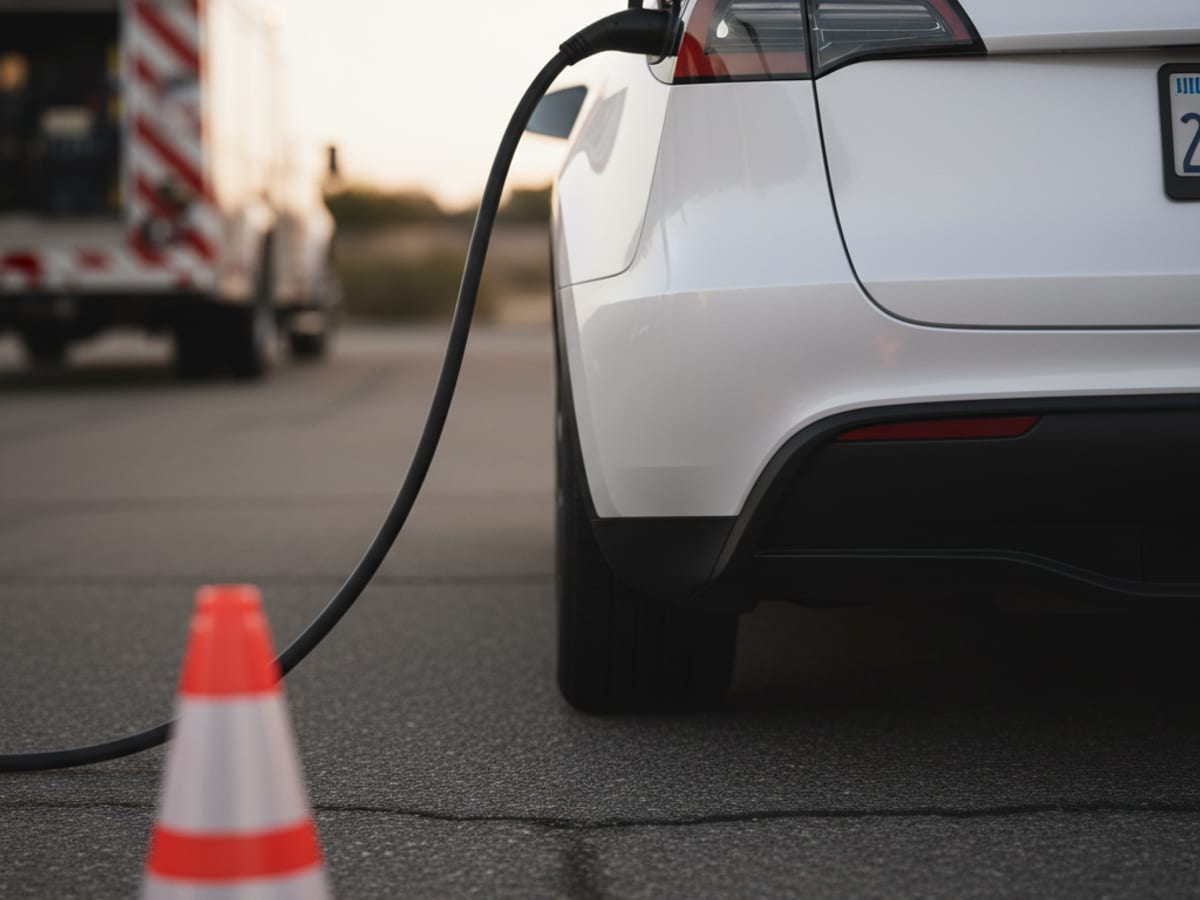
A public stall that never starts a session follows the same pattern. You arrived with a sliver of range. The handshake failed, or the cabinet sat dark. A tow would haul you to another lot, and you’d still sit there and charge. The operator plugs into the car instead, skips the dead cabinet, and adds enough range to leave.
A garage that won’t wake is the quiet version. Morning comes with a black screen. Often the 12-volt is flat. Operators can jump or replace that battery on site, then top the pack if it’s low. One visit at the driveway beats a flatbed in a tight HOA garage.
When a tow is still the right job
Towing a dead EV is the last move when the car can still drive. It’s the first move when it can’t. Call for a flatbed for crash damage, a wheel that won’t roll, or airbags that fired. Call for smoke, a burning smell, or fluid on the pavement. Call for a high-voltage warning on the dash. Call for a tire that won’t hold air. Call for a motor fault that blocks Ready.
A Tesla with a depleted pack is a special case, not a covered tow. Tesla’s own roadside policy answers an empty battery with transportation, not charging at the car. Tesla also says that depleted-battery help isn’t a financially covered service. The 500-mile transport Tesla publishes is for a warrantable breakdown that leaves the car undrivable. Running to zero sits outside that. Tesla can still arrange a move to a charger. It’s a paid move, and it still ends with a charge. If the car will drive after a top-off, on-site charging skips that chain.
Tesla’s owner’s manual notes another wrinkle. The low-voltage battery can lose support once range is gone. The car may look fully dead. A 12-volt jump plus a pack charge is often the sequence. A hook is what you want if that sequence fails. The charge, jump, or tow choice follows the same symptoms in a driveway.
Freeway shoulders, lots, and canyon grades
On a state freeway shoulder, stay put if the car is otherwise healthy. I-5 south of Irvine sees empty-pack stops. So do the 405, the 91 through North County, and SR-22 at the Crush. Theme-park days around Anaheim drain packs in parking structures. Beach lots in Huntington Beach and Newport Beach do the same after a long afternoon.
Canyon grades are a different energy budget. Santiago Canyon Road, Ortega Highway, and the climbs off Laguna Canyon eat range faster than a flat commute. Don’t hunt a stall on foot after dark. Stay with the car. If the operator can reach you and the car will drive after a charge, keep the work on site. If the car is against a guardrail or in a ditch, you want a wrecker with a winch.
Gated streets in Coto de Caza and Ladera Ranch add a gate code, not a different physics. Tell the operator how to get in. A truck at the driveway keeps the work on site. A flatbed has to clear the same gate, then you still need a charge.
Why this fork shows up so often in Orange County
The California Energy Commission counted 210,842 battery-electric cars in Orange County as of December 31, 2025. That’s 8.54 percent of the local light-duty fleet. ZEVs as a group are 10.56 percent. The county holds 12.02 percent of California’s battery-electric vehicles. It makes up 8.33 percent of the state’s light-duty fleet.
CEC’s December 2025 charger file lists 7,095 public ports in Orange County. That’s 36.8 ZEVs per public port. Statewide the same math is 24.4. Tesla still dominates the local BEV fleet. CEC’s make field shows 138,121 registered Teslas, 65.51 percent of county BEVs. Tesla’s published roadside answer for a depleted pack is a ride, not a truck with a plug.
Those figures don’t tell you what you’ll pay. They tell you why the charge-or-tow fork keeps coming up here. The operator still quotes the visit before they start. What goes into a mobile EV charging quote names the parts of that conversation. No honest page can print a number from here.
How to choose in the moment
Look at the car, not the map. If it will drive with range, you want a charge. If it won’t, you want a tow. Smoke, a warning triangle, or crash damage ends the debate.
Treat an empty pack and a dead 12-volt as on-site work until they prove otherwise. The operator can jump the 12-volt and feed the pack on the same stop.
Don’t wait on FSP on a toll road. That coverage isn’t published there. Call a mobile operator or a tow. Don’t stand in a lane.
Skip the cost guess. The operator prices the visit before they start. A tow still needs a charge at the other end. You’re stacking two jobs when one would’ve done.
What to tell the operator
Have this ready when you call. Where you are, including the toll road name. Whether the dash still wakes. The last range you saw. Tesla or another brand, plus the port type. A gate code, structure level, or shoulder marker. Any warning lights, smells, or leaks.
Charge Pro OC connects you with local mobile rescue operators. They handle Tesla and every major EV brand. If the symptoms point to a tow, say so on the call. We won’t pretend a cable fixes a bent control arm.
If you’re on an Orange County shoulder right now, call (949) 444-0151. Tell them where you are and what the dash is doing. The operator quotes the job before any work starts.