A Nissan Ariya that won’t start in Orange County is usually a 12-volt fault. The dash stays dark and the fob goes quiet. The traction pack may still hold range. If that pack is actually empty, you still need CCS or J1772 at the car. A Tesla Supercharger won’t charge a North American Ariya.
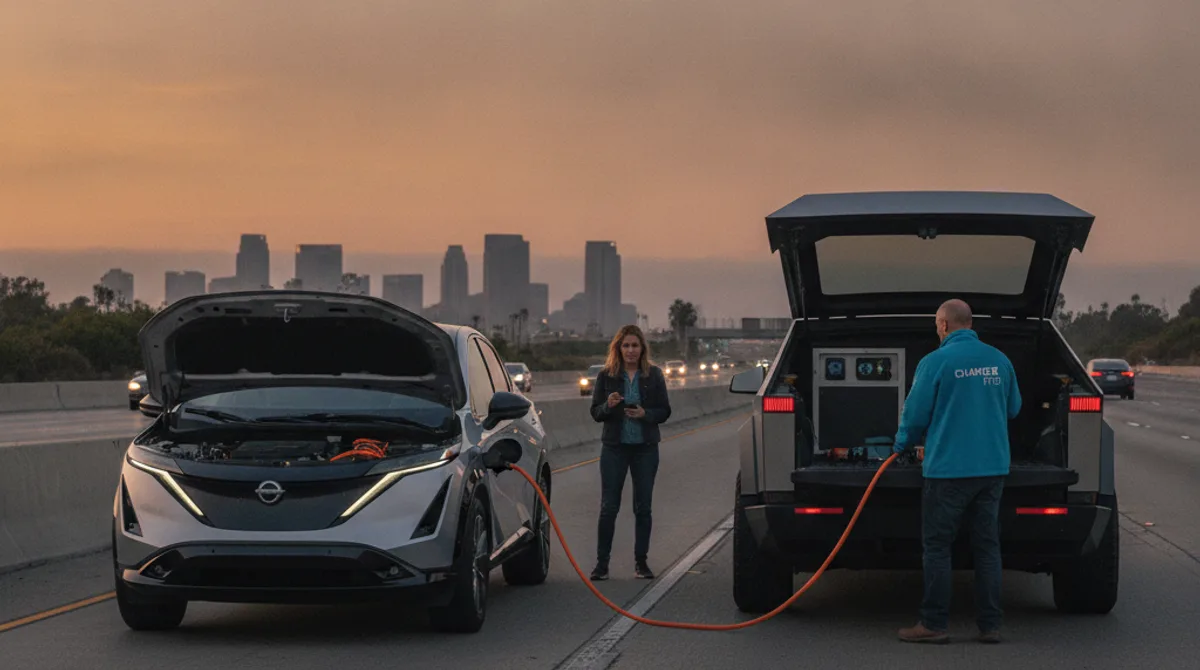
Start with the dash, not a Supercharger hunt
Every production EV runs two systems. The high-voltage pack drives the motors. A smaller 12-volt battery runs locks, screens, and the computers that let the pack wake. When the 12-volt dies, the Ariya won’t enter Ready. Miles left in the pack don’t help until those computers boot.
The Ariya is Nissan’s electric crossover, sold in the US since 2023. It uses a normal front hood, not a latched frunk. That makes the 12-volt easier to reach than on a Tesla. It doesn’t change the inlet. North American cars still use CCS Combo for DC fast and J1772 for Level 2.
Read the cluster before you walk the lot.
| Dash state | Likely cause | First move |
|---|---|---|
| Completely dark, no fob response | 12-volt is dead | Jump under the hood |
| Cluster flashes, then goes black | Module boot loop | 12-volt power cycle |
| Normal boot, warning, no Ready | Software or high-voltage fault | Power cycle, then a dealer scan if it stays |
| Locked charge-port icon | Latch error | Power cycle, then inspect the port |
| Doors unlock, cluster stays dim | 12-volt is low, not empty | Jump, then see if voltage holds |
A black screen isn’t proof the pack is empty. Jump first. Tow second. If you also run a Leaf, the Nissan Leaf no-start checks follow the same 12-volt logic.
Orange County’s charging map is Tesla-heavy
As of December 31, 2025, the California Energy Commission counted 210,842 battery-electric vehicles in Orange County. Tesla accounted for 138,121 of them, 65.51% of the BEV fleet. Countywide ZEVs were 260,833, or 10.56% of light-duty vehicles. Orange County holds 12.02% of California’s battery-electric cars. It makes up 8.33% of the state’s light-duty fleet.
That Tesla share shapes what you can plug into. AFDC data for Orange County shows 1,452 public DC fast ports. Tesla Superchargers hold 861 of those ports at 48 sites. Remove Tesla and you get 175 stations and 591 DC fast ports. Electrify America has 30 stations and 138 ports. EVgo has 30 stations and 131 ports. ChargePoint has 71 stations and only 76 DC fast ports. Many of those are single-plug dealership or office units.
For an Ariya, the big Tesla canopies are the wrong inlet. That includes Anaheim, Irvine, Garden Grove, Tustin, and San Clemente. You need CCS or J1772, or a 240-volt charge at the bumper. The county has 7,095 public ports of all levels. That works out to 36.8 ZEVs per public port, versus 24.4 statewide. Stalls get busy on weekends. Busy isn’t a reason to walk a silent Ariya to a Tesla plug it can’t use.
The 12-volt battery lives under a regular hood
Pop the hood like any gas-powered Nissan. The 12-volt battery and jump terminals are there. There’s no frunk latch. There’s no hidden cabin release to hunt at night.
Clamp a jump pack to the 12-volt positive terminal. Put the negative clamp on a clean chassis ground under the hood. Let the modules sit for 60 to 90 seconds. Then press the power button. Follow the clamp order in the guide to jumping an EV on site.
If it starts and dies again within a few minutes, the 12-volt cell is likely worn. A jump gets you moving. It doesn’t replace the battery. The 12-volt replacement signs and steps explain when a swap is next. Independent operators in the Charge Pro OC network can jump a 12-volt at the car. They can replace one when that’s the job you agree to.
Software hangs, parked drain, and a stuck charge port
Control-module software can block high-voltage startup even with a full pack. Connectivity modules also sip 12-volt power while the car sits. A long weekend in an Irvine apartment garage can finish a weak 12-volt. Several nights on a Huntington Beach street can do the same. Then the computers won’t boot.
A software no-start doesn’t look like a brick. The dash may flash once and quit. The car may boot, show a system warning, and refuse Ready. The port may show a lock and hold the connector. The power button may do nothing while the screens look almost normal.
The field reset is a 12-volt power cycle. Disconnect the negative terminal for about two minutes. Reconnect it. Let the modules come up. Try a normal start. That often clears a stuck boot and a latch fault. If high-voltage warnings remain, stop. That’s a Nissan dealer diagnostic, not a parking-structure experiment.
Don’t confuse a latch error with an empty pack. If the connector won’t release, cycling 12-volt power is the first try. Persistent port faults still belong at a dealer.
If the pack is empty, you still need CCS or J1772
Jumping the 12-volt won’t add range. An empty traction pack needs energy at the charge port. North American Ariya cars take CCS Combo for DC fast and J1772 for Level 2. They don’t take a Tesla Supercharger plug. The exception is a Magic Dock stall that actually presents CCS1.
One Tesla site in the AFDC file lists CCS1 plus NACS. That’s Lake Forest at 24372 Rockfield Blvd. Confirm the connector on the stall before you rely on it.
Other CCS banks sit in the same federal station data. Electrify America at 440 N Euclid St in Anaheim has 10 DC fast ports. Electrify America at Fashion Island, 401 Newport Center Dr in Newport Beach, has 8. Electrify America at 25825 Las Vegas in Capistrano Beach has 12. EVgo at 22351 Antonio Pkwy in Rancho Santa Margarita has 14. EVgo at 638 Camino de los Mares in San Clemente has 10. EVgo at 801 Pacific Coast Hwy in Seal Beach has 4 stalls. Those help when the Ariya can still roll in. They don’t help if it won’t move.
When the car is stuck, out-of-charge recovery is the on-site path. Charge Pro OC matches you with independent operators. They bring a 240-volt Level 2 source to the bumper. For an Ariya they use a CCS or J1772 adapter. Typical charging time is 15 to 30 minutes for about 10 to 20 miles of range. That figure is time on the cable. It isn’t an arrival window. The operator quotes you before work starts and bills you directly.
Use non-Tesla EV rescue when you’re in a CCS crossover. Mobile EV charging is the 240-volt visit itself.
Where Orange County Ariya drivers get stuck
North county lots. Anaheim theme-park and stadium days mean hours parked on Lincoln, Katella, and Harbor. Tesla Superchargers at 1128 W Lincoln Ave and 1734 W Lincoln Ave won’t feed an Ariya. Neither will 2270 E Lincoln Ave or 2404 E Katella Ave. Fullerton’s sites at 1475 S Harbor Blvd and 220 E Orangethorpe Ave are Tesla as well. Buena Park’s 6940 Beach Blvd and 8888 Knott Ave stalls are the same inlet problem. If the 12-volt sagged in the lot, jump it there. If the pack is empty, you need CCS or a truck at the car.
Freeway shoulders. An empty Ariya on the 91 should stay put. So should one on SR-22 at the Orange Crush, on I-405, or on I-5 south of Irvine. Don’t roll a silent EV across lanes looking for a plug. Stay on the shoulder. Call for a 12-volt jump or a CCS charge at the bumper.
Coast lots. A long Huntington Beach or Newport Beach day can take a weak 12-volt down overnight. Costa Mesa airport-area structures do the same when a car sits for a flight. Fashion Island’s Electrify America bank is a CCS option if you can still drive. If you can’t, stay with the car.
South county garages. Irvine office parks around Michelson, Barranca, and the Spectrum leave cars sitting. Workplace chargers fail or stay occupied. Mission Viejo and Lake Forest HOA garages add gates and tight ramps. The Lake Forest Magic Dock is the Tesla site to double-check for CCS1. San Clemente beach parking stays crowded even with large Supercharger sites at Avenida Vista Hermosa. Those Superchargers still won’t charge an Ariya.
Hills and canyons. Yorba Linda grades and North Tustin driveways add load on the way home. Canyon roads do too. Check for CCS or J1772 before you assume a nearby Tesla canopy is your outlet. If the car is already silent, stay with it. Get a charge or a 12-volt jump on site.
What Charge Pro OC actually does
Charge Pro OC is a referral line for Orange County. It matches stranded EV drivers with independent local mobile rescue operators. It doesn’t hold a contractor license, own trucks, or employ technicians. It doesn’t set prices or publish hours. The operator who takes the job brings 240-volt Level 2 charging. They also bring CCS or J1772 adapters for non-Tesla EVs, plus 12-volt jump gear. They handle Nissan and every major EV brand. The pros we connect you with are licensed. You hear the quote before anything starts.
If you already jumped the 12-volt and cycled the negative terminal, say so on the call. It keeps the visit on the remaining problem. That may be a worn 12-volt, a latch, or an empty pack that still needs CCS.
For the countywide CCS picture, non-Tesla EV rescue in Orange County is the companion read.
Frequently asked questions
How do you jump start a Nissan Ariya?
Open the hood and find the 12-volt battery. Connect the jump pack’s positive clamp to the positive post. Connect the negative clamp to a chassis ground nearby. Wait 60 to 90 seconds, then press the power button. Don’t use another EV as a donor unless you know both 12-volt systems allow it.
Can a Nissan Ariya refuse to start with a full traction pack?
Yes. A control-module hang or a charge-port latch can block Ready while the pack shows plenty of range. Disconnect the 12-volt negative for about two minutes, reconnect, and retry. If warnings remain, stop and get a Nissan dealer scan.
What if the Ariya is empty, not just dark?
A 12-volt jump won’t add miles. You need CCS or J1772 at the car. You can also drive to a CCS fast site if it will still roll. Tesla Superchargers in Orange County won’t charge an Ariya unless a Magic Dock stall actually presents CCS1. If the car can’t move, a mobile 240-volt charge is the on-site option.
If your Nissan Ariya won’t start anywhere in Orange County, call Charge Pro OC at (949) 444-0151. An independent operator quotes a 12-volt jump, a power cycle, or a CCS charge at the car. That quote comes before work begins.