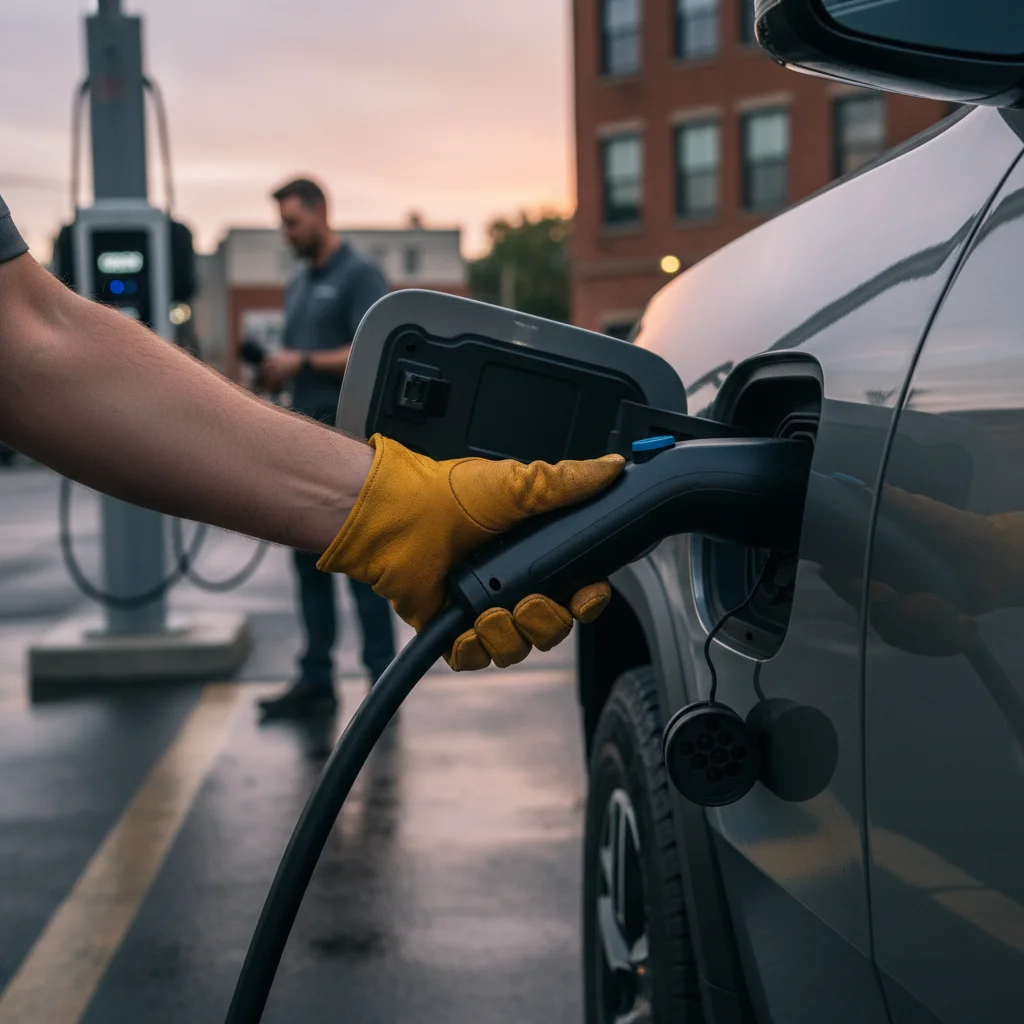
The cable is still locked in the port. Your Rivian session at the Lake Forest Magic Dock is over. Those CCS1 stalls sit at 24372 Rockfield Boulevard, on a Tesla Supercharger site. Federal station data lists 16 DC fast ports there, up to 325 kW. The handle won’t click free, and the latch isn’t listening. The packed NACS stalls beside you don’t retract your pin. A frozen Rivian port at a busy Supercharger site still needs a manual release.
A locked pin, not a dead truck
Your R1T or R1S holds the CCS handle with a motorized pin. When the session ends, that pin should pull back. Sometimes the car never gets the done message. Sometimes the pin moves and the door still binds. Either way, you’re tied to that stall until the latch lets go.
Orange County had 210,842 battery-electric vehicles on the road as of December 31, 2025. The California Energy Commission is the source for that fleet count. Tesla accounts for 65.51% of those county BEVs. The rest of the battery-electric fleet includes Rivian trucks and SUVs. They share the same public map as the Tesla majority. Countywide, Tesla holds 59% of public DC fast ports. Rivian drivers often land on CCS stalls beside a Supercharger. They also use Magic Dock stalls built into a Tesla lot.
That’s why this jam shows up in crowded Orange County lots. Irvine’s Supercharger at 1920 Main Street lists 40 stalls. Garden Grove’s site at 12891 Harbor Boulevard lists 32 stalls. The Tustin Supercharger on Franklin Avenue lists 36 stalls. San Clemente’s Avenida Vista Hermosa site lists 49 stalls. You can sit next to all that Tesla hardware. You can still be locked to a CCS cable. For plug types on local roads, read what charger a Rivian needs in Orange County.
Start with the software, not the frunk
Before you pull trim, check whether the car still thinks it’s charging. A software lock looks like a mismatch on the screens. The port light stays blue, or solid green, after you meant to leave. The center display still shows a live session. The Rivian app says charging when the kilowatts already read zero.
Lock the truck, then unlock it, and give the latch a second look. Use the fob, the phone key, or the card. Run that cycle a few times before you open the frunk. The body computer often rechecks the port and drops the pin.
If you’re on a public unit, end the session from the cabinet too. Electrify America, EVgo, and ChargePoint each have a screen or an app. Tesla’s Magic Dock has a screen as well. The handshake can hang on the station side after the truck is done. Stopping it there beats guessing at the handle.
If you’re parked and safe, you can soft-reset the screens. Hold the far-left and far-right steering-wheel buttons together. Keep holding about 15 seconds, until the displays go dark. Let them reboot, then try the handle again. Don’t run that reset in a live travel lane. Use a stall or a legal parking space.
If you hear grinding or a dry click at the port, stop cycling. That’s closer to a mechanical bind than a software glitch. The frunk cable is the next move, not another reboot. The same latch logic shows up on other brands. Our guide to a stuck EV charge cable covers the shared checks.
The frunk release on an R1T
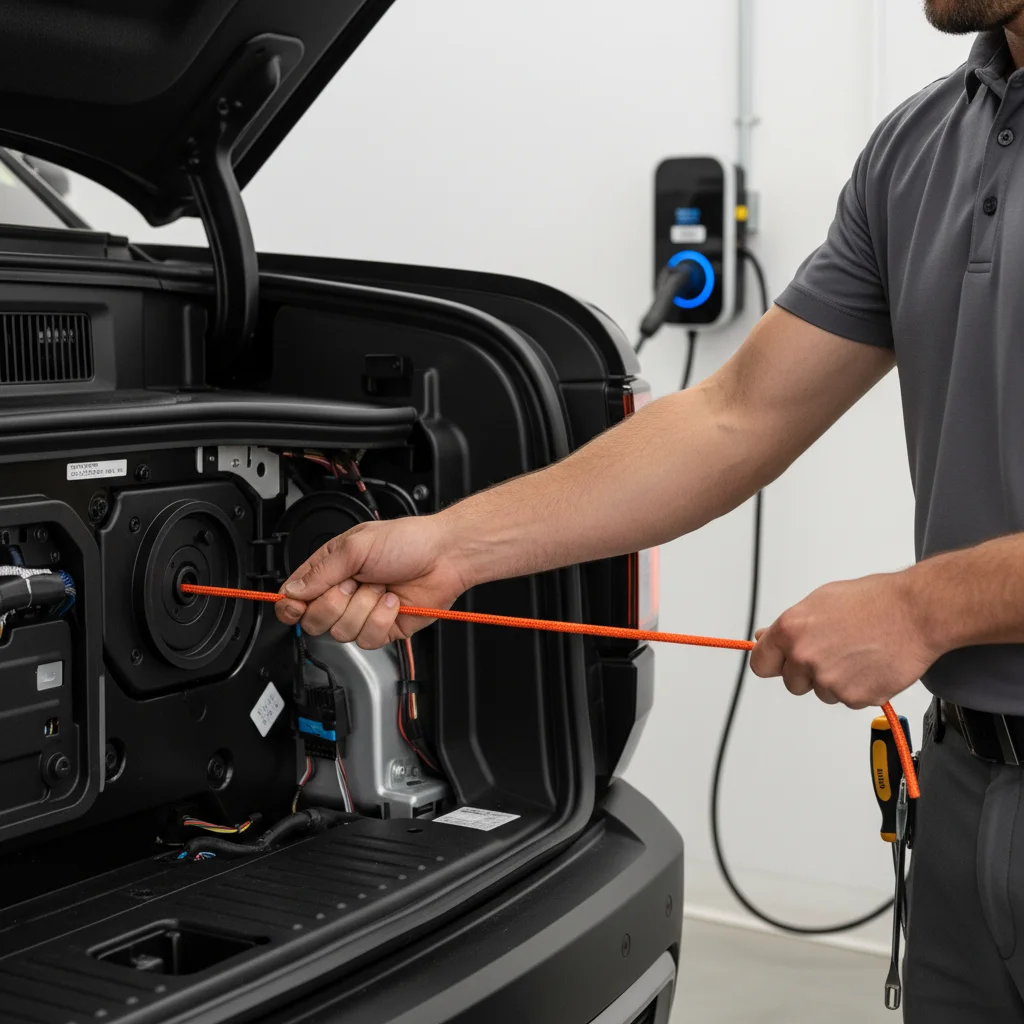
Rivian hid a mechanical backup in the front trunk. You don’t need a shop for this pull. You’ll need light and a minute of patience.
Open the frunk and stand on the driver’s side. Stay near the hinge, close to the cabin wall. Look for a small rectangular plastic panel on that wall. Pop it with your fingers if it gives. If it fights you, use a plastic trim tool. A cloth-wrapped flat screwdriver works if that’s all you have. Don’t scratch the paint around that panel.
Inside the opening is a short cable with a loop. Many trucks mark it with a bright green or yellow tag. Pull the loop firmly toward the front of the truck. Use steady pressure, not a jerk on the loop. You want a clunk at the charge port. That clunk is the pin retracting from the handle. Then walk back and lift the handle straight out.
The same pull on an R1S
The SUV uses the same idea with a slightly different panel. Open the frunk and stay on the driver’s side wall. On the R1S the panel usually sits a bit higher. It also sits farther back than the truck’s cover. Pop it and find the tagged loop inside. Pull toward the nose until you hear the port clunk. Then unplug the handle and close the door.
If the loop moves and you hear nothing, don’t keep yanking that wire. The actuator or the pin may be bound past what the cable can free. Forcing it can snap the loop and leave you worse off.
Supercharger-adjacent lots don’t unstick a latch
A busy Tesla site is a crowd, not a repair. Anaheim’s Electrify America at the Walmart at 440 North Euclid has 10 DC fast ports. Tesla Superchargers sit on Euclid, Lincoln, and Katella in the same city. You can finish a CCS session in that mix. You’ll still need the frunk pull after the session ends.
Fashion Island’s Electrify America at 401 Newport Center Drive has 8 DC fast ports. Newport Beach’s Supercharger at 4241 MacArthur Boulevard is the Tesla cluster nearby. Those stalls can sit full while your handle stays locked. The latch still only answers your truck, not the lot.
Lake Forest is the cleanest local example of this mix. The Rockfield Magic Dock is CCS1 plus NACS on a Tesla lot. The Muirlands Supercharger at 24301 Muirlands Boulevard has 24 stalls. None of that hardware retracts your Rivian’s pin. If you’re in an HOA garage off those arterials, the same latch rules apply. See Lake Forest EV charging and on-site rescue when the car won’t roll.
Electrify America in Capistrano Beach lists 12 DC fast ports at 25825 Las Vegas. That’s the largest non-Tesla DC fast site in south Orange County. EVgo at Plaza Antonio in Rancho Santa Margarita lists 14 DC fast ports.
Countywide, the Energy Commission counted 7,095 public charging ports as of December 31, 2025. That’s 36.8 ZEVs per public port, versus 24.4 statewide. Orange County is worse served per EV than the state average. A locked handle blocks the one you’re in. It also blocks the next driver waiting for that cabinet. Free the cable, then move the truck off the stall.
The same federal extract lists 2 Rivian Adventure stations in Orange County. Those two sites carry 22 DC fast ports. It also lists 175 non-Tesla DC fast stations and 591 non-Tesla DC fast ports. Those are the CCS sites Rivian drivers actually use. They don’t include a remote unlatch for your inlet.
If the station won’t let go
Sometimes the car is ready and the cabinet isn’t. After the software cycle and the frunk pull, look at the station. Many cabinets print the network support number on the door. Call that number and describe the locked connector. Ask them to end the session from their side. They can often send a remote reboot to the cabinet.
Don’t twist the handle to lever it out. Don’t put a foot on the fender and haul. You can crack the Rivian inlet, ruin the cable, or damage the cabinet. That turns a latch job into a body-shop visit.
If the handle still won’t move after the station ends the session, stop. You’ve left the part you can do from the frunk.
A weak 12-volt can fake a charge-port failure
The latch is a small motor on a low-voltage circuit. If the 12-volt battery is tired, the pin may never get a clean command. Lights, screens, and door handles can look half-alive at the same time. Before you assume the actuator is finished, run the R1T and R1S 12-volt checks.
A jump on the 12-volt isn’t a high-voltage charge. It can wake the computers so the pin will listen. If the pack is also low after you finally unplug, that’s a separate problem. The operators we connect you with can treat the 12-volt at the curb. They can add range once the handle is free.
When to bring in a local operator
Charge Pro OC is a referral line for stranded drivers. We match stranded EV drivers with independent local mobile rescue operators. We don’t perform the work, and we don’t own trucks or equipment. We don’t employ technicians, set prices, or publish hours. The operator quotes you before starting, and bills you directly.
Call when the frunk cable didn’t free the handle. Call when you suspect the 12-volt is in the mix. Call when you’re unplugged and the pack is too low to roll. The operators we connect you with bring a 240V Level 2 source to the car. They use a native NACS plug for Tesla inlets. They use a CCS or J1772 adapter for non-Tesla EVs. Charging time is typically 10 to 20 miles of range. That window is 15 to 30 minutes of charging. That’s charging time, not a promise about when someone arrives.
They also jump or replace a dead 12-volt on site. They handle Tesla and every major EV brand, including Rivian. For a stuck non-Tesla inlet, start with non-Tesla EV rescue. If you’d rather try Rivian’s own channel first, start there. Keep Rivian’s number and a local Orange County backup in your phone.
Stay with the vehicle if you can do that safely. Set the hazards on a lot aisle, not in a travel lane. Don’t stand in a Supercharger pull-through while you wait. The operator works at the car, not from a distant bay. You don’t need to drag an R1T to a service bay.
If you’re empty after the cable finally comes out, stay put. A short Level 2 session is enough to roll. Irvine, Tustin, and San Clemente have large Tesla sites. Fashion Island and the Anaheim Euclid Walmart cover CCS.
When you need that match, call (949) 444-0151. Tell the dispatcher you’re in a Rivian and the handle won’t release. Say whether the 12-volt still wakes the screens. The operator quotes the work before anything starts.