The car will not go. The screen is dark, or it is lit and still will not shift into Drive. On Orange County pavement that moment is a Tesla breakdown, whether you are on the I-5 shoulder south of Irvine, in a Disneyland-area lot, or on a canyon grade in East County. The next call depends on what actually failed, not on the word itself.
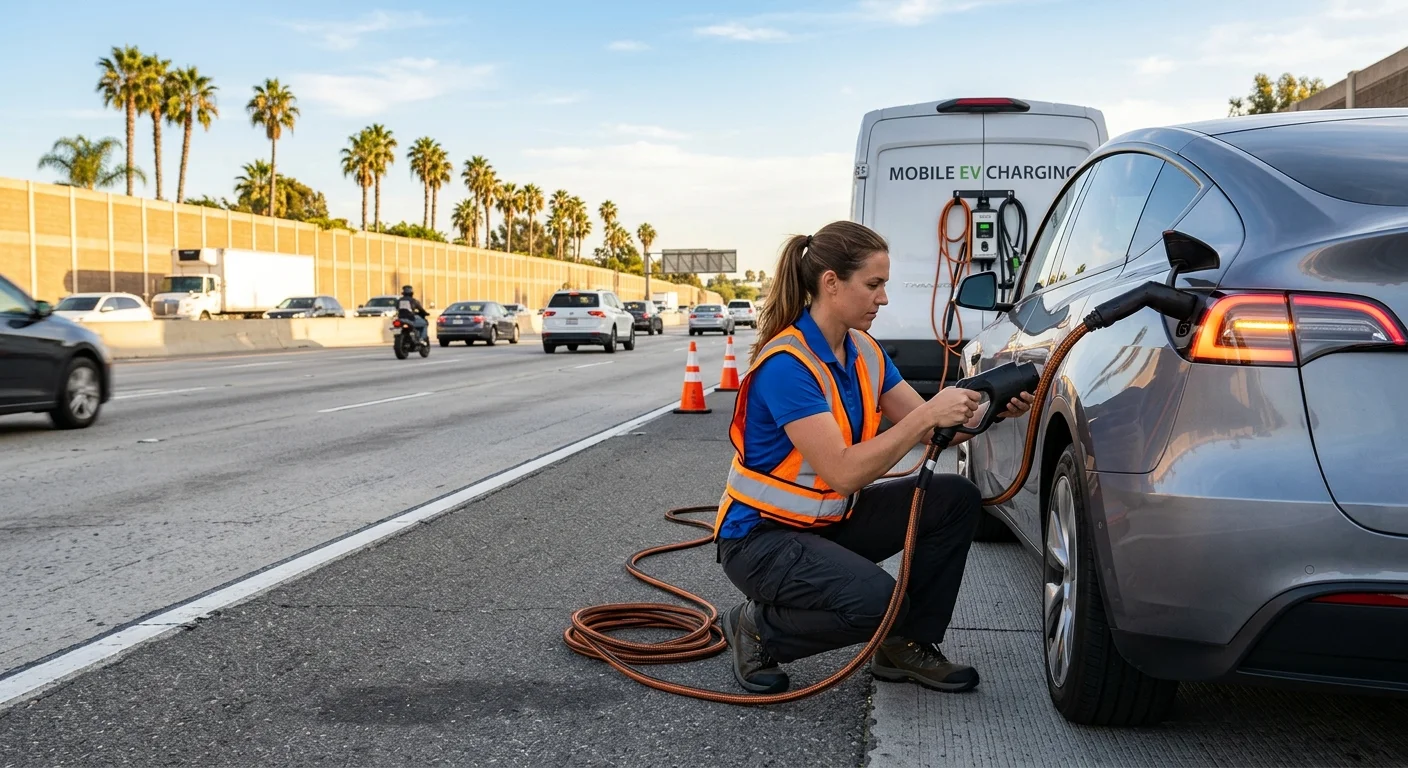
What drivers mean by a Tesla breakdown in OC
Drivers here type “tesla breakdown” when the car will not move. They are not shopping a UK insurance add-on. They are on the 405 through Costa Mesa, the 55 into Santa Ana, PCH after a beach day, or a stall at South Coast Plaza. Tesla not starting, Tesla roadside, Tesla towing service: same search, same stuck minute.
This county has a lot of those cars. As of December 31, 2025, Tesla accounts for 138,121 of Orange County’s 210,842 battery-electric vehicles, 65.51 percent of the county’s BEV fleet, per the California Energy Commission. Teslas are 5.59 percent of all Orange County light-duty vehicles. They sit in the same lots and crawl the same freeways as everyone else.
A Supercharger nearby does not always mean you can reach it. The U.S. Department of Energy Alternative Fuels Data Center lists 48 Tesla Supercharger sites and 861 DC fast ports on the Tesla network inside Orange County. Anaheim has seven of those sites. 2404 E Katella Ave has 16 stalls at up to 250 kW, a short hop from the Disneyland-area lots. Costa Mesa has three, including 1400 Bristol St and 1475 S Coast Dr, the ones people think of after South Coast Plaza. Irvine Main at 1920 Main St has 40 stalls. San Clemente’s west Vista Hermosa site has 49.
That density thins out in the hills and on parts of the coast. Laguna Beach sits 5.3 straight-line miles from the Mission Viejo Crown Valley Supercharger, over hills. Coto de Caza and Rancho Santa Margarita sit 5.1 miles from Laguna Hills Cabot Rd. Silverado is 9.0 miles from Irvine Walnut Ave. Trabuco Canyon is 7.3 miles from Lake Forest Muirlands Blvd. Those are not 1-mile misses. They are the places a “breakdown” becomes a wait because you cannot limp to a stall.
So the word is local and messy. Empty pack. Dead 12V. A warrantable fault Tesla has to touch. A flat. A tow. One search. Different next call.
Empty pack, dead 12V, or something Tesla has to touch
Three failures get lumped together. Only one of them is Tesla’s problem in the warranty sense.
An empty pack is range at zero. You burned the last miles in a Huntington Beach lot after the marine layer lifted. You climbed Santiago Canyon and the estimate did not hold. Inland summer heat does not help. NOAA’s 1991 to 2020 normal for Anaheim is 86.8 F in July and 88.8 F in August. AAA’s 2026 dynamometer study found an 8.5 percent range loss with air conditioning at 95 F. Tesla’s Model Y owner’s manual is blunter than that: once range is exhausted, the low-voltage battery loses support and needs an external power supply before the high-voltage battery can charge. A dead Tesla can look like a brick, not just a low-range car. For the on-the-ground sequence, read what to do with an empty pack on OC roads.
A dead 12V is different. The traction pack may still show range. The car will not wake, will not unlock cleanly, will not go into Drive. That is a Tesla 12V battery jump situation for a local operator, not a Supercharger errand. A freeway jump-start from the Freeway Service Patrol restores a 12V accessory battery. It does not refill a depleted traction pack. OCTA publishes no out-of-charge EV category for FSP. Caltrans FSP assist codes include Out of Gas. They do not include EV charging.
Something Tesla has to touch is a fault that keeps the car undrivable even with charge and a healthy 12V. That is the warrantable-breakdown lane. The split between a depleted pack and a true warranty stop is its own page: depleted pack versus breakdown. Do not guess from a forum error code. Tesla Support and the app are the authority on whether your VIN is in that lane.
No verified source in this site’s claims ledger names “the most common Tesla issue,” and no verified study on this ledger answers “are Teslas breaking down” as a reliability score. Treat the screen, the range number, and whether the car will accept a plug as the facts in front of you.
What Tesla’s own roadside page actually lists
Tesla publishes roadside assistance at tesla.com/support/roadside-assistance. Use that page, not a forum recap, and not a UK “breakdown cover” article. This county is not that market.
On a depleted battery, Tesla’s roadside policy answers with transportation, not on-site charging. That transport is paid. It is not a financially covered service. Running out of charge sits outside the warrantable list.
For a warrantable breakdown that renders the vehicle undrivable, Tesla provides transportation of up to 500 miles to the nearest Service Center. That is the covered transport limit Tesla publishes. It is not a promise that every stop on the 405 is a free tow. Tesla roadside service is complimentary only in the sense Tesla’s own page describes: tied to a warrantable, undrivable failure, not to an empty pack.
The Tesla roadside phone number published on Tesla’s Santa Ana service page is 877-798-3752. You can also request help in the Tesla app. A published wait time for Orange County could not be confirmed in our claims ledger. Neither could a current fee schedule, a free-tow mile for a depleted pack, or a lockout-mile figure we can repeat as fact. Check the app and Tesla Support for the queue, any fees, and whether your VIN is in a covered window. If the app offers a service, take the written terms on that screen.
Tesla does not publish, in the sources this site can cite, a full menu of loaner-wheel days or tire-radius limits that we can print as policy. Do not import those numbers from another country or another site. If a fee or free-tow mile is not on Tesla’s page when you open it, it is not confirmed.
Tesla roadside is Tesla’s program. Charge Pro OC is not Tesla. We do not cover Tesla’s policy. We do not roll Tesla’s truck.
When a local operator is the better Orange County call
Call Tesla first when the car is undrivable from a fault you believe is warrantable, and you want Tesla’s published transport path. Call a local operator when the stop is an empty pack, a 12V that will not wake the car, or a lot where you need range added on site.
A typical rescue charge from the operators we connect you with is 10 to 20 miles of range in 15 to 30 minutes of Level 2 charging. That is charging time, not arrival. The U.S. Department of Energy Alternative Fuels Data Center puts public and workplace Level 2 at roughly 25 miles of range per hour. Enough to reach 2404 E Katella in Anaheim, 1920 Main St in Irvine, or 1008 17th St in Santa Ana. Not a full pack. See how the Department of Energy frames EV charging if you want the national context.
That local path is Tesla roadside rescue: a referral to a licensed, independent operator. Charge Pro OC sets no price and promises no ETA. The operator quotes and bills you. The pros we connect you with are licensed and insured. We are not. We hold no trade license and own no trucks.
A local operator is the better Orange County call in a few repeating places. A structure at South Coast Plaza, where you cannot wait on Tesla transport and the car is blocking a stall. A PCH beach lot in Seal Beach or Huntington Beach, where the nearest Tesla Supercharger may not be in the lot. Seal Beach’s nearest Supercharger is 3.2 straight-line miles, at Garden Grove Valley View St. Huntington Beach has a Supercharger at 6913 Warner Ave, 24 stalls, which does not help if you already died at the sand. East County grades in Trabuco Canyon, Silverado, and Modjeska, 7 to 9 straight-line miles from the nearest Supercharger, with the pack already empty. An FSP drop zone after a freeway tow, where you still need charge, not another tow. A 12V failure, where jumping the low-voltage system is the job so the pack can take a charge.
Tesla towing service, meaning a flatbed under Tesla’s policy, is for the warrantable case Tesla describes. An empty pack is transportation you pay for, if Tesla moves the car that way at all. Confirm that in the app. Do not assume.
Freeway shoulder versus a lot: how the next step changes
On a freeway shoulder the first job is not charging. It is being seen.
California Vehicle Code 25251 requires you to flash the turn signals as warning lights when the vehicle is disabled on the roadway and equipped with a simultaneous-flash device, if that device still works. Hazard lights may also be used off the roadway but within 10 feet of it. Effective January 1, 2026, CVC 21809 covers any stationary vehicle displaying flashing hazard lights. Other drivers must change lanes or slow to a reasonable speed. Violation is an infraction, a fine not more than $50. Your hazards are how that law finds you.
A genuinely disabled vehicle may temporarily stop on a freeway when another vehicle has been summoned (CVC 21718). That is not a camping permit. CVC 22651(b) lets a vehicle that obstructs traffic or creates a hazard be removed immediately. After four hours on a freeway right-of-way, if you cannot move it under its own power, it can be towed (CVC 22651(f)). Sooner if it is in the way. Four hours is a permission to tow, not a grace period.
Freeway Service Patrol is the public option on patrolled Orange County freeways. Call 5-1-1 and select Motorist Aid. For emergencies call 9-1-1. California does not use #399. FSP is free. Drivers may not take tips. Hours on OCTA’s web page are Monday through Friday, 6:00 a.m. to 7:00 p.m., and limited weekend service 10:00 a.m. to 6:30 p.m. FSP does not operate overnight or on listed holidays. OCTA’s fact sheet and web page disagree on some segments and on the weekday start. This copy uses the web page hours. Neither published list includes SR-73, SR-133, SR-241, or SR-261. FSP’s listed outcome for a depleted EV is a free tow to a CHP-designated drop zone, during hours, on patrolled segments, and not guaranteed. A drop zone is short-term. Local parking rules still apply. CHP’s non-emergency line is 1-800-TELL-CHP (1-800-835-5247).
A lot is a different statute. South Coast Plaza structures, Disneyland-area private lots, and many PCH lots can tow under CVC 22658 when signage is in place. If a tow truck is coupled but the car has not left the property, California caps a drop fee at not more than half the regular towing charge. Get the car moving, or get a rescue operator on site, before the lot treats you as abandoned.
On the 405 or I-5, FSP may move you off the lanes first. Then you still have an empty Tesla in a drop zone. In a mall, there is no FSP. The next call is Tesla roadside or a local operator who can add range where the car sits.
When to call us
If the pack is empty, the 12V is dead, or you need range added in a lot or after an FSP drop, that is a mobile EV rescue. Call us at (949) 444-0151 and we’ll connect you with a local EV rescue operator. Charge Pro OC refers. The operator does the work and bills you.