A Volkswagen ID.4 that won’t wake usually has a dead 12-volt battery. That’s the VW ID.4 12V battery problem in Orange County lots. The traction pack can still hold range. The dash, locks, and contactors still go dark. You’ll see it in the same mall and office stalls Teslas use. The fix starts at the small battery, not a DC stall.
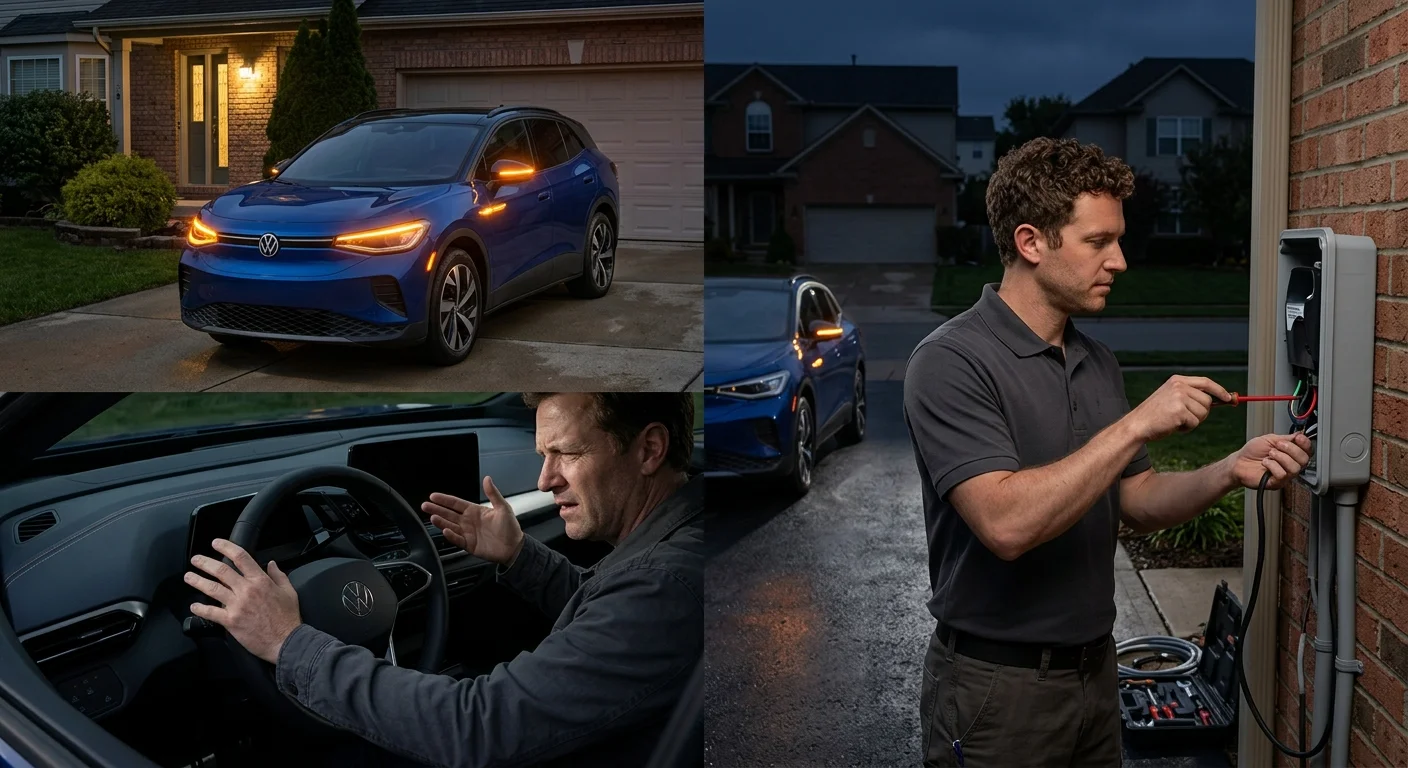
Same Orange County lots, a darker dash
As of December 31, 2025, Orange County had 210,842 battery-electric cars on the road. That count comes from the California Energy Commission’s vehicle population file. Teslas were 138,121 of those BEVs, or 65.51 percent. The other 72,721 battery cars include ID.4s and every CCS brand here. They park in the same Anaheim theme-park decks. They share Irvine office structures and Tustin business-park lots. They wait at Garden Grove, Santa Ana, and Brea malls. A dead 12-volt doesn’t care which badge sits next to you.
Tesla holds 59 percent of Orange County’s public DC fast ports. AFDC’s county extract counted 48 Supercharger sites and 861 Tesla DC stalls. The Irvine site at 1920 Main Street has 40 stalls. Tustin at 14661 Franklin Avenue has 36. Garden Grove at 12891 Harbor Boulevard has 32. Santa Ana at 1008 17th Street has 28. Buena Park at 8888 Knott Avenue has 28. San Clemente at 101 W Avenida Vista Hermosa has 49. Those are Tesla plugs. An ID.4 needs CCS. Electrify America lists ten DC fast ports at 440 N Euclid Street in Anaheim. It lists eight at Fashion Island, 401 Newport Center Drive in Newport Beach. EVgo lists fourteen DC fast ports at Plaza Antonio, 22351 Antonio Parkway in Rancho Santa Margarita. Lake Forest’s Tesla site at 24372 Rockfield Boulevard is the Magic Dock location. AFDC lists that one as CCS1 plus NACS.
None of those stalls wake a car whose 12-volt battery has already quit. You can’t roll to Euclid, Harbor, or Main Street if the computers won’t boot. CEC counted 7,095 public ports in Orange County as of December 31, 2025. That’s 36.8 ZEVs per public port, versus 24.4 statewide. Orange County also holds 12.02 percent of California’s battery-electric fleet. It’s only 8.33 percent of the state’s light-duty fleet. The lots stay busy. A dark ID.4 still needs low-voltage power first. For city-level charging pages, start at EV charging in Orange County. Theme-park and stadium parking is on the Anaheim charging page.
The 12-volt battery is the on switch
The drive battery stores the miles. The 12-volt battery wakes the car. It feeds the screens, locks, windows, lights, and control modules. It also closes the high-voltage contactors. Those contactors connect the traction pack to the rest of the car. No 12-volt power means they stay open. A full pack then sits unused. The ID.4 looks like it has no battery at all.
Tesla owners in the same Orange County lots hit a dead 12-volt too. The difference is what you can do next. A Tesla that still boots can often drive to a Supercharger. An ID.4 that won’t boot can’t drive anywhere. The same failure across brands is in when the 12-volt dies, why the EV looks completely dead. Volkswagen’s van has a parallel write-up: ID.Buzz won’t start: the 12V checks Volkswagen owners miss.
Inland north county runs hotter and drier than the beach cities. Anaheim, Orange, Fullerton, and Yorba Linda bake cars in open structures. Huntington Beach, Newport Beach, and Laguna Beach stay milder. South county grades ask more of the car after it starts. That’s true in Mission Viejo, Laguna Niguel, and Rancho Santa Margarita. None of that changes the first move. Restore 12-volt power. Then drive. Then replace the weak battery so it doesn’t die in the next lot.
Clues you can catch before the fob goes mute
The ID.4 often warns before it goes dark. The screen can take a long time to boot. It can freeze, blank, or reboot while you’re parked. Windows may crawl. Locks may hesitate or ignore the fob. Sensors can throw odd readings. The car can drop itself into Park while you sit still. None of that proves the 12-volt is finished. All of it means you should test that battery before a commute.
Dash text is clearer when it shows. Watch for 12V Battery Low. Watch for Electrical System Fault. Watch for 12V System Malfunction. Stop Safely Now plus weird electrics is another flag. Those messages can point at more than the auxiliary battery. They still belong on your list. If the car acts strange on Katella, Harbor, or the 5, get the 12-volt tested. Don’t wait for a dark evening in a packed structure.
Cars that sit through a work week take a parasitic drain on a small battery. A vacation week in a hot garage can be enough. Street parking in Santa Ana or Garden Grove doesn’t cool the cell. A closed, mild garage does. The traction pack can still show a healthy percent when you return. The 12-volt may not. If you had range left when you parked, treat a dark dash as a 12-volt job.
How to tell a 12-volt failure from an empty pack
These two failures look similar from the sidewalk. They aren’t the same repair. An empty traction pack usually still lets the car talk to you. That lasts until voltage sags far enough that the 12-volt loses support. A failed 12-volt often kills the fob, the screens, and the ready state in one stroke. You had miles showing yesterday. You didn’t crawl to empty on the 405. The car just won’t wake this morning.
If you remember a low-range warning, hunt a CCS stall after the car boots. You can also ask for a mobile Level 2 charge. If you remember a healthy percent and a dark cabin, ask for a 12-volt jump. Don’t guess from a charger map while the doors won’t unlock. The map can’t help a car that can’t shift.
On a freeway shoulder the order is the same. Stay with the car if it’s safe. Hazards on. Then decide 12-volt versus empty pack. I-5 south of Irvine is a hard place to wait. So are I-405, SR-22 at the Crush, and the 91 through north county. A lot at Brea Mall or Westminster Mall is easier. It’s still not a DIY project if you have no cables.
Locked out: key blade, then the under-hood posts
If the fob is mute, the physical key blade is still in the fob. Slide it out. Use it on the driver’s door. Inside, pull the hood release in the driver’s footwell. You’re not jumping the high-voltage pack. You’re feeding the low-voltage posts Volkswagen put under the hood.
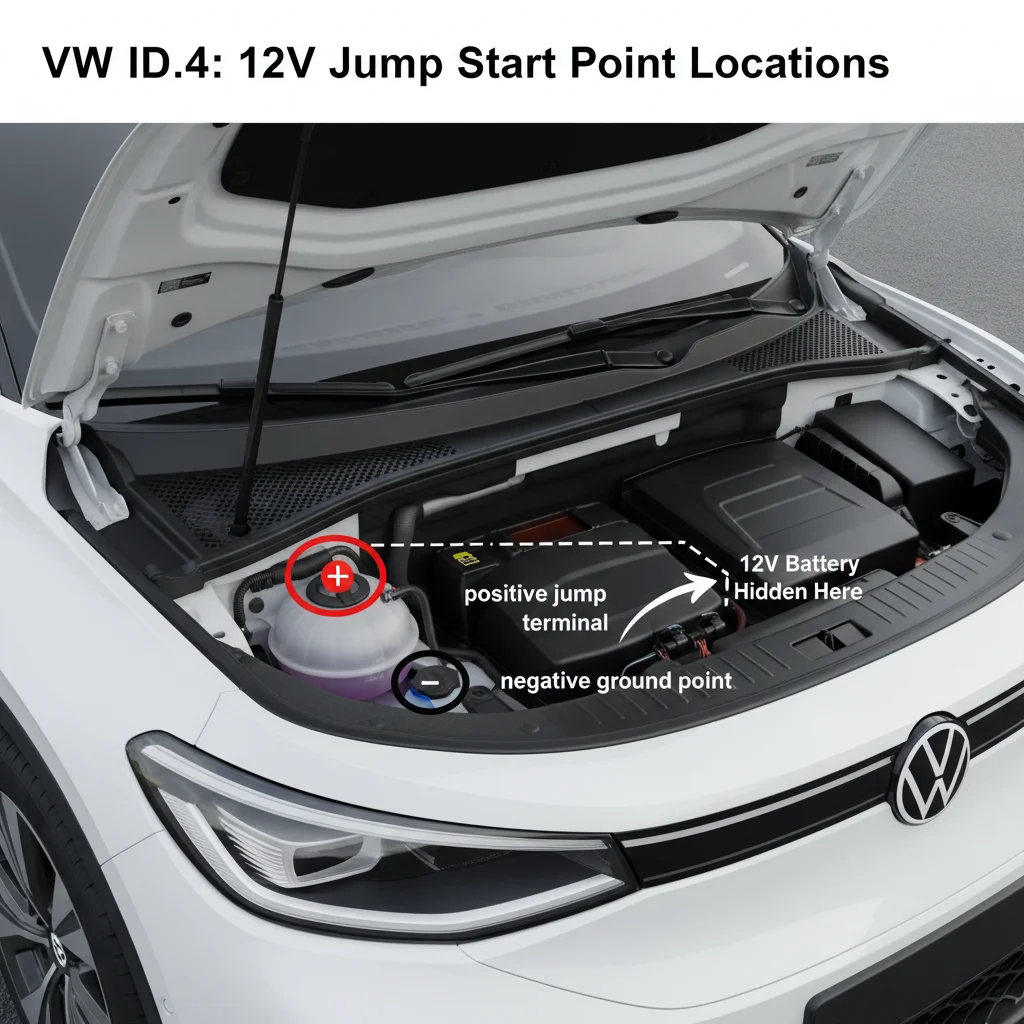
The 12-volt battery itself may not be the thing you clamp. Volkswagen gives you remote jump posts in the front compartment. Look toward the passenger side, near the washer reservoir. A red cap marks the positive post. A marked metal ground nearby is the negative point. Use that ground. Don’t hunt the battery case if a labeled ground is present. Don’t clamp negative there.
Cable order matters. Red to the donor positive first. Red to the ID.4’s red post next. Black to the donor negative. Black to the ID.4 ground last. Keep clamps off painted covers and off each other. Start the donor car and let it run a few minutes. Then try to power the ID.4 with the cables still on. If the dash wakes, leave it in that ready state. Pull the cables in reverse order. Ground off the ID.4 first. Then the donor negative. Then the ID.4 positive. Then the donor positive.
That sequence is a short-term wake-up. It isn’t a repair. How to jump start an electric car without making it worse covers the same idea for other EVs. If you have no donor car, no cables, or no clear view of the posts, stop. A wrong clamp can take out modules. A flatbed to a dealer with a dead 12-volt is a long detour. A simple jump is usually the shorter path.
Once it starts, plan the replacement
Drive the car. Don’t shut it down in the same lot and hope. A jumped 12-volt can collapse again at the next stop. EV battery dies again after a jump: what to do next is for that second failure. Get the battery load-tested. Replace it if it can’t hold voltage. Your Volkswagen dealer or an independent shop that knows EV 12-volt systems can do that work.
Charge Pro OC doesn’t sell parts and doesn’t hold a shop bay. We’re a referral line. The operators we connect you with can jump a dead 12-volt on site. They can replace one on site when that’s the job. They quote you before they start. They bill you directly.
If the pack was actually empty, that’s a different call. A 12-volt jump won’t put miles in a depleted traction battery. Then you want a mobile 240-volt charge at the car. A CCS stall works if you can drive. Typical on-site charging time, once hooked up, is 15 to 30 minutes. That usually adds about 10 to 20 miles of range. That’s charging time, not an arrival time. Non-Tesla EV rescue is the service page for that mix.
When you’d rather have an operator at the bumper
You might lack cables. You might lack a second car. You might be in a structure where a gas donor can’t idle. Huntington Beach lots after a long beach day are a poor place to improvise. So are Costa Mesa airport decks and Anaheim event parking. Gated HOA garages in Irvine or Mission Viejo can block a casual jump too. If you’re unsure about the posts, don’t guess.
Charge Pro OC matches stranded EV drivers with independent local mobile rescue operators. We don’t own trucks. We don’t employ technicians. We don’t set prices. We don’t publish hours or promise when someone will arrive. The operator confirms the job with you. You pay that operator. For an ID.4, say you need a 12-volt jump. Use that when the dash is dark and you had range left. The pros we send handle Tesla and every major EV brand. They bring 12-volt jump gear. They can also bring a 240-volt Level 2 source. Non-Tesla cars get a CCS or J1772 adapter. That’s the tool when the traction pack is empty.
Call (949) 444-0151 when you want that match. Tell them the city, the lot, and whether the fob still works. Tell them you’re in an ID.4, not a Tesla. That keeps the operator from assuming you need a NACS-only stall.
Frequently asked questions
Why won’t my ID.4 wake if the traction pack still has charge?
The 12-volt battery powers the modules that close the high-voltage contactors. If that small battery is dead, the contactors stay open. The traction pack can’t feed the motors or the cabin. The car looks fully dead. Miles on the display from yesterday don’t help until 12-volt power is back.
Can I jump a Volkswagen ID.4 from another car?
Yes, if you use the under-hood jump posts and a proper ground point. Use the key blade if the fob is dead. Don’t clamp onto unmarked metal if a labeled ground is there. Let the donor run a few minutes, then power the ID.4. Treat it as a temporary wake-up. Replace the 12-volt if it won’t hold a charge.
Who do I call in Orange County if I’m not in a Tesla?
Charge Pro OC connects ID.4 drivers with local operators who work on non-Tesla EVs. Tesla Superchargers in the same lot may not fit your plug. Ask for a 12-volt jump when the car is dark and you’d had range. The operator quotes you before starting and bills you directly.