A VW ID.Buzz that won’t start is almost always a dead 12-volt battery. The traction pack can still read full. That small battery sits under the driver’s seat, not under the hood. Orange County owners miss this after theme-park days. Long sits in coastal lots do the same thing. The van never got a plug at that stall.
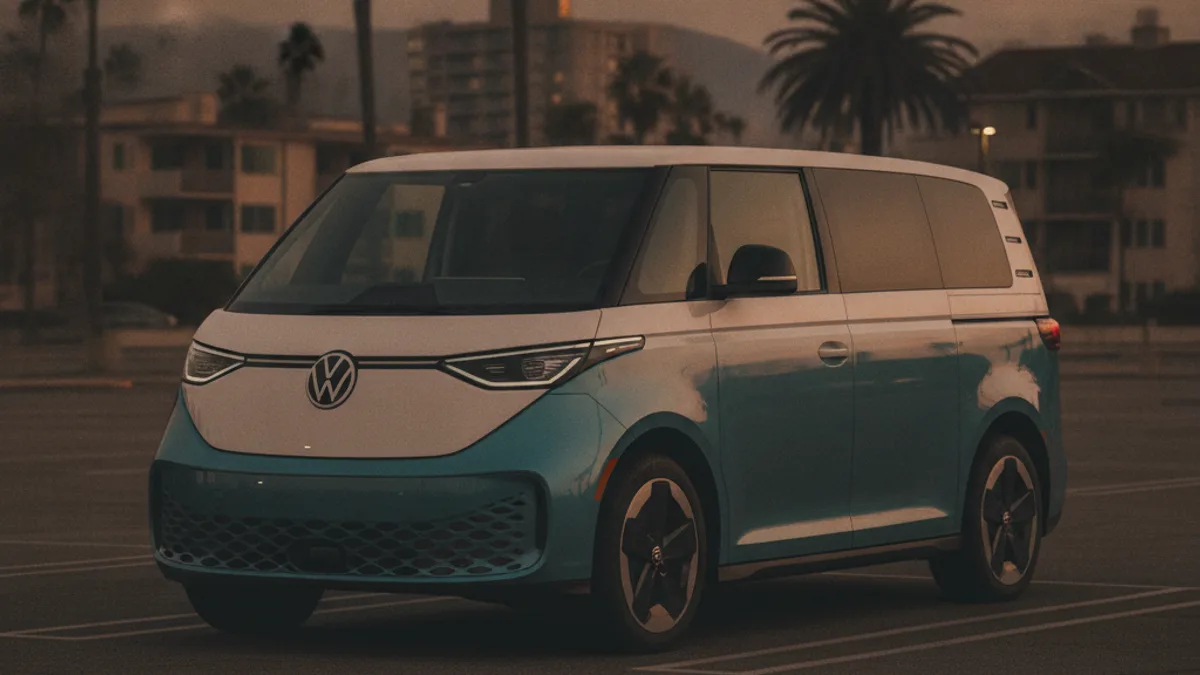
The California Energy Commission counted 210,842 battery-electric vehicles in Orange County. That’s the count as of December 31, 2025. Most of those cars are Teslas. The ID.Buzz is still uncommon here. A lot of EV advice skips Volkswagen’s layout. The checks below are the ones this van actually needs.
The 12-volt is what wakes the van
The ID.Buzz runs two batteries with two jobs. The high-voltage pack moves the van down the road. A smaller 12-volt battery runs the computers, locks, and screens. It also runs the wake-up sequence. If that 12-volt is too low, the traction pack stays locked out. Range on the gauge doesn’t matter until those computers boot.
This is the same MEB platform as the VW ID.4. The van and the crossover share that 12-volt behavior. They don’t share where the battery lives. That’s why ID.4 habits fail on the Buzz in a lot.
Signs you’re looking at a 12-volt failure
Don’t start with a tow. Read the van first.
- A “12 volt system error” or “electrical system fault” on the cluster
- Ready or Drive never comes up, even with charge showing
- The fob is slow, or it does nothing, so you need the physical key
- The screen flickers, or the infotainment keeps rebooting
- The VW app won’t connect or wake the van
- A jump pack is the only way the dash comes back
A hard high-voltage fault that then kills the whole dash is a different problem. That one belongs on a dealer scan. The classic dark-cabin case starts at the 12-volt. You’ll see the same lockout across brands in when an EV 12-volt dies on the road.
Theme-park days and coastal lots are the usual trap
The 12-volt mainly recharges while you drive. Parked, the van still runs a light background load. Hours of sitting add up. A family van left in a lot all day is a textbook drain.
Anaheim and Buena Park make this easy to miss. You arrive at a theme-park lot in the morning. You walk in for a full day. The van sits in sun, with the fob in a bag. The stall you used is just a stall. You come back to a dark dash and a dead fob. Tesla Superchargers sit on Katella Avenue, Lincoln Avenue, and Euclid Street in Anaheim. Buena Park has sites on Beach Boulevard and Knott Avenue. Those are real, mapped stalls. They don’t wake a van whose computers are already down.
Coastal parking does the same thing on a slower clock. Huntington Beach, Newport Beach, Seal Beach, and Dana Point are full-day lot patterns. You came to walk the beach or the harbor, not to plug in. Hours later the 12-volt is the weak link. The traction pack may still have range. You just can’t get the van to Ready.
Inland heat makes the wear worse over the life of the battery. Yorba Linda, Fullerton, Brea, and east Anaheim garages run hotter. A Huntington or Newport garage stays cooler for much of the year. AGM-style 12-volt batteries age faster in that heat. A few-year-old battery in an inland garage is already closer to failing. You may not see a warning until the morning it won’t wake.
After a long park in north county, the same sit-and-fail pattern shows up around Buena Park theme-park lots. The van looks dead. The pack often isn’t.
Where the battery is, and where you actually jump
This is the check ID.Buzz owners miss. Even people who already own an ID.4 get it wrong. The 12-volt isn’t under the hood. It’s in the cabin, under the driver’s seat, behind a plastic trim cover. You slide the seat forward and pull that cover. That’s a poor job on a freeway shoulder. The 91, I-5, and I-405 are the usual ones. It’s a worse job in a packed structure.
VW put remote jump posts up front for that reason. Under the hood cover you’ll find a positive post under a red plastic cap. There’s a separate metal ground for the negative clamp. Those posts are wired back to the buried battery. You jump there. You don’t dig under the seat just to get power back.
Confirm the layout in your owner’s manual before you clamp anything. Model years can shift the exact spot a little. A one-minute check beats guessing under a cover.
How to jump the ID.Buzz from those posts
Do this only with a jump pack or a donor vehicle, and only on stable ground. Stay out of live lanes. If you’re on a freeway shoulder, stay with the van. Don’t crawl under a seat next to traffic.
- Keep the donor or pack off until the clamps are set.
- Open the hood cover and find the red cap on the positive post.
- Clamp red to the ID.Buzz positive post, then red to the donor positive.
- Clamp black to the donor negative.
- Clamp the last black lead to the ID.Buzz ground point, never the battery’s own negative.
- Turn the donor on, or fire the pack, and wait a couple of minutes.
- Press the brake and try to power the van. The dash should wake in a few seconds.
- Pull the cables off in reverse order once Ready holds.
Don’t use the ID.Buzz to jump another vehicle. VW warns against that. It can damage the van’s own electrical system. Use a pack, or use another car as the donor.
If Ready comes back and a 12-volt warning follows, the battery only had enough charge to boot. Replacement is next, and it isn’t a simple parts swap. A new 12-volt has to be coded to the van. Skip that step, and the warnings return. Sleep behavior gets weird. The battery dies again sooner than it should. Treat coding as part of the job, not an extra. The 12-volt replacement guide covers signs, timing, and that coding step. For clamp technique across brands, see how to jump start an EV on site.
Dead 12-volt versus an empty pack
A dark dash and a dead fob is a 12-volt lockout. That’s true if you can still see a healthy pack reading. A jump is the first move.
An empty traction pack looks different. The van may still power on. It just has no range left to drive. A jump won’t put miles back on that pack. You need a charge at the van. Or you need Ready back so you can roll to a stall.
Orange County public charging is busy relative to the fleet. The Energy Commission counted 7,095 public ports in the county as of December 31, 2025. That sits against 260,833 ZEVs. That’s 36.8 ZEVs per public port. Statewide it’s 24.4. Tesla holds 59 percent of the county’s public DC fast ports. For an ID.Buzz you want CCS. Mapped examples include Electrify America at Fashion Island, 401 Newport Center Drive in Newport Beach. There’s also Electrify America at Walmart, 440 North Euclid Street in Anaheim. South county has Electrify America in Dana Point at 25825 Las Vegas in Capistrano Beach. Seal Beach has EVgo at 801 Pacific Coast Highway. Those sites help when the van will wake and roll. They don’t help when the 12-volt has already shut the computers down.
ID.Buzz versus ID.4 on the checks that matter
| Check | ID.Buzz | ID.4 |
|---|---|---|
| Platform | MEB | MEB |
| 12-volt physical location | Under the driver’s seat, in the cabin | Under the hood, passenger side |
| Where you jump | Remote posts under the hood cover, red cap plus a ground point | Remote posts under the hood, near the washer tank |
| Direct battery clamps | No. Use the remote posts. | Remote posts are still the safer route |
| Typical no-start | Van sat parked for hours or days | Same parked-sit pattern |
| OC wear factor | Inland garage heat ages the AGM cell | Same heat pattern inland |
The shared platform is why ID.4 advice almost works. The seat battery is why it doesn’t. Jump the Buzz from the hood posts. Leave the seat cover alone unless you’re replacing the unit.
When you need an operator at the van
If you can’t get a safe jump in the lot, stop forcing it. A packed Anaheim structure isn’t the place to pull a seat cover. Neither is a Huntington curb. A shoulder on the 91 isn’t either. Stay with the van. Don’t walk the shoulder while the dash is dark.
Charge Pro OC is a referral line. It matches stranded EV drivers with independent local mobile rescue operators. It doesn’t own trucks. It doesn’t employ technicians. It doesn’t set prices. The operator quotes you before starting, then bills you directly.
For a 12-volt lockout, the operators we connect you with can jump on site. They can replace that battery there too. For a pack that’s actually empty, they bring a 240-volt Level 2 source to the van. They use a CCS or J1772 adapter for a Volkswagen. That typically adds 10 to 20 miles of range in 15 to 30 minutes of charging. That figure is charge time. It isn’t an arrival time.
See EV roadside assistance and non-Tesla EV rescue for how dispatch works.
Frequently asked questions
Why won’t my ID.Buzz start if the pack still shows charge?
The traction battery and the 12-volt battery are separate systems. The 12-volt has to be alive for the van to power on at all. If it drops too low, the high-voltage system stays locked out. Jump the 12-volt first before you assume the pack failed.
Where is the 12-volt battery, and where do I jump?
It sits under the driver’s seat, inside the cabin, not under the hood. VW puts remote jump posts under the hood cover. The positive post is under a red plastic cap. The negative clamp goes on a separate ground point. Jump from those remote terminals. Don’t clamp the buried battery.
Why does the 12-volt keep dying after a long park?
On VW’s MEB platform, the 12-volt mainly charges while you drive. It can drain slowly while parked, running background systems at a low level. A van that sat through a theme-park day is a common no-start. A coastal lot does the same thing. Inland garage heat speeds wear on the AGM-style battery. Replacement also has to be coded to the van, or the cycle repeats.
If the ID.Buzz is dark in a driveway, a theme-park structure, or a coastal lot, call Charge Pro OC at (949) 444-0151. We’ll go through what you’re seeing before we connect you with an operator.