A Hyundai Ioniq 6 that won’t start is almost always a dead 12V. It isn’t an empty traction pack. The sedan can sit in an Orange County parking structure and look fine. Then it refuses every input. The fob stays quiet, the handles don’t unlatch, and the start button does nothing. Miles can still sit in the high-voltage pack. That small auxiliary battery is what wakes the computers. Check it before you call a tow.
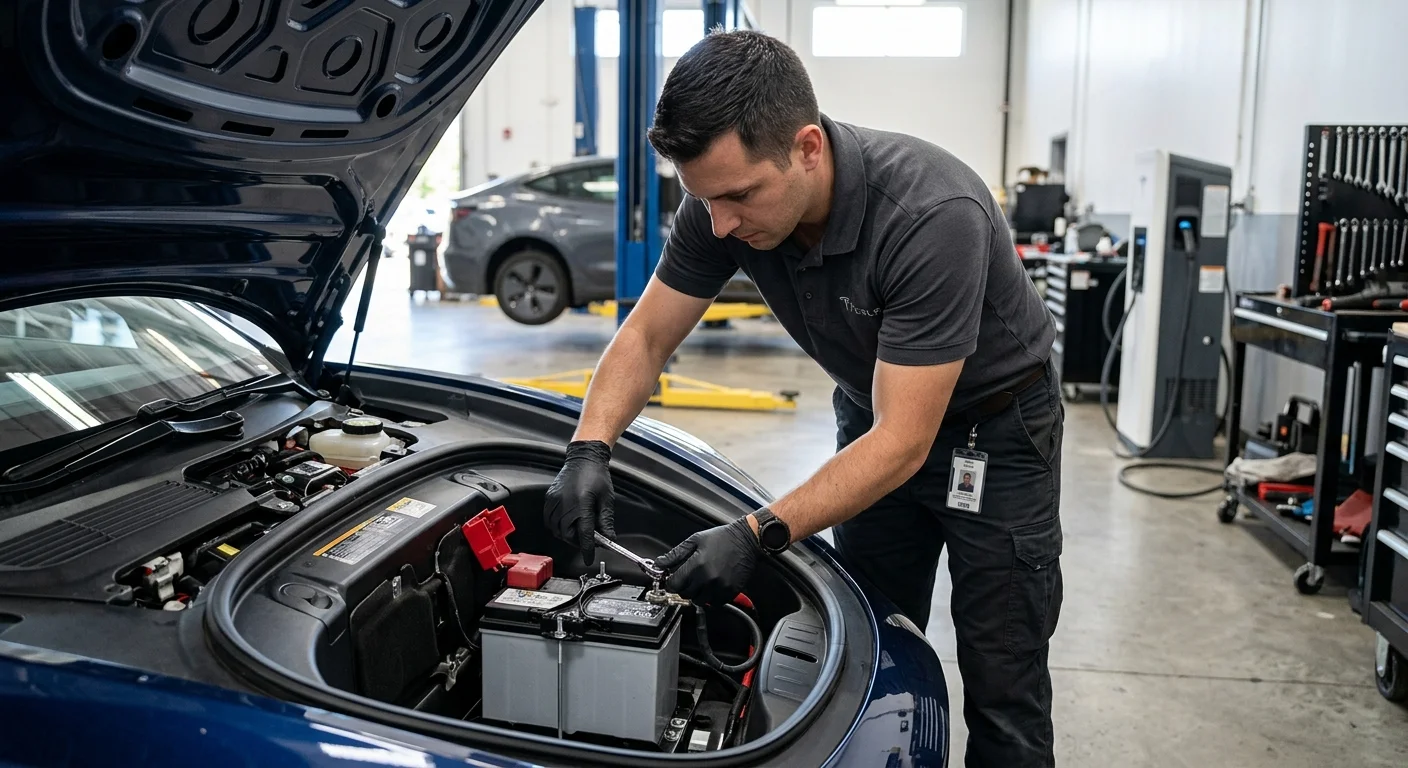
The dark-car pattern in Orange County structures
This failure shows up in garages more than on the shoulder. You park, lock, and walk into an office or a mall. Hours later the Ioniq 6 is a brick. Costa Mesa decks near 1475 S Coast Dr see that stall. Irvine office and Spectrum-area garages go dark the same way. Tustin parkers around 14661 Franklin Ave come back to a silent car. Anaheim lots along E Katella Ave and E Lincoln Ave do too. Fashion Island parking at 401 Newport Center Dr is the same stall in Newport Beach. You return, and the car won’t talk.
A stall on the same property doesn’t fix a car that won’t boot. Electrify America lists eight DC fast ports at 401 Newport Center Dr. That plug doesn’t help if the door won’t unlatch. Tustin has a 36-stall Tesla site at 14661 Franklin Ave. It sits by a lot of office parking. Your Ioniq 6 still needs 12V before it can take a CCS charge. Irvine’s Supercharger at 1920 Main St has 40 stalls. The car has to wake first. A stall you can see from the ramp isn’t a plan yet.
Orange County had 210,842 battery-electric vehicles on the road as of December 31, 2025. That’s the California Energy Commission count. Teslas are 65.51% of that BEV fleet. The rest is a large non-Tesla mix, including Hyundai’s E-GMP cars. If you drive an Ioniq 6 here, you’re not the odd one out. You’re also not in a Tesla. A NACS-only Supercharger map isn’t your first recovery tool.
For the garage version of this stall on any EV, see stalled in a Costa Mesa parking structure.
Two batteries, and only one of them starts the car
The Ioniq 6 shares Hyundai’s E-GMP platform with the Ioniq 5. Both run a big traction pack and a small 12V auxiliary battery. The pack moves the car. The 12V runs the computers, locks, windows, lights, and the module network. Kill the 12V, and the traction pack is locked out. The car can’t boot. Charge level on the big pack doesn’t matter.
There’s a second trap on this platform. The traction pack can fall to a critically low state. Then the battery management system can stop topping off the 12V. The sedan then sits. A few days later the 12V is empty. You can still have traction charge and a dark car. A range number in the app, if it loads, doesn’t clear the 12V.
Don’t keep pressing start. Don’t assume the main pack failed. Don’t call a flatbed first. The 12V is the check that belongs in the structure. When the 12-volt dies walks through that cascade on any EV.
Where the Ioniq 6 hides the 12V
Don’t copy the Ioniq 5 hunt. On the Ioniq 5, the 12V sits up front under the hood. On the Ioniq 6 sedan, it lives in the trunk. It’s on the driver’s side, under the cargo floor trim. Pull the liner back on the left. You’ll see an AGM battery. That’s absorbed glass mat, not a flooded lead-acid jug.
You still don’t jump from those trunk posts. The jump points are under the hood. The hood opens even though this sedan has no frunk storage. Use the interior hood release.
| Spot | What you’ll find |
|---|---|
| Trunk, driver’s side | The actual 12V AGM battery |
| Under hood, driver’s side fuse box | Positive jump post under a red cap |
| Under hood, chassis | Unpainted metal bolt for the negative clamp |
| Cluster, when the car is awake | Auxiliary battery save control |
Pop the black fuse-box cover on the driver’s side of the bay. Lift the red cap for positive. Pick a bare chassis bolt for ground. Don’t put the black clamp on the trunk battery’s negative post.
The Ioniq 5 version of this hunt is here: Hyundai Ioniq 5 won’t start, the 12V checks.
How to jump an Ioniq 6 in the structure
Use a pack made for 12V jumps, or cables to a running gas car. Stay on the hood posts. The trunk battery is real. It isn’t the jump point.
- Pull the interior hood release and open the hood.
- Find the black fuse-box cover on the driver’s side.
- Lift the red cap to expose the positive post.
- Clamp red on that post.
- Find a clean, unpainted chassis bolt for ground. A firewall or strut-tower bolt is a solid choice.
- Clamp black on that bolt, not on the trunk negative.
- If you’re using another car, match positive to positive on the donor, then its negative.
- Give the Ioniq 6 two or three minutes to take a little charge.
- Hit start. The boot can take a few extra seconds after a dead 12V.
If it wakes, don’t sit in the garage on the climate control. Get it on a charger. A single jump doesn’t rebuild a weak AGM. If it dies again within the hour, the 12V needs replacement, not another clamp.
The longer safety walkthrough is in how to jump start an electric car without making it worse.
Checks to run before you clamp anything
Work the easy stuff first.
If the screens never wake, it isn’t a tired fob coin cell. The cabin computers are off. Look at the charge port only after the 12V is alive. A CCS cable in a Santa Ana stall can’t talk to a dark car. Garden Grove is the same. No 12V, no handshake. The port latch, the dash, and the onboard charger all need that 12V rail.
If you can get a door open, don’t leave the cluster on while you wait. That draw is what finished a weak battery.
Auxiliary battery save is prevention, not a rescue
The Ioniq 6 has an auxiliary battery save mode the Ioniq 5 doesn’t present the same way. You turn it on in the cluster when the car is already awake. Typical path is Settings, then Vehicle, then Auxiliary Battery. Trims and software can move that menu. It cuts accessory draw while you sit with the screens on. It won’t revive a battery that’s already dead.
Use it before a long wait. A climate session in a Santa Ana garage near 300 E 5th St. A phone-charging sit at 1025 Westminster Mall. A lunch in the car at 1065 Brea Mall. Those hours nibble a weak 12V. The mode helps. It isn’t a jump.
After it starts, use a CCS plug
Once the computers are up, you still need pack energy if you were already low. Hyundai’s CCS port is the one that matters on this sedan. Lake Forest has a Tesla Magic Dock at 24372 Rockfield Blvd. That site has CCS1 and NACS, so the Ioniq 6 can use the CCS1 side. Electrify America has 10 DC fast ports at Walmart 2242, 440 N Euclid St in Anaheim. It also has 8 DC fast ports at Fashion Island. EVgo has 14 DC fast ports at Plaza Antonio, 22351 Antonio Pkwy in Rancho Santa Margarita. EVgo has 4 stalls at 801 Pacific Coast Hwy in Seal Beach. Electrify America’s Dana Point Station sits at 25825 Las Vegas in Capistrano Beach, with 12 DC fast ports. Countywide, AFDC counts 175 non-Tesla DC fast stations and 591 non-Tesla DC fast ports.
ChargePoint shows up on a lot of Orange County office maps. Those sites are mostly single-plug units at dealers and workplaces. The AFDC file averages about 1.1 DC fast ports per ChargePoint site. That’s a weak rescue bet if the one office plug is taken. Plan on Electrify America, EVgo, or the Lake Forest Magic Dock. Or have a truck meet the bumper.
As of December 31, 2025, Orange County had 5,600 public Level 2 ports. It also had 1,475 public DC fast ports. That’s 7,095 public ports in all. That list doesn’t unlock a dark Ioniq 6. The 12V has to come back before any of those plugs matter.
If you can’t jump it, skip the tight-stall clamp. A mobile operator can bring a 12V jump to the car. The same truck can add a 240V Level 2 charge through a CCS adapter. Typical charging time is 15 to 30 minutes for about 10 to 20 miles of range. That’s charging time, not a promise of when someone arrives. Charge Pro OC is a referral line. It matches you with independent local operators. The operator quotes you before work starts and bills you directly. The pros we connect you with handle Tesla and every major EV brand, including Hyundai.
For non-Tesla cars, use non-Tesla EV rescue in Orange County.
If it dies again, stop jumping it
A 12V that falls a second time is telling you it’s done. Repeated jumps stress the modules. They still leave you in the same structure. Have the battery tested. If it’s weak, replace it. Signs and field steps are in your EV 12V replacement guide.
Operators we connect you with can jump on site. They can replace a dead 12V on site when that’s the right call. They don’t publish a rate on this page. Ask for the quote before they start.
Make the tow the last move
A flatbed is the right tool when the car is damaged, or when it truly won’t take a jump. It’s the last move for a 12V that just needs a clamp and a charge. Start with the 12V. Then a Level 2 charge if the pack is low. Tow after those fail. The longer Orange County version is in towing a dead EV in Orange County.
Charge Pro OC serves every city in Orange County. The operators do the work. They own the trucks. This brand doesn’t. If the Ioniq 6 is dark in a structure, on a curb, or on a driveway, call (949) 444-0151. An operator will quote the visit before anything starts.
How do you jump-start a Hyundai Ioniq 6?
Use the positive post under the hood in the driver’s side fuse box. Don’t jump from the 12V battery in the trunk. Clamp red on the red-capped post in the engine bay. Clamp black on a bare metal chassis bolt. Wait two or three minutes, then try start. The trunk battery is real. The jump points are up front.
Where is the 12V battery in a Hyundai Ioniq 6?
It’s in the trunk on the driver’s side, under the cargo floor trim. That’s the opposite of the Ioniq 5, where the 12V sits up front. The jump terminals still live under the hood in the engine bay.
Can the traction pack have charge if the Ioniq 6 won’t start?
Yes. If the 12V auxiliary battery is dead, the car loses the computers that wake the high-voltage system. No 12V means no boot, even with miles still in the pack. That’s the parking-structure version of this failure, not an empty floor battery.