The Ioniq 5 session looks done, but the cable won’t let go. Start with the fob: lock, pause, then unlock. If the CCS handle still won’t come out, open the hatch. Pull the manual release on the driver’s side of the cargo area. That cable retracts the pin even when the car’s software has stalled. A busy Orange County stall doesn’t change the sequence. You’re just doing it with a line of drivers behind you.
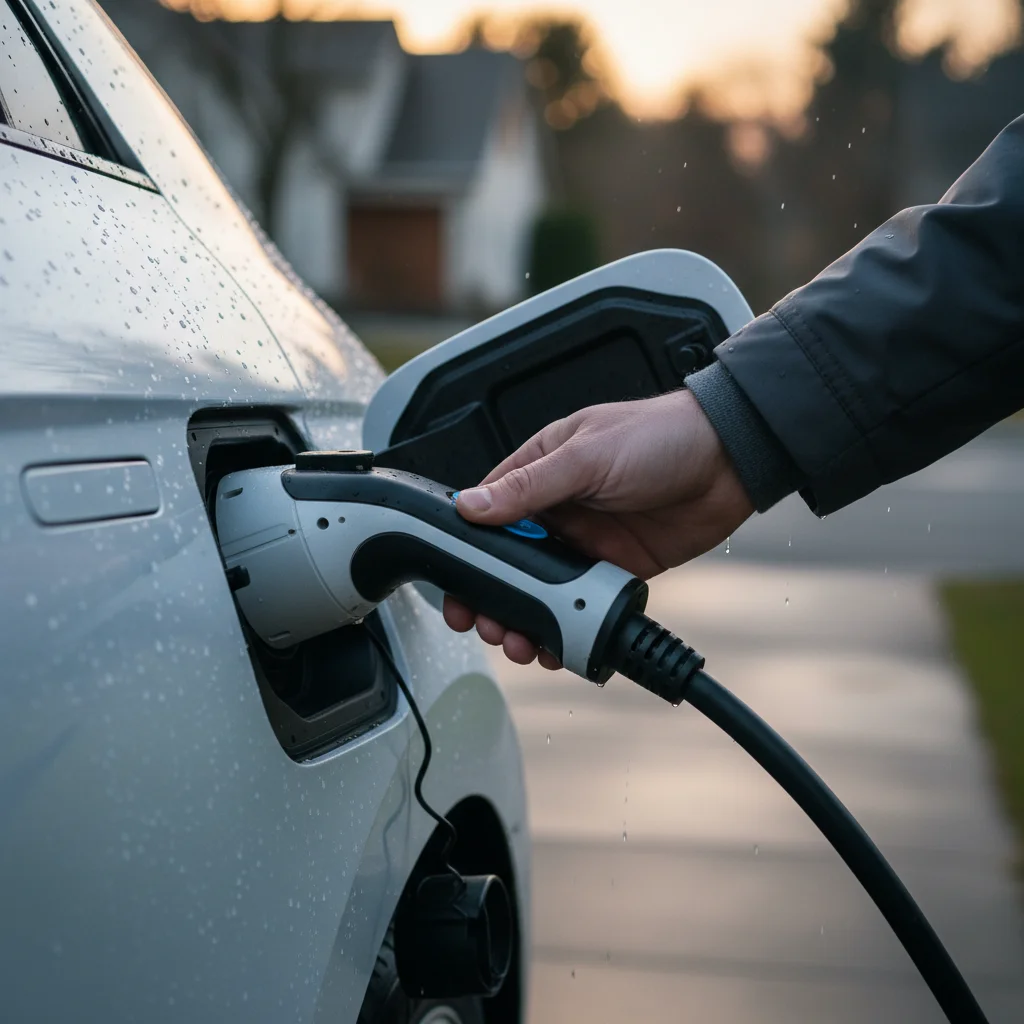
You’re holding a public DC stall other people need. Orange County had 210,842 battery-electric vehicles on the road. That’s the California Energy Commission count as of December 31, 2025. ZEVs in the county totaled 260,833 in that same file. Public charging ports in the county numbered 7,095. That’s 36.8 ZEVs per public port. California’s ratio in the same data is 24.4. A frozen Ioniq 5 handle here isn’t a private-garage delay. It’s a CCS plug occupying a stall in a tight county mix.
The stall is crowded. The pin still has to move.
Tesla makes up 138,121 of those 210,842 battery-electric vehicles. That’s 65.51% of Orange County’s BEV fleet. An Ioniq 5 sits in the other share, on CCS hardware. Countywide, AFDC records show 223 DC fast stations and 1,452 DC fast ports. Tesla holds 861 of those ports, about 59%. Non-Tesla DC fast charging is 175 stations and 591 ports. Electrify America has 30 stations and 138 ports. EVgo has 30 stations and 131 ports. ChargePoint has 71 DC fast sites but only 76 ports. Those ChargePoint plugs are mostly single-stall dealership and office units. They aren’t the multi-stall CCS rows an Ioniq 5 usually occupies.
Coast lots and inland lots use the same latch on different cabinets. Electrify America at 401 Newport Center Dr in Newport Beach has eight DC fast ports. That’s the Fashion Island site. The Anaheim Electrify America at 440 N Euclid St, listed as Walmart 2242, has ten. South county’s largest non-Tesla DC site in that AFDC file sits in Capistrano Beach. It’s Electrify America at 25825 Las Vegas, listed as Dana Point Station, with twelve ports. EVgo at Plaza Antonio, 22351 Antonio Pkwy in Rancho Santa Margarita, has fourteen. EVgo at Ocean View Plaza, 638 Camino de los Mares in San Clemente, has ten. EVgo at Westar Mercantile East, 27542 Antonio Pkwy in Ladera Ranch, has eight. EVgo at 801 Pacific Coast Hwy in Seal Beach has four stalls. Lake Forest has a Tesla site at 24372 Rockfield Blvd. AFDC lists it as Magic Dock, CCS1 plus NACS, 16 stalls. If you’re on a CCS plug there, treat it like any other public fast session.
None of those stall counts matter while the pin is still in the handle. Free the cable first, then move the car. Don’t hunt a second cabinet while you’re physically locked to the first. For the Fashion Island lot layout, see EV charging near Fashion Island. This page stays on the release, not on where to queue next.
In 2026 Q2, ZEVs were 24.77% of new Orange County light-duty sales, 10,469 of 42,264. California’s share was 19.09%. Those new cars keep showing up at the same CCS rows. Don’t call that an accelerating boom. Statewide ZEV share peaked at 25.31% in 2024. 2026 Q1 was the weakest quarter in that series at 15.76%. CEC also changed its new-sale method in 2023 and 2025, so year-to-year reads aren’t clean. The roadside point is smaller. Enough Ioniq 5s already share those cabinets that a stuck handle is a public problem.
Start with the fob, the app, and the stop button
Leave the connector seated for a minute. A hard yank with the pin engaged can scar the port. It can also throw a fault on the cabinet.
Unlock the doors with the fob. Wait a few seconds. Lock them, wait, then unlock again. Give the car time to send the retract command. Don’t mash the fob. A burst of lock commands can freeze the same logic you’re trying to reset.
If Hyundai Bluelink is on your phone, end the session from the app. That remote stop is often the signal the latch was waiting for. Walk to the charger screen next. Press stop if the unit still shows an active session.
Then use the release on the handle. Pull the CCS head straight out. Don’t twist it against the charge door. Don’t kick the handle.
If the car still holds the cable, you’re past the simple resets. On a public unit, the next clean step is the network number on the cabinet. After that, it’s the trunk cable.
At home on Level 2, you can go to the cargo release sooner. You’re not taking a public stall down with a dirty unplug. On DC fast, work the network stop first.
Session length and pack size are a separate question. See how long a Hyundai Ioniq 5 takes to charge in Orange County. You’re here because the session already ended, or looks like it did.
The door motor isn’t the lock
The Ioniq 5 charge door is motorized. The connector lock is a different actuator. That second part is what traps the handle.
A metal pin slides into a notch on the CCS connector when charging starts. Software extends that pin. It’s supposed to pull back when the session ends, or when you unlock the doors. A messy handshake with a public DC unit can skip the retract command. So can a session that dies mid-cycle. The computer still thinks the plug has to stay put.
That’s how this port is built. It isn’t an Orange County-only design. What is local is the mix of cabinets doing that handshake. Electrify America and EVgo are where an Ioniq 5 in this county usually fast-charges. Those are the units with enough ports to draw a line of cars.
Software freeze or a pin that won’t slide
Treat it as software until the car proves it isn’t. You don’t need a shop visit to start the sequence.
Lock and unlock with a pause. Stop the session in Bluelink. Stop it on the cabinet. Call the network with the station ID. Those steps don’t require interior trim tools.
A hardware bind feels different. The pin motor can seize. Grit can sit in the slot. A damaged handle can keep the pin from clearing. You’ll notice that on the manual cable. If the loop is stuck hard, stop. If you pull and hear nothing at the port, stop. Forcing it can snap the override or bend the actuator. Any EV charge cable that won’t release follows that same limit. Don’t win a tug-of-war with a locking pin.
This county’s research file doesn’t give freeze-day counts. Don’t blame ice by default. Dirt, a tired actuator, or a bad handle are enough.
The cargo-area release, in order
Hyundai put a mechanical override in the trunk for this stall. Use it after the software path when you’re on a live public unit. If the cabinet is still talking to the car, a sudden unplug can fault the stall. The next driver then inherits your error.
Work this in order.
The car should be off, in park. Unlock it if you still can. Open the rear hatch.
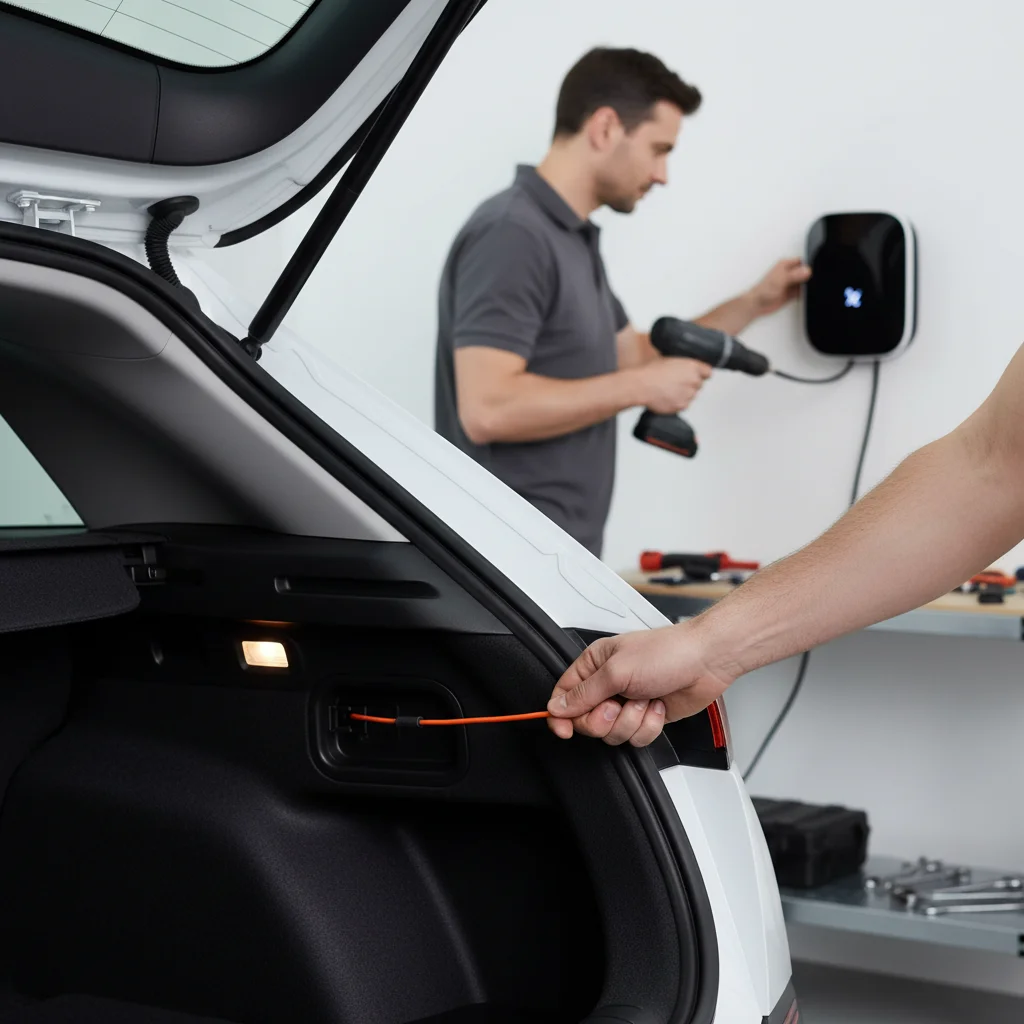
Stand in the cargo opening and look left. That’s the driver’s side. You’ll see a small rectangular panel in the liner, roughly behind the tail lamp. Pop it with your fingers. A plastic trim tool is gentler than a house key if the cover is tight.
Inside is a short cable with a loop or a small handle. It may be black. Some years use an orange tab. That’s the charge-port release, not a random wiring loop.
Pull it toward the center of the trunk, short and steady. You’re sliding a pin. You’re not starting a generator. Listen for a click or a clunk at the port. Then walk around and draw the CCS handle straight out.
Snap the panel back in. If you want the diagram for your year, use Hyundai’s published manuals. They’re at owners.hyundaiusa.com, under manuals and warranties. Model years move labels around. Your booklet beats a remembered video.
Call the network before you pull that loop
At Electrify America or EVgo, the cabinet is a second computer in the handshake. The number printed on the station is the next tool. Read the station ID off the unit. Tell support the session won’t end and the connector won’t release.
They can often force-stop from their side. That remote command is what many Ioniq 5 lockups were waiting for. It’s also the step that protects the stall.
Use that call at the Newport Center Electrify America cabinets. Use it at the Euclid Walmart site in Anaheim. Use it at the twelve-port Capistrano Beach station. It’s the same call at EVgo on Camino de los Mares in San Clemente. It’s the same on Antonio Parkway in Rancho Santa Margarita. It’s the same at 801 Pacific Coast Hwy in Seal Beach.
After you’re free, report the stall to the network. Log it in your charging app if you keep one. The next Ioniq 5 doesn’t need your leftover error code.
A handle that stays in is a latch problem. A handle that sits in and still adds no energy is a different fault. For that path, use plugged in, connected, still not charging.
When the 12-volt froze the port
The latch is an electronic actuator. It runs off the 12-volt system, not the traction pack. If that small battery is flat, the fob may do nothing. Interior buttons may do nothing. Bluelink may not reach a car that’s gone dark. The motorized door may sit wherever it last stopped.
That’s not another software loop. It’s the same 12-volt failure that leaves an Ioniq 5 looking fully dead. If the car is still awake enough to test, walk through the Ioniq 5 12V checks. If it isn’t, don’t start prying cargo panels and hoping.
Charge Pro OC matches stranded EV drivers with independent local mobile rescue operators. It doesn’t perform the work, and it owns no trucks. The operators jump or replace a dead 12V on site. They also bring a 240V Level 2 source. For a non-Tesla EV, they use a CCS or J1772 adapter. Typical charging time is 15 to 30 minutes for about 10 to 20 miles of range. That’s charging time, never an arrival time. On a stuck port, the first job is power to the latch. Then a clean release. Extra range only matters after the cable is out.
A packed Fashion Island stall is a bad place to guess. So is the Euclid Walmart row in Anaheim. If the car is dark, treat it as a 12-volt rescue.
Stop when the override doesn’t click
Pull once, firmly. If the cable feels like it will tear, stop. If you hear no click at the port, stop. A broken override turns a latch job into a port replacement.
You’re also done with DIY if you can’t open the hatch. A dead 12-volt can trap the release inside. That’s when you want an operator who works Ioniq 5 and other non-Tesla EVs.
Charge Pro OC is a referral line. It doesn’t employ technicians and it doesn’t set prices. It connects you with independent local operators. The operator quotes you before starting, and bills you directly.
Call that path when the pin is still in. Call it when the car is dark. Call it when you don’t want to open interior trim in a public structure. The non-Tesla EV rescue page is the service that fits this car. Kia EV6 owners share a similar E-GMP family port. If you’re comparing checklists, start with Kia EV6 won’t charge. It isn’t a substitute for this trunk cable.
Newport Beach, Anaheim, San Clemente, and Rancho Santa Margarita don’t get different pins. They get different lots and different networks. The pin either retracts or it doesn’t.
If you’ve worked the fob, the app, the cabinet, and the network, stop there. If the handle is still in, you need a person at the car. Charge Pro OC’s number is (949) 444-0151. That’s the line that connects you to a local operator. It isn’t a dispatch clock, and it isn’t a quote. The operator sets the quote. You decide before they start.
Frequently asked questions
Why won’t the Ioniq 5 charge cable come out?
The locking pin is still in the CCS handle. The car never sent the retract command, or the pin can’t move. Start with fob lock and unlock, a Bluelink stop, and the charger’s stop button. Then call the number on the cabinet with the station ID.
Where do I pull the Ioniq 5 manual release?
Open the hatch. On the driver’s side of the cargo liner, pop the small panel behind the tail lamp. Pull the loop toward the middle of the trunk until you hear the port click. Then draw the handle straight out.
What if the Ioniq 5 is dark and the port stays locked?
A flat 12-volt battery can freeze the latch and the fob together. Don’t keep yanking the trunk cable. The operator restores 12-volt power, then releases the connector without levering on the port.