A Tesla Model S that won’t start in Orange County is usually a dead 12V battery. The screen stays black. The handles stay flush. The app shows the car offline. That pattern shows up in the same mall and office lots that already hold Model 3 and Model Y cars. The traction pack can still show range. The car still won’t wake. Nothing on a Tesla boots until the low-voltage battery does.
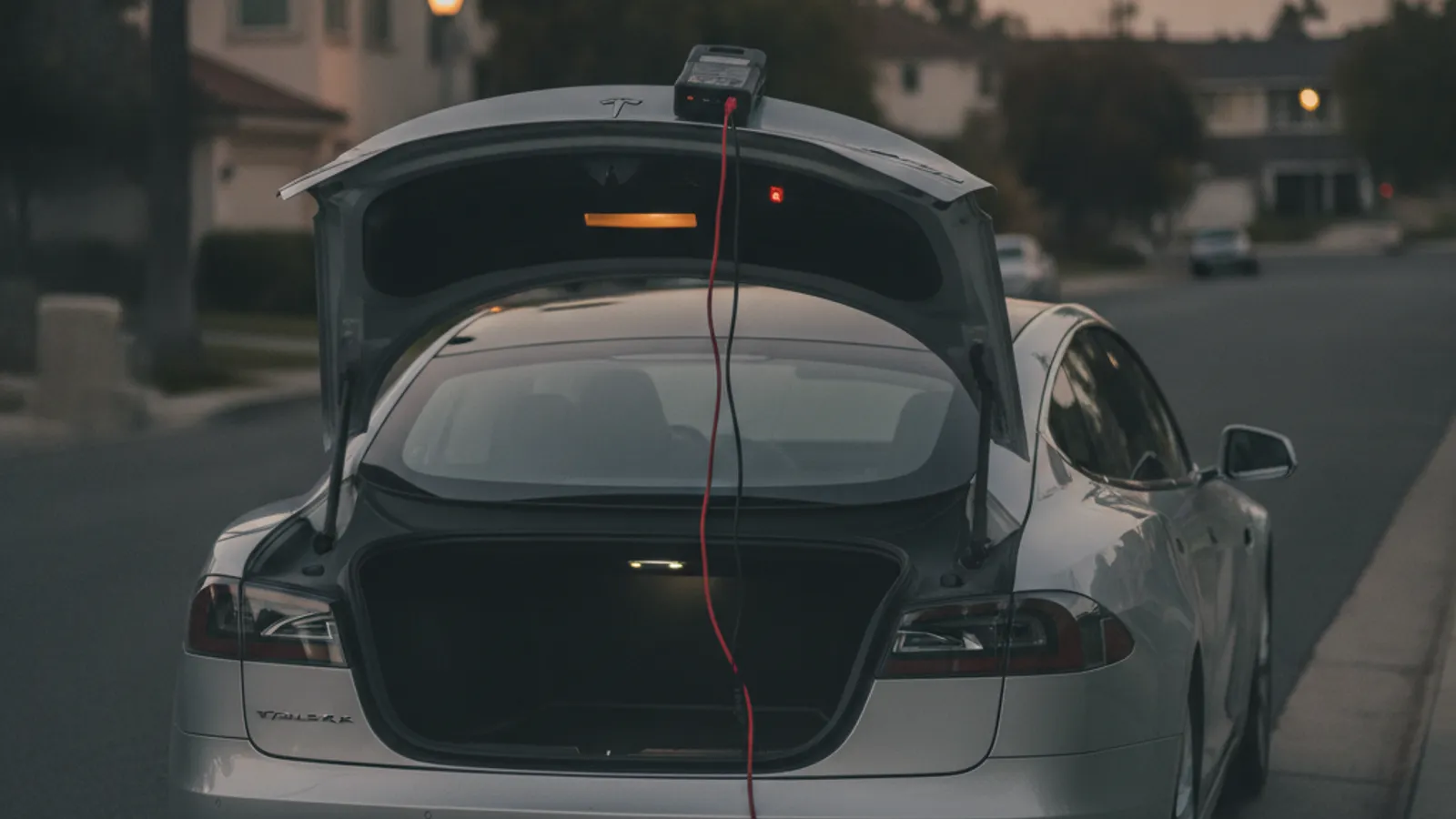
The Model S fails in the same lots as the volume Teslas
Orange County had 138,121 Teslas on the road as of December 31, 2025. That’s 65.51% of the county’s 210,842 battery-electric cars, per the California Energy Commission. Most of those Teslas are Model 3 and Model Y cars. The Model S is the minority car in the same structure. When it goes silent, owners often assume a luxury-car fault. It’s usually the same 12V failure the smaller Teslas get.
The county held 12.02% of California’s battery-electric fleet, with only 8.33% of the state’s light-duty vehicles. Teslas concentrate here more than they do statewide, by 6.4 points. A no-start in Irvine or Santa Ana is a common Tesla problem. It isn’t a rare Model S one.
Tesla has 48 Supercharger sites in Orange County, with 861 DC fast ports. That’s U.S. Department of Energy station data in this research. Model S, 3, and Y cars sit in those stalls and in the lots around them. A long Sentry session can flatten a weak 12V in any of them.
Rule the empty pack out before you chase the 12V
Not every silent Model S is the small battery.
If the screen comes on and says to plug in, the high-voltage pack is empty. A jump won’t fix that. You need energy into the traction battery. Tesla’s Model Y owner’s manual covers running out of range. It notes that the low-voltage battery can lose support once range is gone. The car then needs external power before the high-voltage pack can charge. That’s Tesla’s published Model Y wording. Confirm the Model S entry in your year’s manual.
If the screen shows a PIN pad, that’s PIN to Drive. Enter the PIN. Or reset it from the app on another phone.
A frozen update bar is firmware, not a battery. Hold both scroll wheels for about ten seconds and let it reboot.
If the car was fine a few hours ago, Sentry or cabin overheat protection may have run the 12V down. The fix is still a jump.
The black-screen, flush-handle, app-offline trio is a dead 12V until you prove otherwise. For pack versus 12V, read Dead Tesla: how to tell 12V failure from a dead pack. The wider walkthrough is Tesla won’t start: seven checks before you call for help.
Classic and refresh Model S cars don’t hide the 12V the same way
Most Tesla checklists assume a Model 3 or Y frunk. The Model S changed twice. That matters when you’re locked out.
Cars built from 2012 to 2020, the classic Model S, use a lead-acid AGM 12V in the front trunk. It sits under the floor liner, toward the firewall. Cars from 2021 on, the refresh, use a lithium-ion low-voltage battery. Tesla relocated it in that redesign. Same job. Different chemistry. Different way it dies.
You can tell the generation from the cabin. The classic has the tall vertical screen. The refresh has the wide horizontal screen, and either a yoke or a round wheel.
AGM packs in the older cars often fail with almost no warning. The car drives home. The next morning it’s a brick. Heat in inland lots, Anaheim, Tustin, Yorba Linda, shortens lead-acid life. That’s ordinary battery chemistry, not a local study. Confirm replacement timing with Tesla service in Costa Mesa, Buena Park, Santa Ana, Irvine, Anaheim, or Aliso Viejo. Street addresses weren’t re-checked in a live browser for this page. Confirm them on Tesla’s find-us list before you navigate there.
The lithium pack in a refresh Model S usually lasts longer. When it fails, it still fails fast. A jump can wake either chemistry. On a worn AGM, a jump is a temporary save. The battery can die again soon. Plan a replacement, not another jump next week. For the layout across Tesla’s lineup, see Do Teslas have a 12V battery? A model-by-model guide.
Flush handles are a 12V symptom, not a broken part
Classic Model S cars present handles when you walk up. Refresh cars use touch-to-open handles. Both need 12V. When the low-voltage battery is gone, the handles stay flush. You can be locked out of a car that still has miles on the pack.
That’s not a failed handle motor. It’s the same 12V the Model 3 and Y use to release latches. Getting in often means feeding external 12V first. The frunk and doors stay asleep until that happens. The feed point changes by year. Prying trim can damage the car. The locked-out sequence is in Locked out of a dead Tesla: the rescue sequence that works.
What bringing the 12V back actually takes
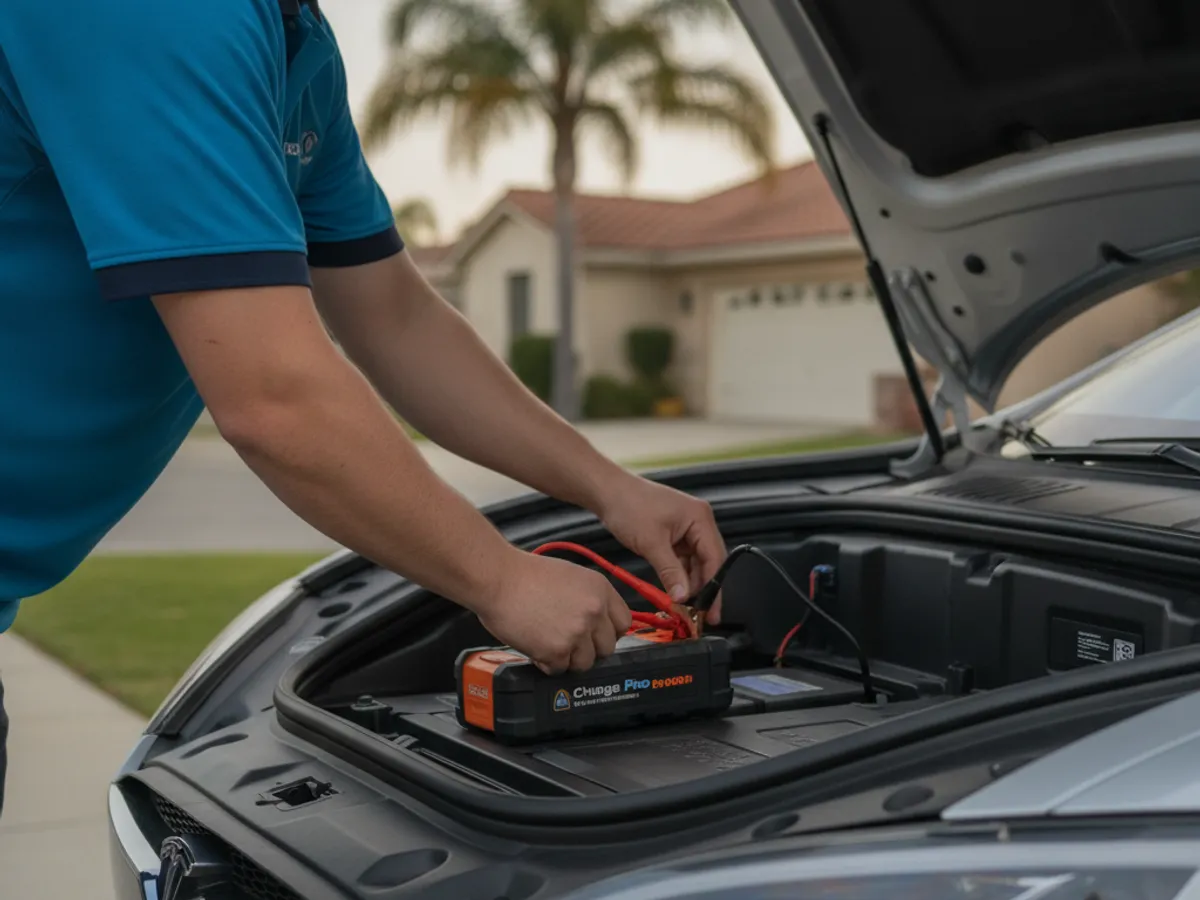
The safe wake-up is a lithium jump pack on the Model S 12V terminals. Don’t clip a running gas car onto a Tesla low-voltage bus. The operators Charge Pro OC connects you with bring those packs. They jump or replace a dead 12V on site.
If the car is fully asleep, the frunk latch is asleep too. Someone has to wake the car from the outside first. Year-by-year terminals are in Tesla won’t crank: jump-start steps for Model 3, Y, S, and X. If you’re not sure of the year, wait for the operator. The quote comes before any work starts. The operator bills you directly.
Once the systems come up, give the car a minute. Don’t tug a handle or tap the screen yet. Then open Controls, Service, and 12V Battery, and see what the car reports. Drive to a charger, or plug in at home, so the DC-DC converter can refill the 12V. A jump without a follow-up charge leaves a classic AGM close to the next no-start.
If the screen never stays on, and the car asks to plug in, you’re in pack-empty territory. That’s out-of-charge recovery, not a 12V jump. Operators can bring a 240V Level 2 source to the car. They use a native NACS plug, or a CCS or J1772 adapter for other EVs. Charging time is typically 15 to 30 minutes for about 10 to 20 miles of range. That’s charging time, not a promise of when someone arrives.
Where Orange County Model S cars actually sit cold
The failure is the 12V. The setting is whatever lot a Tesla already uses.
Irvine’s Supercharger at 1920 Main St has 40 stalls. Office and apartment parking around that site is a workday Sentry sit. A Model S and a Model Y can go quiet in the same structure. Tustin’s site at 14661 Franklin Ave has 36 stalls. A weak AGM that survived overnight at home often dies after hours on asphalt. Santa Ana has 28 stalls at 1008 17th St. Downtown lots there mix Teslas of every model.
Anaheim has seven Supercharger addresses in the federal station file, from Lincoln Avenue to Santa Ana Canyon Road and Katella. Those all-day lots are where Sentry plus heat drains a 12V. Yorba Linda’s two Superchargers on Yorba Linda Blvd are 8 stalls each. Inland, smaller sites, longer walks back to a hot car.
Mall days are long sits. Brea Mall has 20 stalls at 1065 Brea Mall. The Shops at Mission Viejo has 10 stalls. Tesla’s own listing for that Mission Viejo site says up to 72 kW, which is the figure to use.
Coast lots look different and still produce the same 12V brick. Huntington Beach has 24 stalls at 6913 Warner Ave. San Clemente has 49 stalls at 101 W Avenida Vista Hermosa. Fashion Island has an Electrify America site at 401 Newport Center Dr with 8 DC fast ports. A Model S in any of those lots still needs 12V before it will accept a charge. The 3 and Y in the next stall get the same surprise. The S just adds flush handles and a generation-specific frunk.
What Tesla’s roadside page says, and what it doesn’t
Tesla’s roadside-assistance page wasn’t opened directly for this research. Search-index snippets of Tesla’s own wording are the source. Confirm the live page before you rely on a sentence. Those snippets say Tesla can assist when the pack is depleted, but it isn’t a financially covered service. Transport of up to 500 miles to the nearest service center is for a warrantable breakdown that leaves the car undrivable. Running out of charge sits outside that covered transport.
The honest read is simple. Tesla’s published roadside path for a depleted battery is transportation, not an on-site charge. Tesla’s 12V-specific roadside language wasn’t verified on a live page for this article. Call Tesla Roadside Assistance at 877-798-3752, the number published on the Santa Ana service page, and ask what they’ll send. The North America roadside policy PDF is the document that lists covered items. Open it before you assume a free tow.
A local operator is the other path. Charge Pro OC is a referral line. It matches you with independent mobile rescue operators in Orange County. It doesn’t own trucks, hold a license, or set a price. For a 12V no-start, ask for a Tesla 12V battery jump.
After it starts, finish the job
A wake-up isn’t a repair. On a 2012 to 2020 Model S, an old AGM will drop you again. Get the car to a charger. Let the converter work. Then schedule the 12V replacement with Tesla or a shop that handles these packs. Refresh cars still need that follow-up charge.
If you saw a 12V service message before the no-start, treat it as a deadline. Stay with the car if you’re in a stall or a private lot. Don’t roll it into traffic to hunt a different charger while it’s still asleep. A Model S that won’t present handles won’t plug in either. Wake the 12V first. Charge second. Tow last, and only if the car still won’t take power.
Charge Pro OC serves every city in Orange County. If you need a person at the car, call (949) 444-0151. The operator quotes you before work starts and bills you directly.
Frequently asked questions
Why won’t my Tesla Model S start?
A dead 12V is the usual cause. The screen stays dark, the handles stay flush, and the app shows offline. The main pack can still hold range. The car won’t boot until the 12V wakes. A lithium jump pack on the correct terminals brings the systems up. Then plug in so the converter can recharge that small battery.
Is a Model S no-start different from a Model 3 or Y?
The cause is usually the same 12V failure. The Model S adds flush handles that lock you out, and two generations of 12V hardware. Classic cars hide an AGM under the frunk liner. Refresh cars use a lithium low-voltage pack. In Orange County those cars sit in the same Supercharger and office lots, from Irvine Main Street to San Clemente’s Vista Hermosa stalls.
Can I jump a Model S from another car?
No. Don’t connect a running gas car to a Tesla 12V system. Use a lithium jump pack. If the handles won’t present, you may need outside 12V before the frunk opens. An operator in the Charge Pro OC network can do that on site.