Your Ford Mustang Mach-E won’t start after sitting in a Coastal OC lot. The 12V battery is the usual reason, not an empty pack. Airport long-term parking and beach lots do this to parked EVs. Dark screens and a dead fob usually mean the 12V quit. A tow is still the wrong first call.
What a long sit does to a Mach-E
Coastal Orange County is where Mach-E owners leave cars for hours or days. Long-term airport lots on the Costa Mesa and Newport Beach side are one version. Huntington Beach and Seal Beach parking after a beach day are the other. The car looks fine when you walk away. It can look fully dead when you come back.
Orange County had 210,842 battery-electric vehicles as of December 31, 2025. That’s CEC registration data for the light-duty fleet. Tesla still holds 65.51 percent of those BEVs. Your Mach-E sits in the non-Tesla slice of that fleet. Help for that slice isn’t a Tesla Supercharger hop.
The Mach-E still uses a conventional 12-volt battery to wake up. That battery feeds the computers, locks, lights, and the pack contactors. If the 12V is flat, a full pack still won’t boot the car. When an EV 12V dies on the road, the whole vehicle looks like a brick.
A drained traction pack behaves in a different way. The car usually still wakes and shows a low-charge warning. Drive may be blocked, but you still get a screen. A black cluster with no click is almost always the 12V.
How Coastal OC parking sets the trap
A Mach-E in long-term parking keeps computers in a low-power state. Days of that drain will flatten the small battery. Cars sit in coastal heat on the Huntington and Newport stretch. The 12V still has to hold a charge through that sit. None of that means the big pack failed.
Beach lots add a second version of the same failure. You walk to the sand with the car off. A weak 12V then sits in the sun until you return. You tap the fob and get silence. The same scene shows up in Huntington Beach lots after a long beach day. It’s the 12V more often than the pack.
Costa Mesa structures near the airport corridor are a third version. Cars sit through a trip, and the 12V sags while you’re gone. You come back to a silent Mach-E that still holds traction energy. Costa Mesa EV roadside help is built around lots and structures like that.
If the car wakes and the pack is empty, Coastal OC still has named public DC fast sites. Electrify America lists eight DC fast ports at Fashion Island. That’s 401 Newport Center Drive in Newport Beach. EVgo lists four stalls at 801 Pacific Coast Highway in Seal Beach. Electrify America also lists 12 DC fast ports at 25825 Las Vegas in Capistrano Beach. That’s the largest non-Tesla DC fast site in south Orange County in the AFDC record. Tesla Superchargers sit nearby on MacArthur Boulevard, Warner Avenue, Bristol Street, South Coast Drive, and Hyland Avenue. Those stalls don’t wake a Mach-E with a dead 12V. You still need a car that will shift into Drive.
Messages that point at the 12V
If you get any screen at all, read it before you call a hook.
A “System Off to Save Battery” notice and a shutdown countdown usually mean the 12V is almost gone. The car is protecting what’s left of that small battery.
A “Key Fob Not Detected” alert can be a coin cell in the fob. It can also be a 12V too weak to hear the fob. Try a fresh fob battery first, then treat it as a 12V problem if the cabin stays dark.
A fully blank cluster with no chime is the classic dead 12V. There’s no computer left to write you a warning.
A “Stop Safely Now” alert is a different class of message, not a jump-and-go prompt. Don’t keep trying to drive on that one. Get the car into a safe spot if it’s still rolling. Then get EV-aware help. A “Service Vehicle Soon” light is more often a later shop issue than a no-start.
Trust what you see on the glass, then check the owner’s manual for your year if the wording differs.
Find the 12V, then decide if you’re jumping
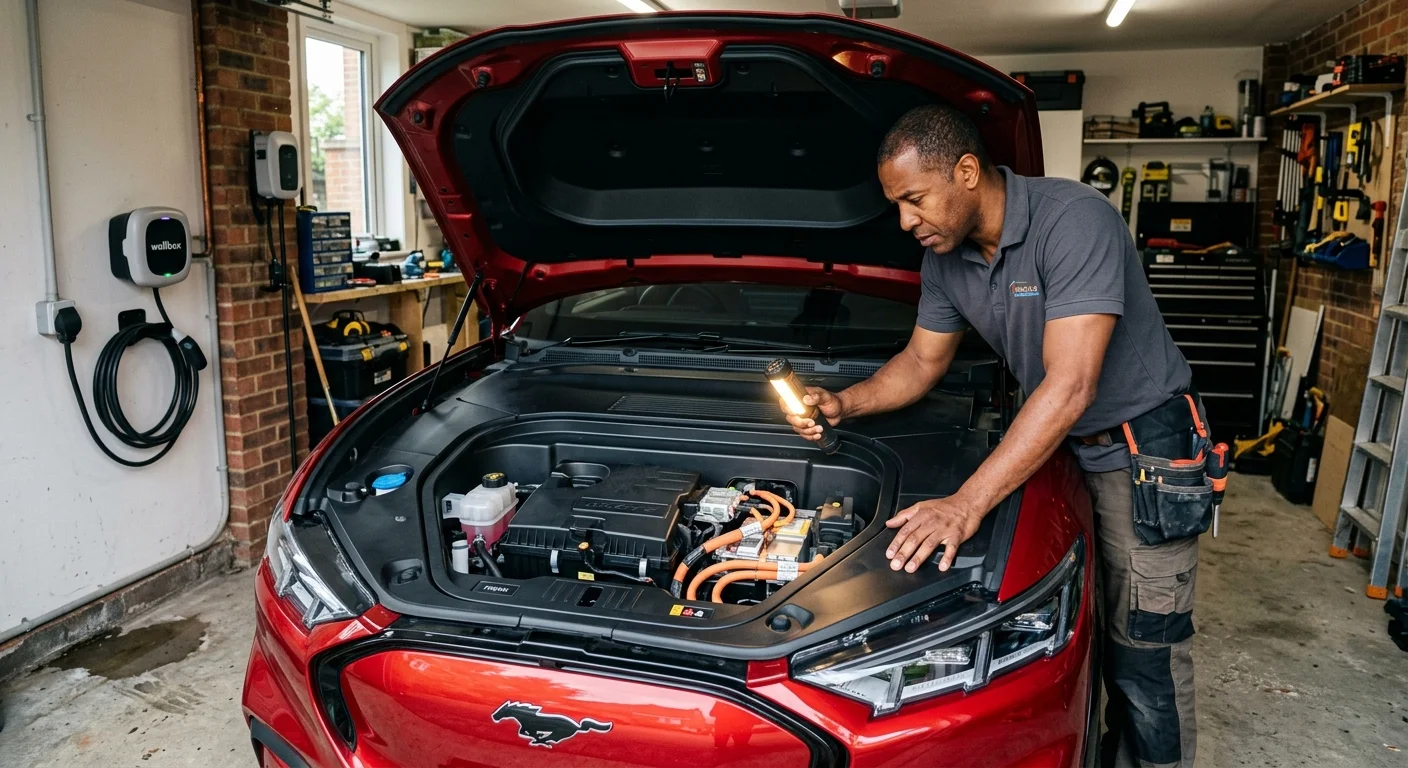
Ford put the Mach-E 12V under the hood, in the front trunk. Open the frunk with the fob, or the interior release if you still have power. On the passenger side you’ll find a cover over the battery. Clips or small fasteners hold that cover in place. Under that cover sits a small 12-volt battery. It looks like any other car battery.
If the frunk won’t open, you’re already past a DIY check. A dead 12V can lock you out of the front bin. That’s when you stop pulling on latches and call for a safe EV jump.
If you can see the battery and you have a meter, set it to DC volts. Put red on positive and black on negative. A rested, healthy 12V reads near 12.6 volts. A number under about 12 volts means it’s discharged. Around 11.5 or lower, it won’t wake the car on its own. Voltage only tells you state of charge in that moment. A battery can read okay and still fail under load.
You’re not testing the high-voltage pack with that meter. Stay off orange cabling and stay off the traction battery. The 12V is the only thing you’re touching.
Jump the 12V, not the pack
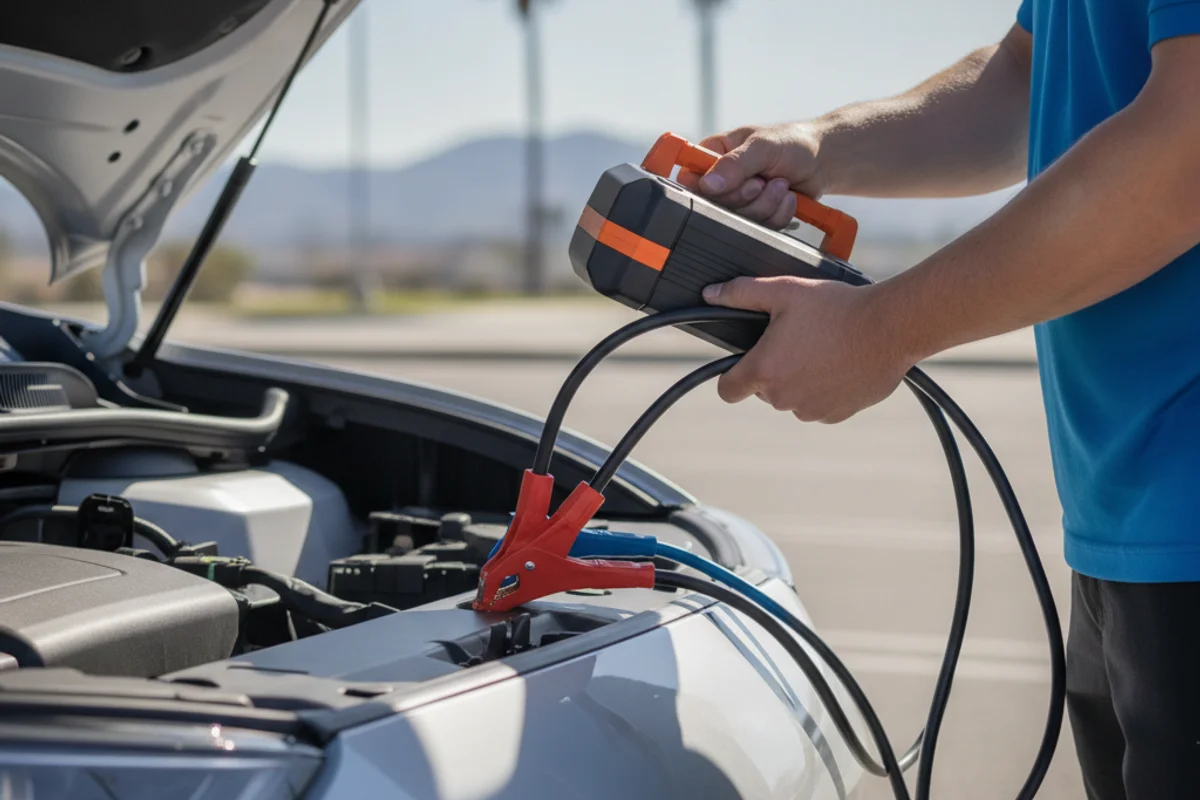
A jump on a Mach-E feeds the 12-volt system only. It doesn’t charge the high-voltage pack. Ford gives you jump posts in the frunk so you don’t clamp the battery itself. Look for a positive post under a red cap. The negative is a nearby bare-metal ground point on the chassis. Don’t pick a random bolt because it looks handy.
Use a jump pack rated for 12-volt automotive use, or another 12-volt vehicle. Both vehicles stay off while you connect the leads.
Clip red to the Mach-E positive jump post. Clip black to the Mach-E ground point. Then red goes to the donor positive. Black goes to the donor negative or its ground. If you’re on a pack, power the pack after the clamps are set. If you’re using another car, start that car and give the Mach-E a few minutes of support. Then try to power on the Ford.
If it wakes, disconnect in reverse order. Get the negatives off before the last positive clamp on the Mach-E. Keep the Mach-E on after it boots. Drive it or plug it in so the DC-DC converter can refill the 12V from the pack. A jump is a wake-up, not a repair. If it dies again in the next lot, the battery is likely due for replacement.
Follow the owner’s manual for your year if the post layout differs. Don’t reverse the clamps, and don’t jump through the charge port.
When jumping isn’t the job
Some no-starts aren’t a 12V problem. If the car wakes, shows a low traction charge, and refuses Drive, you need energy in the pack. Operators in this network can bring a 240-volt Level 2 source to the car. They use a native NACS plug, or a CCS or J1772 adapter for non-Tesla EVs. Typical on-site charging adds about 10 to 20 miles of range. That takes 15 to 30 minutes of charge time, not travel time. It isn’t a promise of when a truck appears.
If the 12V is fine and the car still won’t go, stop the DIY work. High-voltage faults aren’t a parking-lot experiment.
A tow from a beach lot or an airport structure is a last move. Use a flatbed only after the 12V path is ruled out. Charge, jump, or tow is the real choice in that moment. Most silent Mach-Es in Coastal OC lots are the jump.
Who actually shows up in Orange County
Charge Pro OC is a referral line for stranded EV drivers. It matches you with independent local mobile rescue operators. It doesn’t own trucks, employ technicians, or set prices. The operator quotes you before any work starts and bills you directly.
The operators we connect you with handle Tesla and every major EV brand, including Ford. They can jump or replace a dead 12V on site. They can also add that Level 2 charge if the pack is the problem. They’re licensed. The brand on this site isn’t the one holding a trade license.
For a Mach-E, that usually means non-Tesla EV rescue at the space you’re already in. You don’t have to roll the car to Warner Avenue or MacArthur Boulevard first. You don’t have to guess at a connector on a car that won’t wake.
If you’ve already tried the frunk posts and the car is still dark, call (949) 444-0151. We’ll connect you with a local operator. Tell them you’re in a Coastal OC airport or beach lot with a Mach-E that won’t wake. Tell them whether you got a screen. That’s enough for the quote.