A Mercedes EQE that won’t start after days in a lot has a pattern. It’s almost always a dead 12V, not the drive pack. The screen stays dark and the flush handles stay in. Ready never shows, even when the main battery still reads high. That failure clusters in Orange County airport parking and other long-stay lots. It doesn’t show up as often on a short errand. Jump the underhood terminals, wait two minutes, and the car usually reboots.
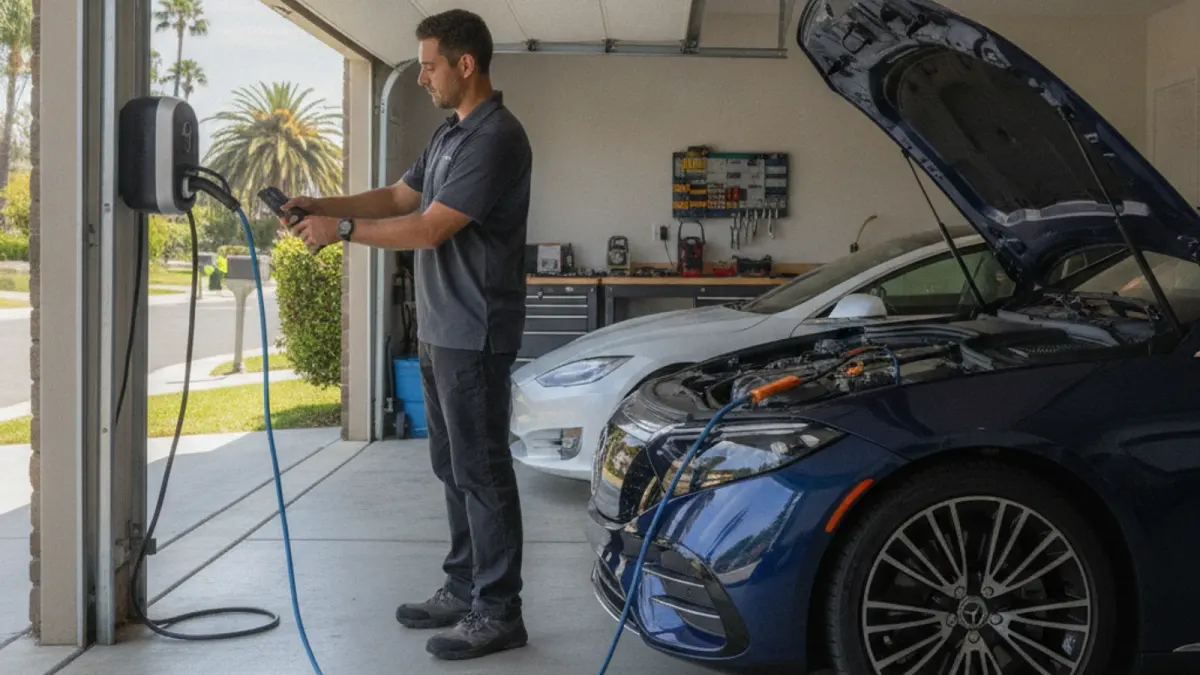
The EQE doesn’t wake from the high-voltage pack. A small AGM 12-volt battery powers the modules that finish that handshake. When it sags, the car looks fully dead. Charge Pro OC is a referral line. We match stranded drivers with independent local operators. Those operators jump or replace a dead 12V on site. They quote you before they start and bill you directly.
Why long-stay parking flattens the EQE 12V
The EQE keeps a lot of electronics partly awake while it sits. The connectivity gateway draws a trickle. So do the radar and camera units. The over-the-air system and MBUX ambient gear add more. Park for many days and that load can drop the 12V. Then the control units don’t have the voltage they need.
Airport decks and hotel structures are the usual setup. You leave for a trip. You come back to a silent cabin. A vacation week on a home driveway does the same thing. If the car isn’t plugged in and cycling, the 12V isn’t getting topped up.
Orange County has the fleet that produces these calls. The California Energy Commission counted 210,842 battery-electric cars here. That count is as of December 31, 2025. ZEVs were 10.56% of the county’s light-duty fleet. Orange County held 12.02% of California’s battery-electric vehicles. It was only 8.33% of the state’s light-duty fleet. Tesla was 65.51% of those BEVs. That still leaves 72,721 non-Tesla battery EVs on the same roads. Mercedes EQE owners sit in that group.
A public stall doesn’t wake a dark EQE. The car has to boot before you can drive to a charger. A 12V failure in a long-stay lot is a jump problem first.
What a dead EQE 12V looks like on the dash
The car fails in stages. They all point at the same small battery.
| What you see | What it means |
|---|---|
| Dark cabin, handles stay flush, fob does nothing | The 12V is fully flat |
| Screen starts, then freezes or dies before Ready | Voltage is too low to finish the handshake |
| A 12V electrical-system warning, then a black display | Control units dropped under their threshold |
| Unlocks, but won’t leave Park | Low-voltage modules can’t bridge to the drive pack |
None of that means the expensive pack failed. The drive battery can sit at 80% and still refuse to move the car. The 12V is what brings the EQE online.
If you’ve seen this on an EQS, you’re in the same family. The EQE shares the EVA2 platform and the same low-voltage idea. Our Mercedes EQS 12V guide covers the larger sibling. The EQE SUV uses this layout too. The EQB and EQA sit on a different platform. Their 12V packing isn’t the same. A dead 12V still strands them.
The battery is in the trunk. You jump it under the hood
The 12V battery isn’t under the hood. It sits in the rear, under a trunk floor panel. Swapping it means pulling the cargo liner. That’s a shop job, not a lot job. A dead 12V also kills the powered tailgate. You wouldn’t want to tear the trunk apart in a stall anyway.
For a jump you never touch that rear pack. Mercedes puts jump terminals in the engine bay for this failure.
Get the hood open when the fob is silent
The fob often does nothing once the 12V is gone. Slide the mechanical key blade out of the fob. Unlock the driver’s door by hand. Pull the interior hood release by the driver’s sill. It’s a mechanical cable, so it still works with no 12V. That’s your path to the jump terminals.
Clamp the underhood studs, not the rear pack
- Open the hood. On the driver’s side you’ll see a black fuse and relay box.
- Lift the cover. A marked positive stud sits under a red cap. That’s the jump positive.
- For negative, use an unpainted chassis bolt or a strut-tower ground. Don’t run negative to the rear battery.
- Connect in the usual order. Positive to the EQE stud, then to the donor. Negative to the donor, then to the EQE chassis ground.
- Wait two full minutes. Then try to start. The display should boot, and Ready should return.
Those two minutes matter. The low-voltage side needs time to recover before the handshake can finish. If you crank right away, the screen can flicker and die again.
| Battery detail | Mercedes EQE |
|---|---|
| 12V battery location | Rear cargo area, under the trunk floor |
| Jump terminal location | Engine bay, driver’s-side fuse box |
| Battery type (typical) | 12V AGM lead-acid |
| Common failure pattern | Parasitic draw while parked for days |
| Dark screen | 12V system, not the high-voltage pack |
| Replacement | Shop job, rear access and battery registration |
One line to keep straight: the battery lives under the trunk floor. The terminals you jump live under the hood. Owners mix those two places up. That’s how a lot rescue stalls.
Operators who handle non-Tesla EVs bring the right clamps. Charge Pro OC’s non-Tesla EV rescue line matches you with those independents.
Costa Mesa stalls won’t boot a silent EQE
Costa Mesa has Tesla Superchargers at 1400 Bristol St. There are more at 1475 S Coast Dr and 3303 Hyland Ave. Newport Beach has one at 4241 MacArthur Blvd. Those sites are in the federal AFDC station file. They don’t help if the EQE won’t boot.
You can’t drive a silent car across a deck to a stall. You can’t complete a plug handshake if the 12V already dropped the control units. The fix is at the car. After it wakes, you can roll to a charger. Do that if the drive pack is also low.
The CEC counted 7,095 public charging ports in Orange County. That snapshot is as of December 31, 2025. That mix was 5,600 public Level 2 and 1,475 public DC fast. There were also 20 public Level 1 ports. Orange County had 36.8 ZEVs per public port. Statewide the same math was 24.4. That’s a crowding story. It isn’t the 12V story. A long-stay EQE still fails when a named stall exists in the same city. The car never wakes to use it.
Electrify America at Fashion Island lists 8 DC fast ports. The AFDC file puts that site at 401 Newport Center Dr. Those help after the EQE is alive. They don’t replace a jump.
For parking structures in that same travel corridor, see stalled in a Costa Mesa parking structure. The 12V playbook is the same on a deck or on the surface.
What to do in the lot, in order
Read this from the parking stall.
- Try the doors. If they stay dead, use the mechanical key in the fob. Open the driver’s door by hand.
- Look for any 12V sign: a dome light, hazards, a flicker on MBUX. Nothing means you need a jump.
- Pop the hood with the interior cable, which is mechanical.
- Find the red-capped positive stud on the driver’s-side fuse box.
- Use a jump pack or a donor car. Wait two full minutes after the last clamp before you start.
- If a 12V fault stays after a clean jump, the battery is failing inside. That needs a shop replacement.
Don’t keep jumping a battery that won’t hold. Once you’re rolling, the DC-DC converter feeds the 12V from the drive pack. An internally failed AGM will sag again after the next long sit.
The general EV jump sequence is in how to jump start an electric car on site. For why a full pack still leaves you stranded, read when the 12-volt dies on the road. After you’re mobile, the 12V replacement guide covers signs and next steps. We don’t publish prices. Confirm the shop quote before you approve the work.
Call for a jump before you call a tow
A flat 12V rarely needs a hook. A proper jump on the underhood studs is the first move. Independent operators who take these calls bring jump gear sized for EVs. They can also bring a 240V Level 2 source if the drive pack is empty. That typically adds 10 to 20 miles of range. Plan on 15 to 30 minutes of charging, not travel time. For a classic EQE lot death, the 12V jump is the job.
Charge Pro OC doesn’t own trucks or employ technicians. We connect you with local mobile rescue operators. The operator quotes you before starting and bills you directly. We set no prices. We promise no arrival window.
If you need the Costa Mesa lot pattern, see EV roadside assistance in Costa Mesa.
After it starts, keep it from dying twice
Drive it. Let the DC-DC do its work. Then plug in at home if you can. The next trip shouldn’t begin with a weak 12V. If the car dies again after a short park, stop treating it as a fluke. Get the 12V load-tested. Replacement isn’t a parking-lot DIY. The battery is under the trunk floor. It usually needs registration with a compatible diagnostic tool.
The EQE SUV follows the same rear-battery, underhood-jump split. If someone in the family drives an EQS, send them the sibling guide linked above.
New ZEV sales in Orange County still run above the state. In 2026 Q2, ZEVs were 24.77% of new light-duty sales here. Statewide that share was 19.09%. That doesn’t mean adoption is racing ahead. California’s ZEV share of new sales peaked at 25.31% in 2024. The point for EQE owners is simpler. More electric cars in long-stay lots means more 12V strandings that look like a mystery. They aren’t mysterious. They’re a small battery that sat too long.
Frequently asked questions
How do you jump a Mercedes EQE in a parking lot?
Use the underhood positive stud inside the driver’s-side fuse box. Connect negative to a chassis ground, not the rear battery. Wait two minutes, then start. The real 12V pack stays in the trunk. Don’t clamp the rear battery in a lot. You can’t reach it without pulling the cargo floor. The powered tailgate may already be dead.
Why won’t a Mercedes EQE start if the main battery is charged?
The drive pack moves the car. The 12V wakes the computers, handles, and screen. If that small battery is dead, Ready never happens. Pack percent doesn’t matter until the 12V is back.
Can I change the EQE 12V myself in a lot?
No. It sits under the trunk floor, and replacement usually needs registration. Get a jump so you can drive. Then book a Mercedes dealer or an independent EV shop. Confirm what they’ll charge before they start. A published figure for that job isn’t in our files.
If a Mercedes EQE won’t start in Orange County, call Charge Pro OC. The number is (949) 444-0151. We’ll connect you with an independent operator who can jump the 12V at the car.