A Mercedes EQS 12V battery dead in an Anaheim theme-park garage isn’t the traction pack. You walk back to the stall after a long park day. The fob gets no answer, and the Hyperscreen stays black. Ready mode never shows on the glass. The high-voltage battery can still hold a strong charge. The small 12-volt battery is what failed. Jump the underhood terminals, wait two minutes, and the car often reboots. This page is the Orange County lot sequence for that failure.
CEC vehicle files through December 31, 2025 count 210,842 battery-electric cars in Orange County. The California Energy Commission puts ZEVs at 10.56% of the county’s light-duty fleet. Tesla makes up 65.51% of those battery-electrics. An EQS lives in the thinner non-Tesla slice. Tesla holds 59% of Orange County’s public DC fast ports. A dark EQS can’t occupy one until the 12-volt net wakes.
The theme-park structure problem
An EQS can sit in a covered Anaheim garage all day. The pack can still hold plenty of charge. Cabin pre-conditioning still draws from the 12-volt side while you wait. The MBUX stack, radar sensors, and connectivity gateway keep polling too. Powered door handles sit on that same net, and so does the Hyperscreen. Control units that connect the pack to the motors sit there too. When 12-volt voltage sags, that handshake never finishes. The car looks finished, and the pack isn’t.
Buena Park parking along Beach Boulevard and Knott Avenue produces the same sit-and-drain day. You leave the car in the morning and return after dark. The fob is quiet. That’s a 12-volt failure more often than a zero pack. Once the car can move, named Superchargers exist in both cities. Anaheim’s Katella site at 2404 E Katella Ave lists 16 stalls. AFDC lists that site at 250 kW. Another Anaheim site at 2270 E Lincoln Ave lists 20 stalls at 325 kW. Buena Park’s site at 8888 Knott Ave lists 28 stalls at 325 kW. The Beach Boulevard site at 6940 Beach Blvd lists 24 stalls at 150 kW. None of those stalls wake a dead 12-volt system. They matter after Ready, not before.
Theme-park traffic spills onto the 91, then onto Katella, Lincoln, Harbor, and Beach. If the EQS won’t enter Ready, stay with the car. Don’t shove it toward a charger on a guess. A silent EQS isn’t a mapping problem. It’s a 12-volt problem.
For stadium and theme-park structures around Anaheim, see EV roadside assistance in Anaheim around theme-park and stadium lots. If the car sat in Buena Park all day, Parked all day in Buena Park and the EV won’t wake walks that version.
Anaheim’s Tesla inventory is larger than those two sites. AFDC lists 1128 W Lincoln Ave with 16 stalls at 250 kW. It lists 1734 W Lincoln Ave with 20 stalls at 325 kW. The Imperial Highway site at 156 N Imperial Hwy has 16 stalls at 325 kW. Euclid has 16 stalls at 680 N Euclid St, listed at 325 kW. Santa Ana Canyon Road has 20 stalls at 8148 E Santa Ana Canyon Rd. AFDC lists that canyon site at 75 kW. Electrify America has a 10-port DC fast site at 440 N Euclid St. AFDC logs it as Walmart 2242. You can use those addresses after the car boots. You can’t use them while the Hyperscreen is dark.
What a dead 12-volt EQS looks like
The failure can look like three different cars. It’s still one battery.
The fob gets no reply, and exterior handles stay flush. Interior lamps stay out. That’s a deep 12-volt sag.
The Hyperscreen flashes a 12-volt warning, then goes black before Ready. The glass was never on the traction pack. It ran off the small battery.
The display sticks on “vehicle being prepared, please wait.” The car started a boot, and it never finished. That line is a low-voltage clue, not a pack clue.
Don’t call for an empty-pack tow until you’ve ruled the 12-volt side out. If the car in the stall is an EQE, the weakness is similar. The underhood layout isn’t the same. Read Mercedes EQE won’t start: how a dead 12V leaves you stranded. The EQA and EQB sit on another platform.
Lot steps, in the order that actually helps
Start with the doors. If the power-extend handles don’t present, slide the mechanical key out of the fob. Open the driver’s door with that key. Don’t pry the flush handle. The mechanical lock is still there.
Look for any 12-volt sign, even a dome lamp or a lock click. Hazard lights count too. Total silence means you need a jump, not a charge session.
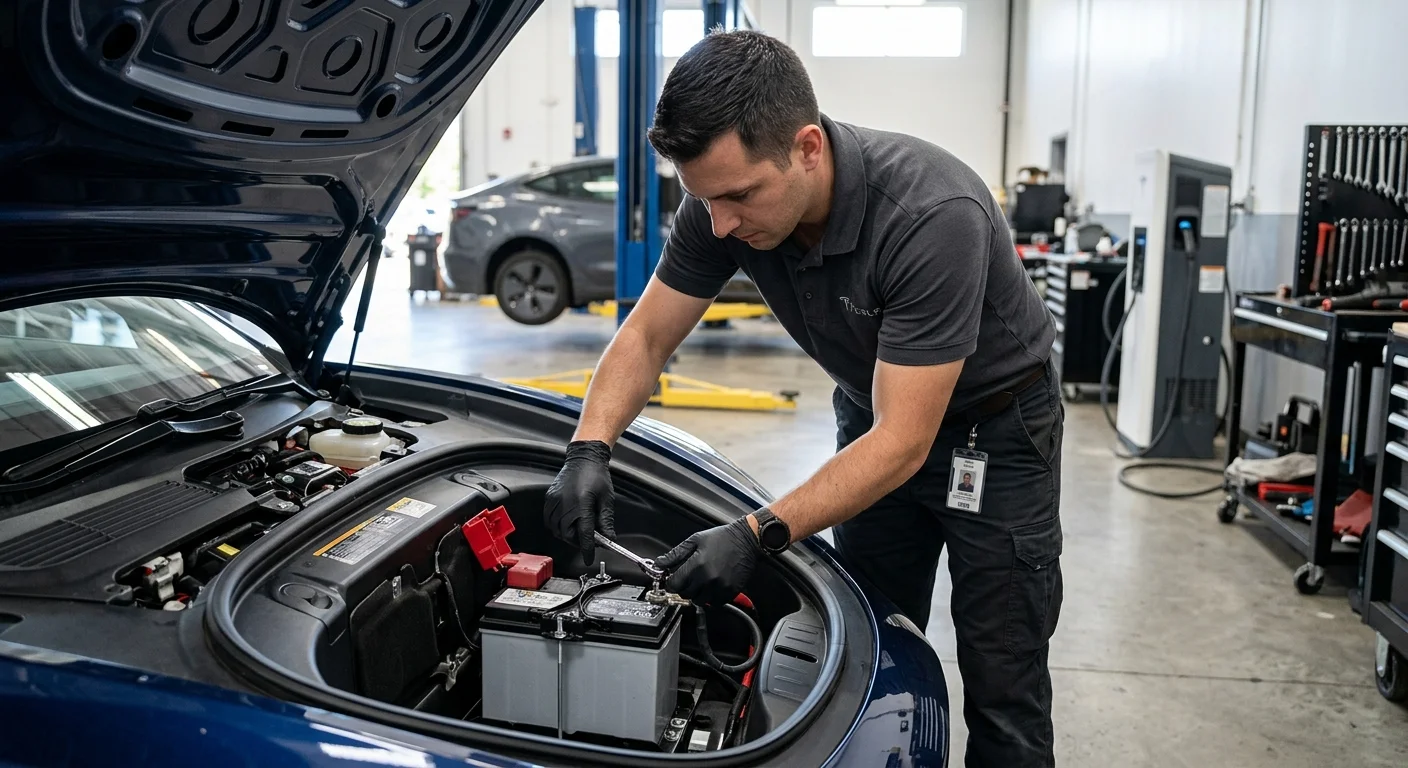
The interior hood release still works as a cable. Pull it, then raise the hood. Skip the trunk for now. The 12-volt battery lives under the cargo floor on the driver’s side. That’s a shop teardown. Mercedes put jump posts under the hood for this exact stall.
On the driver’s side of the front bay, find the black fuse and relay box. Lift the cover. Under a red cap you should see a marked positive stud. That stud is the jump positive. For the negative, pick an unpainted metal bolt or bracket on the chassis. Grounds near the strut towers are the usual choice. Don’t clamp the negative lead to the trunk battery. Use an unpainted chassis ground instead.
Clip positive to the EQS stud first, then positive on the donor pack. Then negative on the donor, and last to the EQS chassis. Wait two full minutes. Don’t hit start in the first seconds. The control units need that pause to climb back onto a stable voltage. Then request Ready.
The Hyperscreen should run its boot, and Ready should follow. If a 12-volt fault stays on screen and won’t clear, plan on a replacement. Drive to a shop if it holds for the trip. Don’t make jumping it every morning the plan.
For a jump sequence that covers other EVs, see how to jump start an electric car without making it worse. For why a big pack still leaves you stranded, read when the 12-volt dies, why the EV looks completely dead.
The battery is in the trunk, not under the hood
The EQS hides the 12-volt battery under the rear load floor, driver’s side. You won’t reach it between parked cars. The powered tailgate may already be dead. That’s why the underhood posts exist. Treat those posts as the only lot-safe path.
Replacement is a workshop job, because the liner and floor board have to come out. Some shops also register a new battery to the car’s management software. Confirm that step with the shop that does the swap. Don’t assume a generic parts-store battery will behave if it isn’t coded. Get the jump first. Book the replacement once you can roll.
The EQS 12-volt unit is an AGM lead-acid battery. Amp-hour ratings change by year and spec. A published amp-hour figure for every EQS build could not be confirmed here. Check the battery label, the window sticker, or the dealer parts desk.
What you can finish in the lot is the jump. What you can’t finish in the lot is the trunk swap. Keep those jobs separate.
Why a park day is hard on this 12-volt net
The EQS keeps a long list of modules listening while you stand in line. Radar, the connectivity gateway, MBUX ambience, and over-the-air update gear can keep polling. Pre-conditioning on standby adds more draw. A closed structure on a hot Orange County afternoon doesn’t rest that net.
A car that sits unused for long stretches can sag the 12-volt side even with a full pack. Don’t assume a full traction pack keeps the small battery healthy. That can fail while the car sleeps. Confirm standby behavior in the owner’s manual for your year.
Huntington Beach and Newport Beach lots create the same long-sit pattern after a beach day. Inland parking in Irvine, and around the Crush on SR-22, heats the cabin a different way. The failure mode is still the 12-volt net. The streets change. The electrical path doesn’t.
CEC charger files through December 31, 2025 count 7,095 public ports in Orange County. That total includes 1,475 public DC fast ports. That works out to 36.8 ZEVs per public port. Statewide the ratio is 24.4. The county is thinner per EV than the state. That ratio still doesn’t help a dark EQS. You can’t take a stall if the car won’t wake. Fix the 12-volt side first. Hunt a stall second.
Once Ready returns, the DC-DC converter should feed the 12-volt battery while you drive. If the battery has failed internally, that charge won’t stick. You’ll be dark again in a few days. That’s the cue for a replacement, not another jump. Your EV 12V replacement guide: signs, timing, and what to do lays out that choice.
After Ready: drive, then pick the next stop
If the jump holds, drive. Don’t idle in the structure hoping the screen stays up. A short drive lets the converter work. Then choose a shop or a public stall based on what you actually need. A 12-volt rescue isn’t a pack fill. If the traction battery is also low, that’s a second job.
Independent operators in this network can bring a 240V Level 2 source to the car. They use a native NACS plug, or a CCS or J1772 adapter for non-Tesla EVs. Charging time at the car is typically 15 to 30 minutes. That usually adds about 10 to 20 miles of range. That’s charging time, never an arrival time. For a 12-volt-only failure, you want the jump, not a range top-off.
Charge Pro OC is a referral line. It matches stranded drivers with independent local mobile rescue operators. It doesn’t own trucks, employ technicians, or set prices. The operator quotes you before starting and bills you directly. For the Mercedes EQ lineup and other non-Tesla EVs, use non-Tesla EV rescue.
Fullerton’s Harbor Boulevard Supercharger lists 12 stalls at 325 kW. Garden Grove’s Harbor Boulevard site lists 32 stalls at 250 kW. Those are useful after the car is alive. They’re not a workaround for a black Hyperscreen.
If the jump doesn’t take
You used the mechanical key, and the hood is up. Cables are on the stud and a chassis ground. Two minutes passed, and there’s still no boot. Stop adding extra clamps. You may have a failed battery, a blown fuse, or a module that won’t come up. That’s past a parking-lot jump. A shop with Mercedes diagnostic tools is the honest next step. An operator can still try a controlled jump at the same posts. They can’t rebuild the trunk battery on the parking deck.
Stay with the car in the structure, and keep kids clear of the cables. Watch ramp traffic. A dedicated jump pack on the underhood posts is cleaner than improvising from a random running engine.
Frequently asked questions
How do you jump a Mercedes EQS in a parking structure?
Use the underhood positive stud under the fuse-box cover on the driver’s side. Ground the negative clamp to chassis metal near the strut towers. Leave the trunk battery alone. Wait two minutes after the last clip, then request Ready. The real 12-volt battery is under the cargo floor, and that space is a shop job.
What does “vehicle being prepared, please wait” mean on an EQS?
The car found enough 12-volt power to start booting, then lost the voltage it needs to finish. Control units never complete their handshake. The high-voltage pack is usually fine. A jump on the underhood posts is the first fix to try.
Can you swap the EQS 12-volt battery in the lot?
No. The battery sits under the rear floor panel on the driver’s side. The liner has to come out. A powered tailgate may already be dead. That makes the trunk path worse in a tight garage. Jump at the front posts to get moving. Schedule the replacement with a shop that can register the new unit if your year requires it.
If you’re still standing in that structure, call Charge Pro OC at (949) 444-0151. You’ll be matched with an independent operator who can jump the EQS at those underhood terminals. We serve every city in Orange County. The operator quotes before any work starts.